Harquahala


Quick answer: Harquahala is a trade name for chalcedony from Arizona, commonly sold as agate or jasper depending on its pattern and opacity. It is usually tan, brown, cream, or reddish brown, with desert-like banding, brecciation, or landscape patterns.
AI Rock ID can help compare Harquahala against similar tan-brown chalcedony, jasper, and agate varieties from a photo. RockIdentifier.io treats Harquahala as a locality-based chalcedony trade material rather than a separate mineral species.
Good fit
- Collectors interested in Arizona lapidary materials
- People comparing agate, jasper, and chalcedony trade names
- Cabochon buyers who like tan, brown, cream, and desert-pattern stones
- Beginners learning how locality names are used in the gem trade
Not a good fit
- Buyers who need a formally recognized mineral species name
- People seeking bright transparent gemstones
- Anyone expecting every piece labeled Harquahala to show identical patterning
Most commonly confused with
- Agate: Agate is banded chalcedony; Harquahala may be sold as agate when visible banding is present.
- Jasper: Jasper is opaque microcrystalline quartz; Harquahala is often labeled jasper when it is more opaque and earthy colored.
- Chalcedony: Chalcedony is the broader microcrystalline quartz category that includes many agates and jaspers.
- Picture Jasper: Picture jasper is valued for landscape-like scenes, while Harquahala refers to material associated with the Harquahala area of Arizona.
Harquahala vs. Similar Tan-Brown Stones
| Material | Typical Label Basis | Key Difference |
|---|---|---|
| Harquahala | Locality/trade name | Arizona chalcedony sold as agate or jasper |
| Agate | Texture and banding | Usually defined by visible chalcedony bands |
| Jasper | Opacity and color | Opaque microcrystalline quartz with earthy colors |
| Picture Jasper | Visual pattern | Landscape-like scenes, not necessarily from Arizona |
| Petrified Wood | Fossil origin | Silicified wood structure may be visible |
AI identification confidence
AI identification of Harquahala from images is usually moderate to low because it is a locality-based trade name, not a distinct mineral with a unique visual signature. AI can more confidently suggest the broader material group, such as chalcedony, agate, or jasper, when hardness, translucency, and close-up pattern photos are available.
When AI gets it wrong
- A polished cabochon lacks locality information and resembles other tan-brown jaspers.
- Lighting makes cream, red, or brown color zones appear more saturated than they are.
- The photo shows only one face and does not reveal translucency, banding, or fracture texture.
- The material is another Arizona chalcedony sold under a different mine or regional trade name.
Final recommendation
Choose Harquahala for its Arizona locality association and natural desert-pattern appearance rather than for a unique mineral formula. Ask sellers for source information, untreated status, and clear photos of both wet and dry surfaces when authenticity matters.
How to Check a Harquahala Listing
A reliable Harquahala listing should describe the material as chalcedony, agate, jasper, or microcrystalline quartz and should not imply that Harquahala is a separate mineral species. Useful listings include the Arizona locality, whether the stone is rough or polished, and whether any dye, resin, or stabilization has been used.
Photo Tips for Identifying Harquahala
Photograph Harquahala in natural light on a neutral background, then include a close-up of the pattern and an edge shot that may show translucency. A wet surface photo can reveal bands or color zones, while a dry surface photo helps show the stone’s normal appearance.
Authenticity Notes for Collectors
The main authenticity issue with Harquahala is not synthetic production but labeling accuracy. Similar chalcedony from other localities may look nearly identical, so documented source information is more important than appearance alone for locality collectors.
What Is Harquahala?
Harquahala is just a lapidary trade name people use for patterned chalcedony (microcrystalline quartz) that comes out of the Harquahala Mountains area of Arizona, and it’s usually sold as agate or jasper. Most of what you run across is tan, caramel, and that dusty brown desert tone, with cream streaks, little scenic swirls, and every so often some tighter banding that reads more agate than jasper.
Pick up a slab and you feel it right away. That quartz coolness, even if the room’s warm. And under your thumb it’s got that good chalcedony feel, kind of slick-waxy instead of that sharper, glassy vibe you get off clear quartz points. I’ve bought it as preforms at shows where the same seller had it tagged three different ways depending on the pattern (yep, that’s pretty normal with this material).
At first glance it can pass for just another desert jasper. But the better Harquahala has depth. Tilt a polished face under overhead lights and you’ll catch faint clouds and wispy lines sitting in layers, not just surface staining. Thing is, don’t expect loud colors. If you’re after neon reds and yellows, you’re thinking of other Arizona stuff, like some rhyolites or certain jaspers.
Origin & History
“Harquahala” is just a trade name pulled from the Harquahala Mountains out in west-central Arizona. It isn’t an official mineral species, and you won’t find it listed like one. In the rock and gem world, though, that name stuck.
Dealers started leaning on the locality name because the rough tends to come in a pretty consistent desert color range and it takes a hard, glassy polish when you run it on the wheels (you can feel it slick up on the final pad). So it turned into this recognizable “type” at shows and in lapidary circles. Easy to point at. Easy to sell.
Most dealers I’ve met treat it like a simple locality stone. You’ll hear the story told a few different ways across booths, but the dependable part is the geography: it’s Arizona chalcedony tied to the Harquahala area, collected and sold for cutting, cabbing, and slabs.
Where Is Harquahala Found?
Harquahala is associated with the Harquahala Mountains area in Arizona, USA. On the market it’s typically sold as Arizona rough for cabochons and slabs.
Formation
Chalcedony like this starts out when silica-rich fluids push through fractures and little open pockets in volcanic or sedimentary host rock, then drop microcrystalline quartz as they cool off or the chemistry shifts. It doesn’t happen in one go, either. Over time you end up with layers: some clearer chalcedony, some more opaque, jaspery zones, and sometimes tiny pockets where iron oxides stain everything tan and brown.
Look, if you’ve got a polished slice in your hand and you tilt it under a light, you can usually tell it didn’t form all at once. You’ll catch soft banding, healed cracks, and those cloudy “smoke” areas that come from pulses of silica being laid down, stop, then laid down again. And the headache with trying to pin Harquahala to one “signature look” is that chalcedony just doesn’t behave. In one bucket of rough, half the pieces can read agate-like, and the other half looks like scenic jasper. Why? Because it is.
How to Identify Harquahala
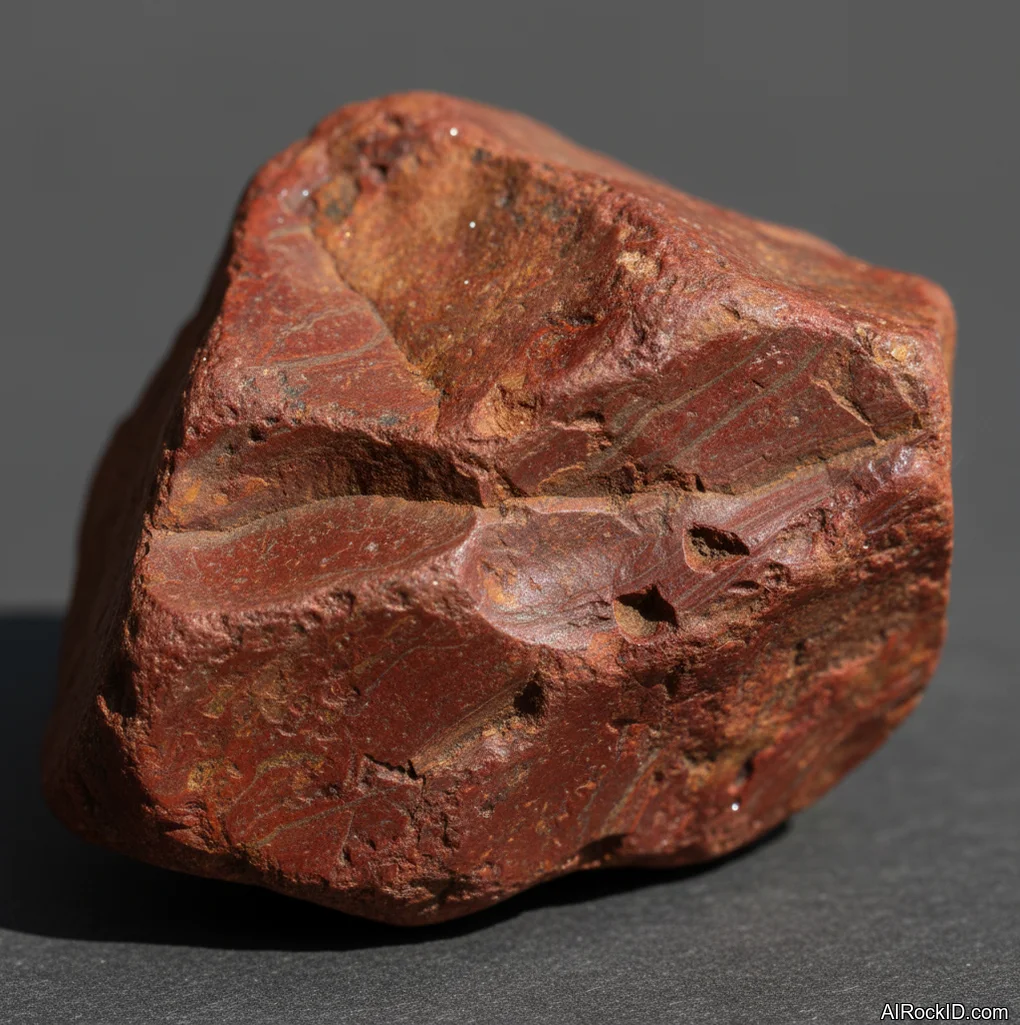
Color: Most Harquahala is tan to caramel brown with cream or light gray areas, sometimes with subtle banding or scenic swirls. Reds can show up, but they’re usually rusty, iron-oxide reds rather than bright cherry tones.
Luster: Polished Harquahala has a waxy to vitreous luster, typical of chalcedony.
If you scratch it with a steel nail, it won’t bite easily, and that’s your first big clue you’re in quartz territory. The real test is a fresh break or unpolished edge: chalcedony tends to show a smooth, curved conchoidal fracture instead of crumbly grain. And in-hand, real chalcedony stays cool longer than most look-alike resin or dyed composites, which feel oddly warm and “dead” right away.
Common Look-Alikes
Harquahala is sometimes confused with these materials:
- Paint Rock agate
- Mookaite jasper
- Snake skin agate (dyed)
- Common picture jasper
- Glass with printed patterns
- Heat-treated Brazilian agate
Market Cautions & Treatments
When AI Can Get This Wrong
AI photo tools mix up Harquahala with Mookaite or painted jasper all the time, especially if the cream streaks get lost in low light. Paint Rock agate and some dyed agates look close in pictures but feel wrong in person. The best check is hardness (it scratches glass), plus that gritty quartz coldness—glass and plastic fakes can’t fake both.
Properties of Harquahala
Physical Properties
| Crystal System | Trigonal |
| Hardness (Mohs) | 6.5-7 (Hard (6-7.5)) |
| Density | 2.58-2.64 |
| Luster | Waxy |
| Diaphaneity | Translucent to opaque |
| Fracture | Conchoidal |
| Streak | white |
| Magnetism | Non-magnetic |
| Colors | tan, cream, brown, light gray, rust red |
Chemical Properties
| Classification | Silicates |
| Formula | SiO2 |
| Elements | Si, O |
| Common Impurities | Fe, Mn, Al |
Optical Properties
| Refractive Index | 1.530-1.540 |
| Birefringence | 0.009 |
| Pleochroism | None |
| Optical Character | Uniaxial |
Harquahala Health & Safety
Harquahala is safe to handle and it won’t hurt anything around water. But if you cut it or sand it, you can kick up respirable silica dust, the same fine powder that clings to your fingers and leaves that gritty film on the saw table. So treat it like any other quartz-based lapidary material.
Safety Tips
Do your cutting or grinding wet. If you’re going to kick up dust anyway, put on a properly fitted respirator rated for silica, with the straps snug and the seal sitting flat against your face (you shouldn’t feel air leaking around your nose). And when you’re done, rinse the slurry up with water. Don’t dry sweep it.
Harquahala Value & Price
Price Range
Rough/Tumbled: $8 - $40 per pound
Price swings mostly come down to the pattern and how clean the rough looks in hand. Tight, scenic faces with barely any fractures, that smooth high polish you can feel under your thumb, will pull more money than chalky field rough that’s spider-cracked all over.
Durability
Very Durable — Scratch resistance: Excellent, Toughness: Good
Chalcedony is stable in normal household conditions and holds a polish well, but thin edges can still chip if you knock them on tile.
How to Care for Harquahala
Use & Storage
Store it like any polished chalcedony: separate from softer stones so it doesn’t scratch them, and keep slabs where corners won’t get banged up. If you’ve got a high-gloss cab, a soft pouch saves it from little grit marks.
Cleaning
1) Rinse with lukewarm water to remove dust or grit. 2) Wash with mild soap and your fingers or a soft brush, then rinse well. 3) Pat dry with a soft cloth to avoid water spots on a high polish.
Cleanse & Charge
If you do spiritual cleansing, plain running water or smoke cleansing is fine for chalcedony. Avoid salt baths if the piece has fractures that can trap residue.
Placement
On a desk or shelf is fine, and it handles sunlight without drama, but strong window light can make pale patterns look washed out. I keep my best slabs angled so the overhead light catches the depth in the bands.
Caution
Don’t breathe in the dust when you’re cutting or polishing. That fine silica powder is the real danger, and it hangs in the air longer than you think (you can feel it get gritty in your throat). And be careful with the edges on thin slabs. One slip, one drop onto concrete, and you can hear that little “tick” as a corner pops right off.
Works Well With
Harquahala Meaning & Healing Properties
In the metaphysical world, Harquahala gets talked about like a “desert grounding” stone, mostly because it straight up looks like the terrain it comes from. When I’m sorting rough at my bench, it’s the kind of material that makes me slow down without even meaning to. Not because it’s doing mystical fireworks. It’s just got those quiet, steady patterns, the sandy bands and soft speckling, that keep your eyes moving without getting overwhelmed.
Pick up a palm stone and you’ll get why people lean on chalcedony for calming routines. It’s dense. Cool to the touch, like it’s been sitting in shade even if the room’s warm. And it doesn’t feel fragile, so you don’t get that little background worry you get with selenite or anything that bruises if you look at it wrong. But look, I’ll be straight: a lot of the “Harquahala meaning” stuff online reads like generic jasper text pasted in and swapped with a new name. If you want to use it in a grounded way, treat it like a texture-and-focus stone. Hold it while you journal. Or keep a slab where your eyes actually land during the day (not tucked in a drawer).
And none of that is medical. If anxiety, sleep, or mood is a real issue, crystals are support at best, not the fix. Still, I’ve watched plenty of customers reach for this material when they want something earthy that isn’t jet black, and isn’t super flashy either, and that choice alone can nudge you into a steadier daily habit. Who doesn’t want that?
Common mistakes
- Assuming every tan-brown Arizona jasper is Harquahala without source documentation
- Treating Harquahala as a separate mineral species instead of a chalcedony trade/locality name
- Confusing polished surface shine with evidence of dye or coating
- Relying on color alone when many agates and jaspers share similar desert tones
- Ignoring translucency, banding, and fracture texture when separating agate from jasper labels
Identify Harquahala from a photo
Compare Harquahala traits, care tips, value clues, and common lookalikes with a clear photo.