K2
What Is K2?
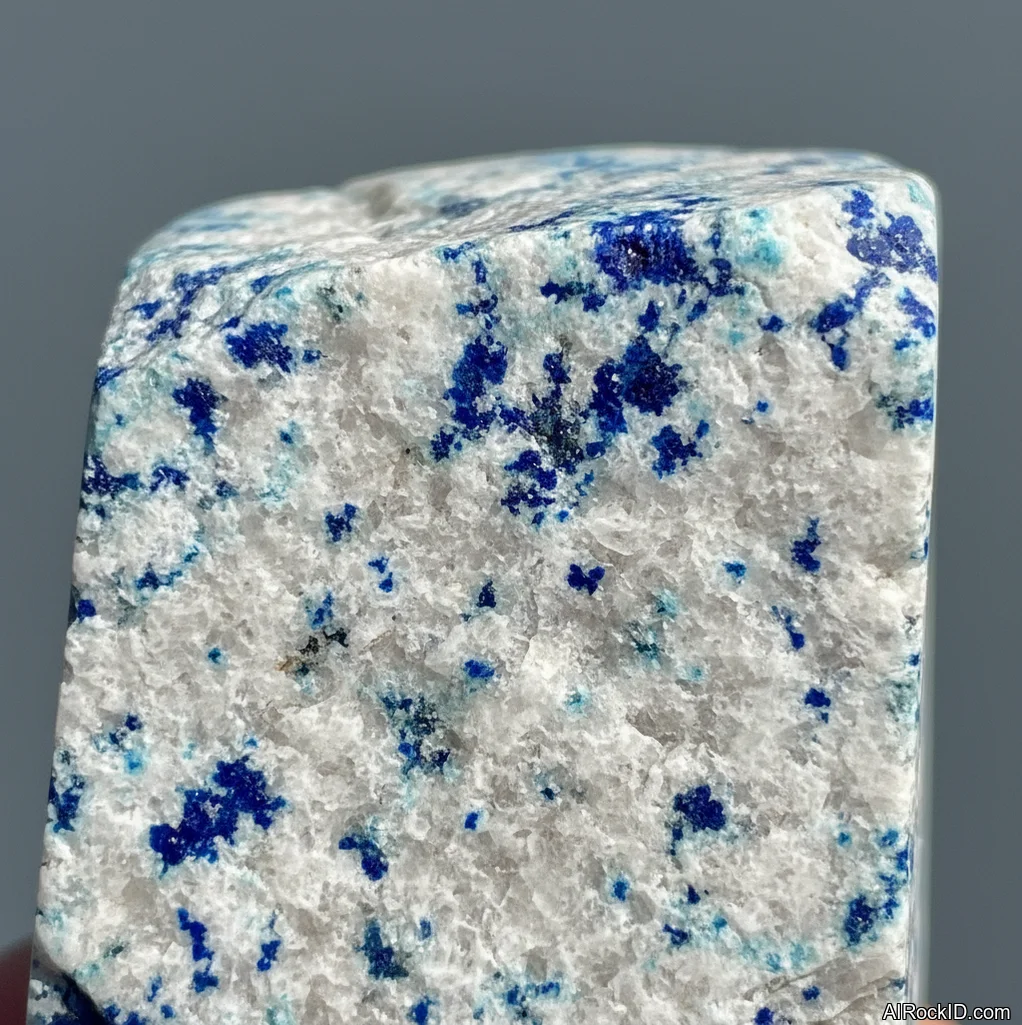
K2 is a trade name for a granite that contains azurite, and you can spot it fast by those vivid, blue, orb-like dots sitting in a pale, speckled base.
Pick up a little palm stone and the contrast hits you immediately. The granite itself feels like any other hard countertop rock, kind of dry and slightly gritty under your thumb, but the blue spots look like somebody literally flicked wet paint across the surface. And since most of what’s sold is polished, those azurite dots end up looking almost glassy, set against the softer-looking white and gray grains of feldspar and quartz.
Look, if you stare at it for a minute, you’ll see why collectors nitpick the name. It isn’t jasper. It isn’t one single mineral, either. It’s a rock. But as lapidary material it’s just plain fun (who doesn’t stop for that color?), and as a conversation piece it’s the kind of stone that keeps getting picked up at shows because nobody expects that electric blue sitting on a snowy matrix.
Origin & History
Most dealers didn’t start calling it “K2” or “K2 stone” until material began coming out of northern Pakistan in the 2000s. The stuff was sold with the story that it was collected near the K2 mountain region in the Karakoram (you’ve probably seen those photos of white granite with sharp blue dots). Thing is, “K2” is just a trade name. It isn’t a formal mineral species, so you won’t find “K2” listed as an approved mineral name.
But the ingredients themselves are nothing new. Azurite has been described and named since the 1800s (the name comes from the word for azure blue), and granite has been studied forever. So what’s actually new here is the combo showing up in a clean, lapidary-friendly form, the kind that takes a decent polish without the blue bits crumbling out, and then sliding right into the gem show pipeline.
Where Is K2 Found?
Commercial K2 material is sourced from northern Pakistan in the Karakoram area, commonly sold under the K2 mountain-region trade name.
Formation
Granite starts out as silica-rich magma that cools slowly underground. Slow cooling is what gives you those big, interlocking grains of quartz and feldspar you can literally pick out with your bare eyes. That’s the pale matrix in K2.
The blue spots are azurite. It’s a copper carbonate mineral, and it shows up later, after the granite’s already there, when copper-bearing fluids work their way through tiny cracks and little pockets (you can picture those hairline seams you see on a cut face). This usually happens in an oxidation-zone setting.
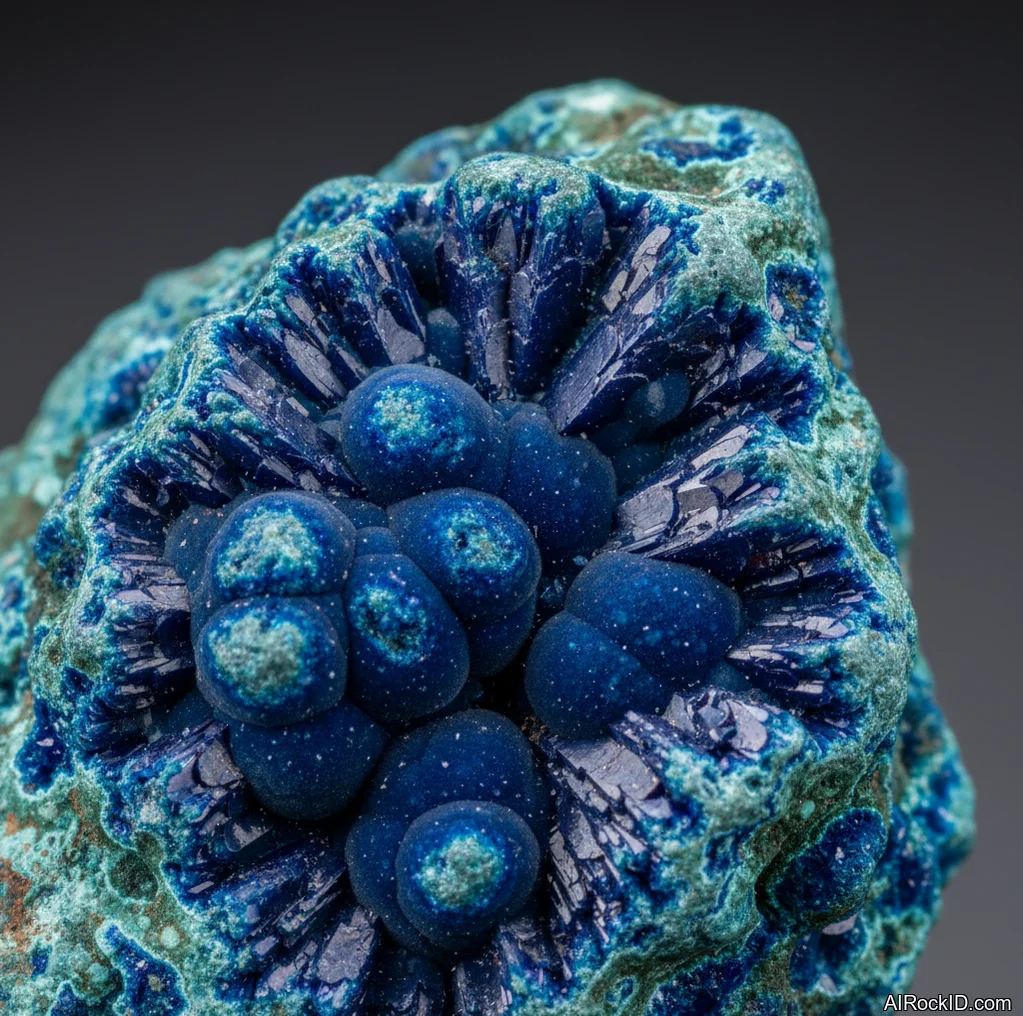
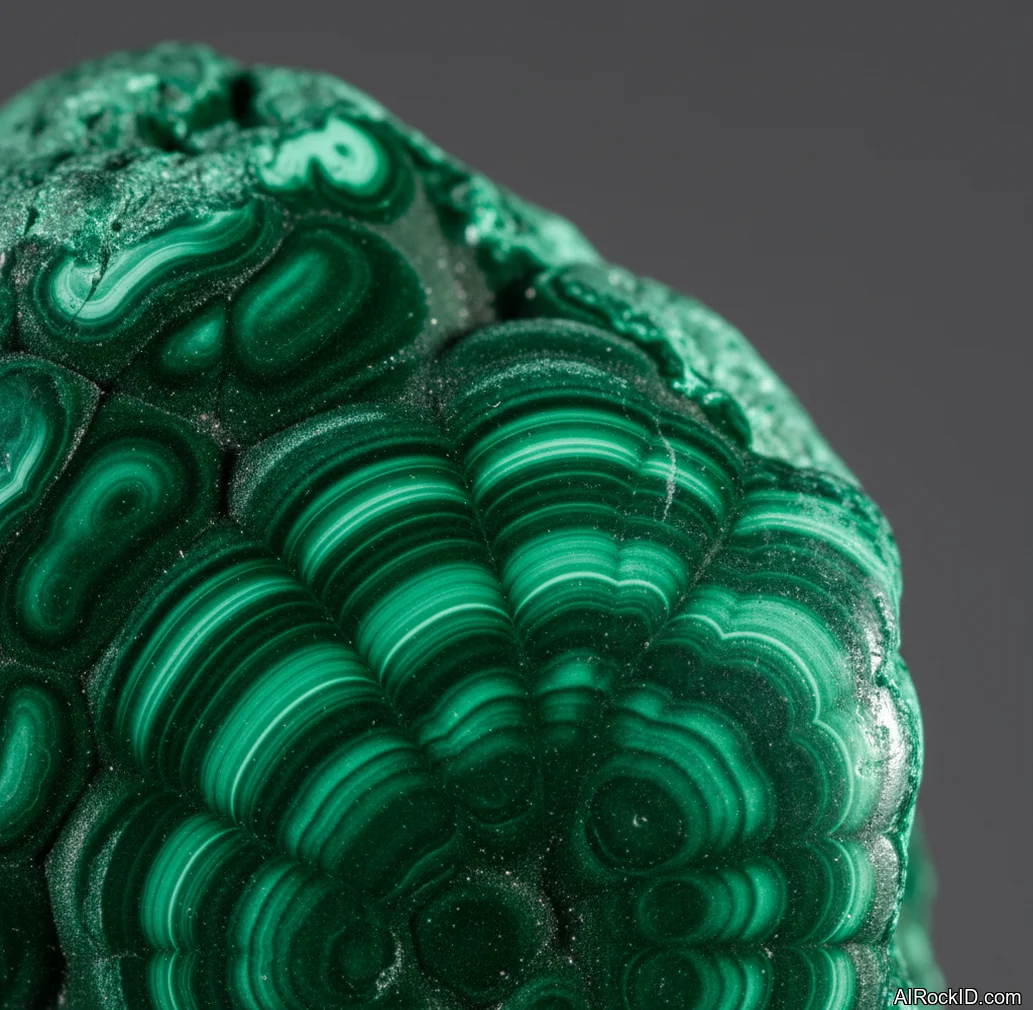
If you put it next to a classic azurite nodule from Morocco, K2’s azurite comes off a lot tighter and more spotty. Think small blebs that just filled whatever tiny openings the granite offered up. And yeah, you’ll sometimes catch a thin hint of green malachite around the blue, which tracks, because azurite and malachite can flip back and forth depending on chemistry and weathering. But don’t go in expecting big crystal sprays. Most of the time it’s compact, rounded patches that take a polish and end up looking like little blue planets.
How to Identify K2
Color: White to light gray granite with scattered, round to irregular bright azure-blue azurite spots; occasional green malachite may appear near the blue.
Luster: Polished pieces show a vitreous shine on the azurite spots and a more glassy-to-dull look on the granite grains depending on the polish.
The real test is the pattern: K2 usually has clean, isolated blue dots instead of veining like dyed howlite or crackle quartz. If you scratch it with a steel point, the granite won’t care much, but azurite can nick more easily and may leave a faint blue smear if it’s soft and chalky. Cheap versions sometimes use dye, and the giveaway is color bleeding into tiny fractures or pooling around pits after a wipe with alcohol on a cotton swab.
Properties of K2
Physical Properties
| Crystal System | Monoclinic |
| Hardness (Mohs) | 3.5-4 (Soft (2-4)) |
| Density | 3.7-3.9 g/cm3 |
| Luster | Vitreous |
| Diaphaneity | Opaque |
| Fracture | Uneven |
| Streak | Light blue |
| Magnetism | Non-magnetic |
| Colors | white, light gray, black, azure blue, green |
Chemical Properties
| Classification | Carbonates |
| Formula | Cu3(CO3)2(OH)2 |
| Elements | Cu, C, O, H |
| Common Impurities | Fe, Mn |
Optical Properties
| Refractive Index | 1.730-1.838 |
| Birefringence | 0.108 |
| Pleochroism | Strong |
| Optical Character | Biaxial |
K2 Health & Safety
You can hold it and wear it without any issue. But if you’re cutting or grinding azurite-bearing rock, the lapidary dust is the part you don’t want in your lungs (it gets in the air fast), so don’t inhale it.
Safety Tips
Use wet cutting or wet grinding. Wear a respirator when you’re shaping it, because that fine blue dust gets in your nose fast (you’ll taste it). And wipe down the bench, floor, and your tools after, so the blue powder doesn’t end up tracked everywhere.
K2 Value & Price
Price Range
Rough/Tumbled: $10 - $120 per piece
Cut/Polished: $2 - $15 per carat
Price jumps around depending on how deep the blue looks in person, how many spots show up, and if the polish comes out clean, with no undercutting around the azurite (you can usually feel that little dip with a fingernail).
Durability
Moderate — Scratch resistance: Fair, Toughness: Fair
The granite matrix is tough, but the azurite areas are softer and can scratch or chalk if they’re handled hard.
How to Care for K2
Use & Storage
Store it so polished faces don’t rub against harder stones, because the azurite spots can pick up scratches. A small pouch or a divided box tray works.
Cleaning
1) Rinse quickly with lukewarm water and a drop of mild soap. 2) Use a soft toothbrush around pits, then rinse again. 3) Pat dry and let it air-dry fully before putting it away.
Cleanse & Charge
If you’re into cleansing routines, stick to smoke, sound, or a quick rinse and dry. I skip salt bowls with K2 since azurite can get cranky over time.
Placement
Put it where you can actually see the blue spots in daylight. On a desk, it reads like a little sky map, but keep it away from spots where keys and coins get tossed.
Caution
Don’t hit it with harsh cleaners, acids, or vinegar. Carbonates like azurite can react and go dull fast, kind of like that chalky haze you see after a bad wipe-down. And don’t leave it soaking for a long time, either. If you’re cutting or sanding it, keep the dust out of your lungs (it hangs in the air longer than you’d think).
Works Well With
K2 Meaning & Healing Properties
A lot of folks grab K2 because it just looks wild, but people also talk about it like a “mind meets ground” kind of stone. And yeah, you get why the second you hold one. The granite feels plain and steady under your thumb, almost boring in a good way, then those bright blue azurite spots keep stealing your attention like they shouldn’t even be real.
If you’re into meditating with stones, K2 usually gets framed around focus and perspective. The granite part reads as practical, like, “alright, back to work,” and the azurite is the piece people connect with insight and mental clarity. I’m not calling that medical advice. It’s more a ritual object, something you keep nearby to set a tone and stay in it.
But look, there’s a downside. Some K2 has azurite that’s a little chalky, and if you carry it in your pocket a lot, you’ll notice the first tiny scuffs show up on the blue spots. So if you want it as an all-day worry stone, go for one that’s properly polished with hard, saturated blue, not that soft, powdery-looking stuff (you can usually tell just by how it catches the light when you tilt it).
Identify Any Crystal Instantly
Snap a photo and get properties, value, care instructions, and healing meanings in seconds.