Kambaba Jasper
What Is Kambaba Jasper?
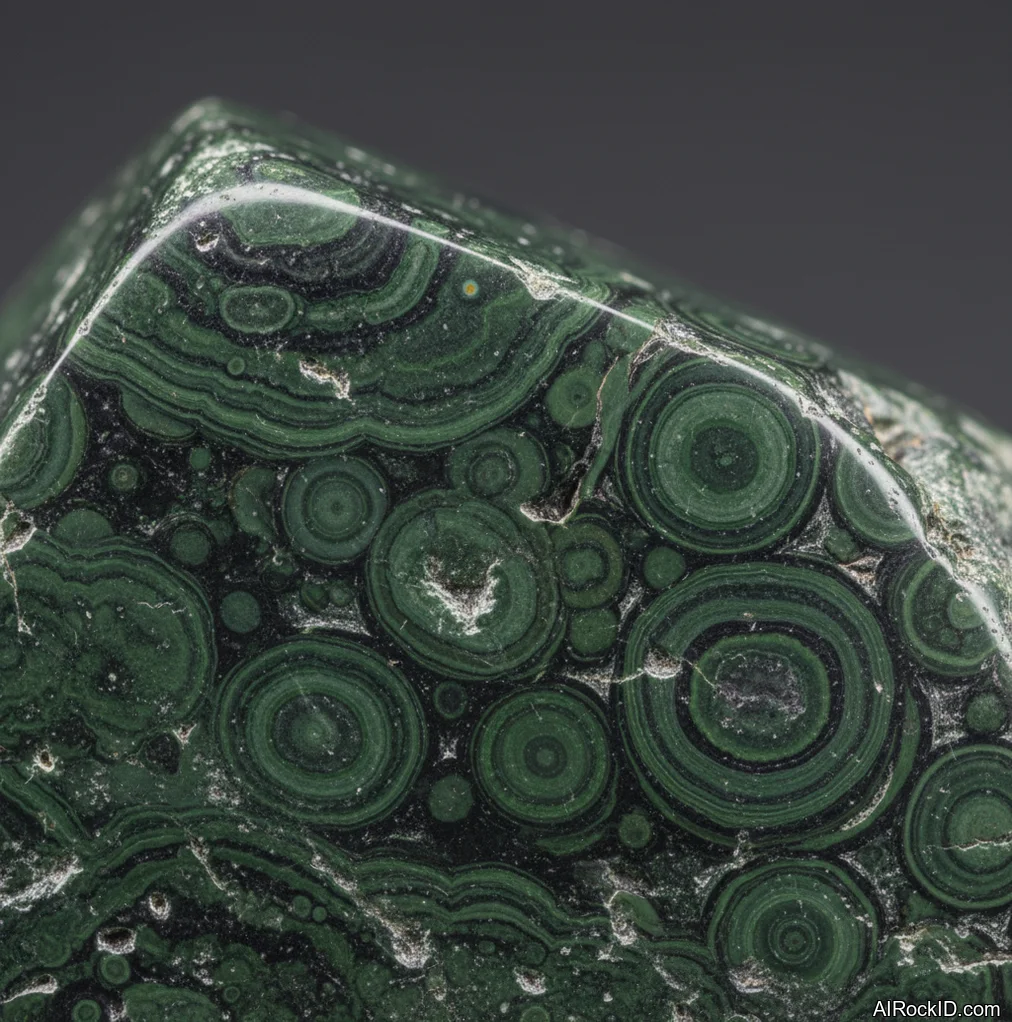
Kambaba Jasper is an orbicular type of jasper, meaning it’s microcrystalline quartz, also called chalcedony, with dark green to black swirls and those eye-like spots. Most of what you see for sale comes out of Madagascar.
Grab a polished palm stone and you feel it right away. It’s slick, almost waxy, even when the polish isn’t anything to brag about. The pattern is why anyone cares. Some stones look like tiny green galaxies floating in a black sky, and some have tight little bullseyes that scream “croc skin” (that’s where the Crocodile Jasper nickname comes from).
But here’s the collector reality: plenty of what gets labeled “kambaba jasper” isn’t the classic orbicular material with crisp circles. I’ve stood over trays at shows and picked through batches where half the pieces were just blotchy green-black jasper, no real eyes to speak of. The good ones? They’ve got real contrast, clean orbs, and that deep green that doesn’t go swampy under indoor lighting.
Origin & History
“Kambaba” is basically a trade name that caught on in the lapidary and metaphysical world, not some official geologic term you’d see nailed down in a textbook. Most sellers use it for that Madagascar stone with the dark, orb-like swirls (the kind you notice the second you pick up a polished palm stone and the light slides over it). And you’ll also run into it as “Crocodile Jasper,” which is just a marketing label borrowed from the pattern.
Geology-wise, the trade usually describes it as jasper with fossilized stromatolite or algae-like structures. But there isn’t one clean “first described by” moment, like you get with a lot of named minerals, because this is a rock variety, not a new mineral species. Thing is, in my experience the name really started getting used everywhere once the Madagascar material began showing up reliably at gem shows in the 2000s, especially as bead strands, palm stones, and carvings.
Where Is Kambaba Jasper Found?
Most of the material sold as Kambaba Jasper in shops comes from Madagascar, with similar-looking stromatolitic jaspers sometimes attributed to southern Africa in the trade.
Formation
Look at the pattern for a second and you can see why stromatolites come up so fast in the conversation. Those little “orbs” and swirly bits make sense if you’re staring at layered microbial structures that later had silica-rich fluids running through them, slowly replacing and cementing the whole thing into a hard, quartz-rich rock (the kind that feels almost glassy when it’s freshly cut).
Jasper and chalcedony are basically silica that moved into open spaces and locked everything down tight, with iron and other trace stuff giving the color its tint. Kambaba-type material is usually opaque and fine-grained, so you won’t see crystals in it, even under a bright light. It’s more like a silica concrete that held onto the original shapes and layering, and then someone polished it up until those patterns finally pop. Why else would the swirls look so clean?
How to Identify Kambaba Jasper
Color: Dark forest green to olive green with black swirls, orbs, and concentric “eye” spots; usually high contrast when polished. The green can look almost gray-green in low light.
Luster: Waxy to dull in rough pieces; waxy to vitreous when well polished.
Pick up a palm stone and feel the temperature. Real quartz-rich jasper stays cool in your hand longer than resin or plastic imitations. If you scratch it with a steel nail, it shouldn’t take a scratch easily, but a fresh sharp edge on the nail can leave a faint mark on a cheap, low-polish surface that wipes off. The real test is a simple glass scratch check in an inconspicuous spot: jasper should scratch glass because it’s basically quartz.
Properties of Kambaba Jasper
Physical Properties
| Crystal System | Trigonal |
| Hardness (Mohs) | 6.5-7 (Hard (6-7.5)) |
| Density | 2.58-2.65 g/cm3 |
| Luster | Waxy |
| Diaphaneity | Opaque |
| Fracture | Conchoidal |
| Streak | White |
| Magnetism | Non-magnetic |
| Colors | dark green, olive green, black, gray-green |
Chemical Properties
| Classification | Silicates |
| Formula | SiO2 |
| Elements | Si, O |
| Common Impurities | Fe, Mn, Al, C |
Optical Properties
| Refractive Index | 1.530-1.539 |
| Birefringence | 0.004-0.009 |
| Pleochroism | None |
| Optical Character | Uniaxial |
Kambaba Jasper Health & Safety
Kambaba Jasper is generally safe to handle, and it’s fine to get it wet during normal use. But like any silica-rich stone, don’t breathe in the dust if you cut or grind it (that gritty, chalky powder gets everywhere).
Safety Tips
If you’re doing lapidary work, do it wet. Use water to keep the dust down, keep the area well ventilated (a fan pulling air away from your face helps), and wear a proper respirator that’s rated for fine particulates.
Kambaba Jasper Value & Price
Price Range
Rough/Tumbled: $5 - $40 per palm stone or small specimen
Cut/Polished: $0.50 - $3.00 per carat
Prices bounce around depending on how sharp the pattern is and how well it’s polished. Tight, high-contrast orbs in clean carving-grade material cost more than the muddy green-black stuff you’ll see sold in bulk.
Durability
Durable — Scratch resistance: Good, Toughness: Good
Quartz-rich jasper is stable in normal household conditions, but polished surfaces can dull if it bangs around with harder stones.
How to Care for Kambaba Jasper
Use & Storage
Store it in a pouch or separate compartment if it’s polished, because quartz can scuff other softer stones and get scuffed by harder stuff like topaz or corundum. And keep carvings out of a pocket with keys.
Cleaning
1) Rinse with lukewarm water and a drop of mild soap. 2) Use a soft toothbrush to get into carved grooves and drilled bead holes. 3) Rinse well and dry with a microfiber cloth.
Cleanse & Charge
For non-medical, spiritual-style cleansing, a quick rinse and a few hours on a dry windowsill or on selenite is common practice. Don’t bake it in direct, hot sun all day if it’s in a display window, since constant heat cycling can stress some jaspers over time.
Placement
On a desk, it reads calm and earthy, and the pattern holds up well under lamp light. I like it where you can actually turn it in your hands, because the “eyes” shift as the light catches the polish.
Caution
Don’t use harsh cleaners or an ultrasonic cleaner on beads, especially if the piece has fractures or filled pits. That buzzing vibration can push gunk down into those tiny spots where it’s a pain to rinse out (you’ll see it cling in the little creases), and it can also make existing cracks worse.
Works Well With
Kambaba Jasper Meaning & Healing Properties
Kambaba Jasper hits you as a grounding stone right away, and honestly a lot of that is just physical. It’s weirdly heavy for its size. And the colors live in that dark green and black zone your brain instantly files under “earth.”
I keep a little palm stone in my jacket pocket sometimes. The polish is slick, almost like glass that’s been handled a thousand times, so it turns into an easy fidget when I’m stuck in traffic or standing around at a show with nothing to do but wait.
In crystal circles, people link it with calm, steadiness, and moving a little slower. That matches what it’s like in your hand. The pattern’s busy, sure, but it’s not shouting at you. You can get lost in those orb shapes and, without trying, your breathing drops a notch.
But let me say the quiet part out loud: it’s not medicine. If anxiety is really messing with your life, crystals can be a comfort object (like a worry stone), not a substitute for actual care.
One practical thing I like about using it is it doesn’t feel “fragile” emotionally the way people talk about those high-energy, super sparkly stones. You can toss it in a bag, forget about it, pull it back out, and it looks the same and feels the same. Compared to something like selenite, it’s low-maintenance. And if you meditate, it’s a solid anchor because it’s cool to the touch at first, then warms up slowly as you hold it.
Identify Any Crystal Instantly
Snap a photo and get properties, value, care instructions, and healing meanings in seconds.