Orca Agate
What Is Orca Agate?
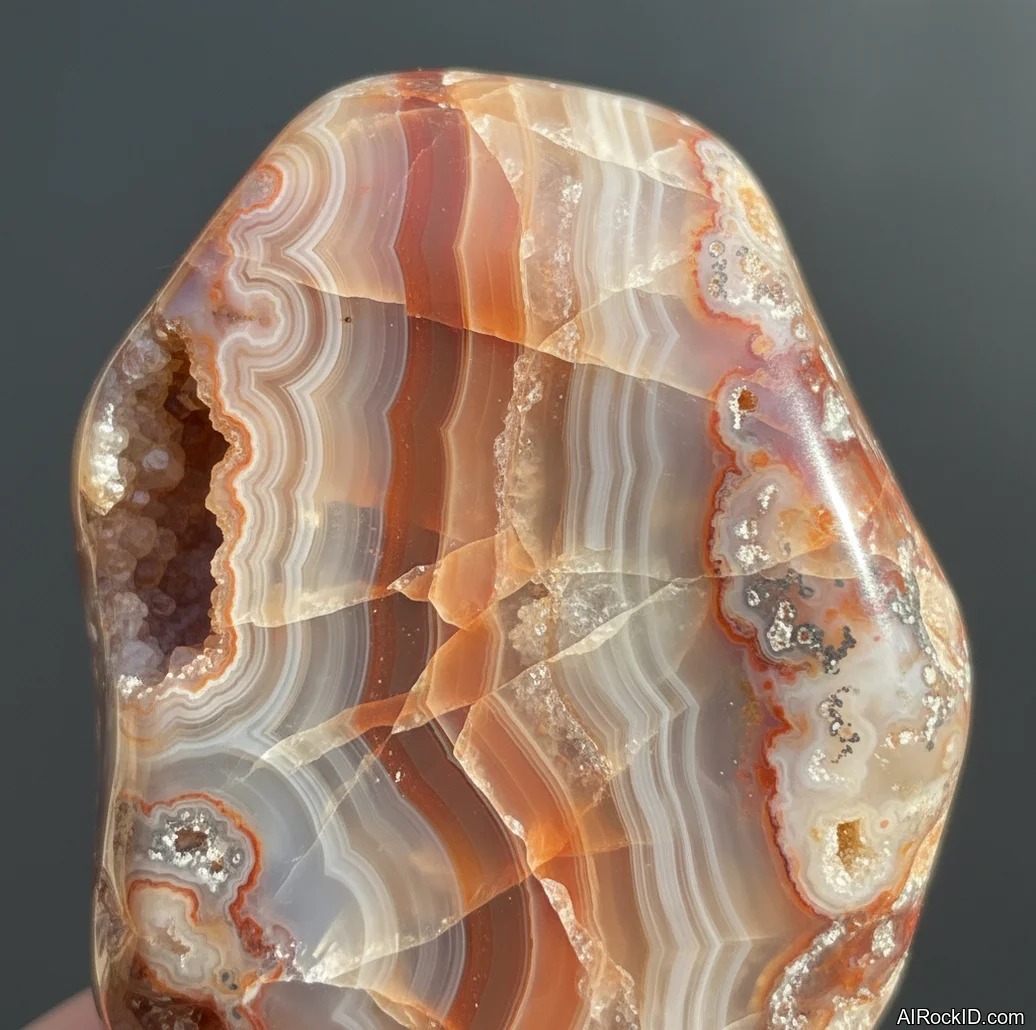
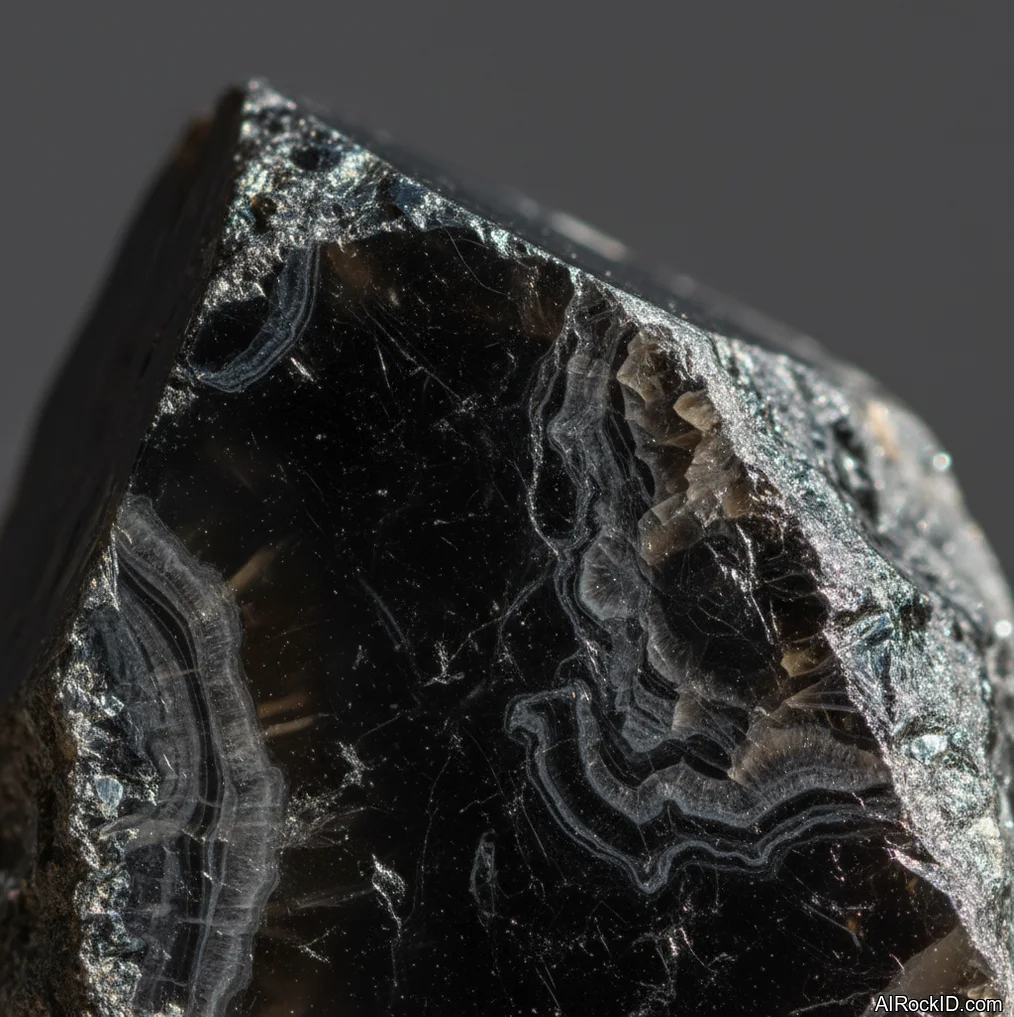
Orca Agate is a black, gray, and white banded chalcedony (agate) people trade for those patterns that honestly look like orca whales or stormy sea foam. Most pieces you run into are polished, since the pattern shows up best with a shine, but I’ve handled a few rough chunks where the bands don’t really show until you splash a little water on the surface and, all of a sudden, the whole thing wakes up.
Grab a palm stone and you feel it immediately. Smooth, but with that slightly “grippy” agate polish that catches your skin just a bit. Cool at first touch. The bands look like someone painted them on, but they didn’t. And the pattern swings all over the place from piece to piece. Some are inky black with thin white ribbons, while others lean smoky gray with big cloudy patches that kind of glow at the edges when you hold them up to a lamp (I’ve done that more times than I’ll admit).
Origin & History
Orca Agate isn’t some old museum label. It’s a trade name, and it really only caught on once that banded black-and-white agate from Madagascar started popping up in the late 2010s and early 2020s. Dealers saw the “orca” vibe right away and pushed it hard. And honestly, it stuck because you can spot those black-and-white bands from across the room, even under bad shop lighting.
The material itself is chalcedony, so it’s in the same family as Botswana agate and lace agate. People will also call it “Orca jasper,” but that’s basically store language. Jasper’s usually opaque and kind of grainy, while this behaves like agate and chalcedony when you cut it, run it on the wheels, polish it up, and hold it to the light to see what it’s doing. Why call it jasper, then? Because it sells, I guess.
Where Is Orca Agate Found?
Commercial Orca Agate on the market is sourced from Madagascar, with material coming out of the northern and northwestern regions in mixed chalcedony agate deposits.
Formation
Most agate gets going the same way. Silica-rich fluids slip through cracks and little cavities, then they drop off one thin layer after another until the whole space is packed tight. In volcanic ground, those cavities are often old gas bubbles trapped in basalt. But you’ll also see silica plugging fractures where the rock bent, popped open, and left just enough room for the fluid to move in.
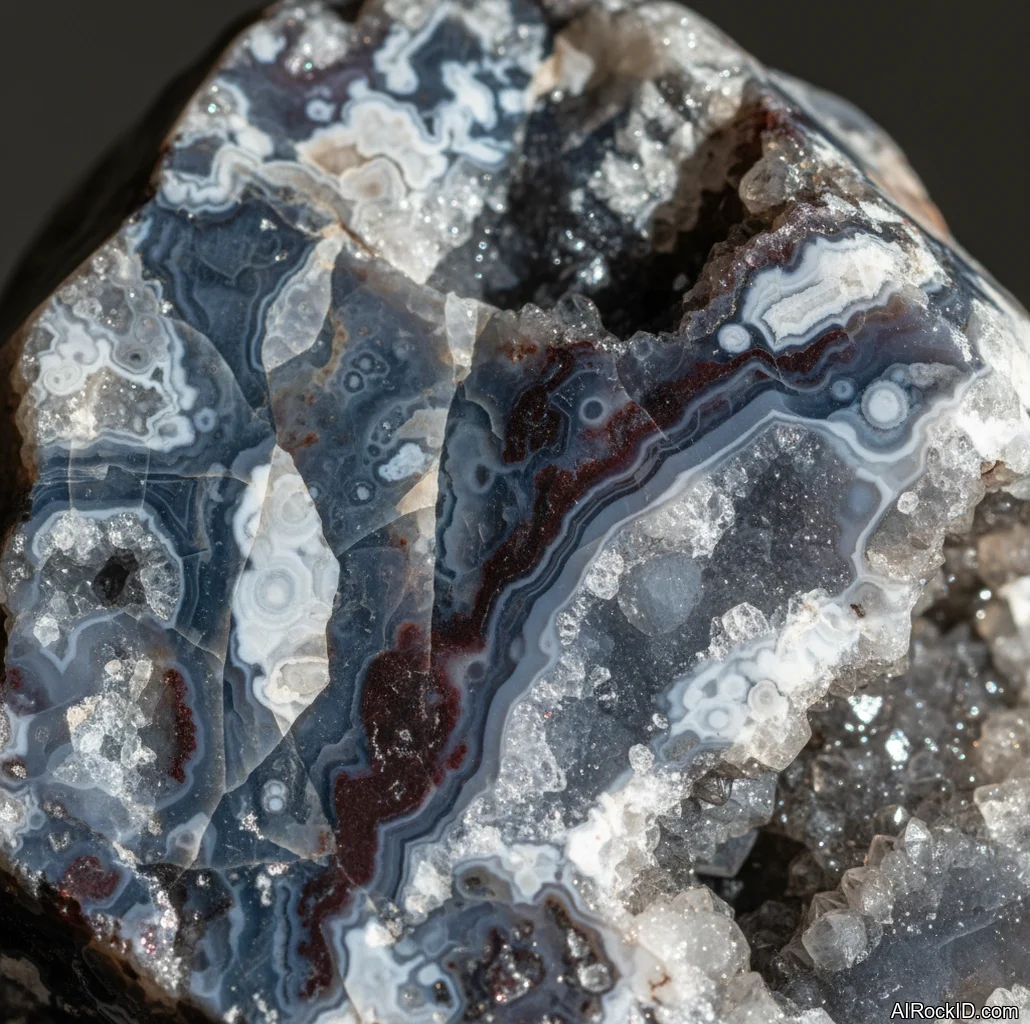
If you stare at Orca Agate up close, the banding basically keeps a record of how it grew. Some bands look razor-sharp. Others go hazy, almost like someone smudged them with a thumb. And some pieces have tiny drusy pockets where the very last bit of silica finished up as micro quartz (you can catch that little sugar-sparkle when you tilt it under a light). But here’s the thing: the black isn’t some magical mineral swap. It’s usually tiny inclusions and impurities that darken parts of the chalcedony while it’s forming.
How to Identify Orca Agate
Color: Mostly black, charcoal, gray, and white with banding or cloud-like patches; some pieces show translucent gray edges when backlit.
Luster: Waxy to vitreous when polished, more dull and chalky in rough.
Pick up a real piece and it stays cool in your hand longer than glassy fakes, and the bands look “inside” the stone instead of printed on the surface. If you scratch it with a steel nail, it shouldn’t bite easily, but a quartz point will leave a mark because it’s basically the same hardness. The problem with dyed agate is the color tends to pool along tiny cracks and pits, so check holes and edges with a loupe.
Properties of Orca Agate
Physical Properties
| Crystal System | Trigonal |
| Hardness (Mohs) | 6.5-7 (Hard (6-7.5)) |
| Density | 2.58-2.64 g/cm3 |
| Luster | Waxy |
| Diaphaneity | Translucent to opaque |
| Fracture | Conchoidal |
| Streak | White |
| Magnetism | Non-magnetic |
| Colors | Black, Gray, White, Charcoal, Smoky gray |
Chemical Properties
| Classification | Silicates |
| Formula | SiO2 |
| Elements | Si, O |
| Common Impurities | Fe, Mn, C |
Optical Properties
| Refractive Index | 1.530-1.543 |
| Birefringence | 0.009 |
| Pleochroism | None |
| Optical Character | Uniaxial |
Orca Agate Health & Safety
Orca Agate isn’t toxic, so you can handle it without worrying. And once it’s polished and finished, it’s totally fine if it gets splashed or sits near water. But don’t start grinding or sanding it in open air with no dust control, because that fine powder goes everywhere (you’ll see it settle on the bench and even on your fingertips). Why breathe that stuff in?
Safety Tips
If you’re going to cut or polish it, keep it wet and put on a real respirator that’s actually rated for silica dust. And for day-to-day handling, don’t just chuck it in a pouch with diamonds or corundum, because it’ll come out with little scuffs all over it.
Orca Agate Value & Price
Price Range
Rough/Tumbled: $10 - $80 per piece
Cut/Polished: $1 - $8 per carat
Price mostly follows the pattern first: how sharp the bands look and how much the black pops against the white. Then it’s size, and then how clean the polish came out. Big pieces that have that crisp, high-contrast banding and a face that doesn’t show pits (you know, those tiny pinholes you can feel if you run a fingernail over them) get expensive fast.
Durability
Durable — Scratch resistance: Good, Toughness: Good
It’s stable in normal conditions, but like most chalcedony it can take a dull spot if it gets dragged around with harder stones in a pocket or bowl.
How to Care for Orca Agate
Use & Storage
Store it in a soft pouch or a separate compartment so the polish doesn’t get hazed by harder gems. I don’t leave mine rolling around in a dish with quartz points for that reason.
Cleaning
1) Rinse with lukewarm water and a drop of mild soap. 2) Use a soft toothbrush to clean pits and edges, then rinse well. 3) Pat dry with a microfiber cloth and let it air-dry fully before storing.
Cleanse & Charge
If you’re into energetic care, water rinse or smoke cleansing works fine, and moonlight is gentle. I skip salt so it doesn’t crust up in tiny cavities.
Placement
A desk or nightstand is where I notice it most, because the banding reads well under a lamp. Backlighting near a window can bring out the smoky translucent zones, but don’t bake it on a hot sill.
Caution
Skip harsh chemicals, ultrasonic cleaners, or anything that gets really hot. And don’t use saltwater if the piece has tiny pits or those drusy, sugar-grain-looking spots, because the salty stuff can sink in and get stuck there.
Works Well With
Orca Agate Meaning & Healing Properties
People usually grab Orca Agate when they want something that reads calm without going full pastel. In my own pile, it’s the stone I reach for when my head feels noisy, mostly because those black-and-white bands give my eyes a steady place to park. That’s it.
A lot of people who use it in a metaphysical way tie it to grounding and emotional steadiness, in the same general lane as other black-and-white stones. But it’s not a sedative disguised as a rock. Some days it’s just a cool palm stone with that satisfying, solid heft, and the smooth polish feels almost slick at the edges. And that’s fine. If you’re dealing with anxiety or sleep problems, crystals should be a support tool, not the plan.
One collector reality check, though. You’ll see tons of Orca Agate sold as perfectly matched sets, and sure, some are totally legit. But the pattern can also be “curated” by slicing one nodule into a bunch of similar faces, so everything lines up and looks like it was meant to be together. Nothing wrong with that (it’s smart cutting), just don’t pay a rare-stone premium for something that’s basically good polish and clever slicing. Who wants to overpay for that?
Identify Any Crystal Instantly
Snap a photo and get properties, value, care instructions, and healing meanings in seconds.