Paragonite
What Is Paragonite?
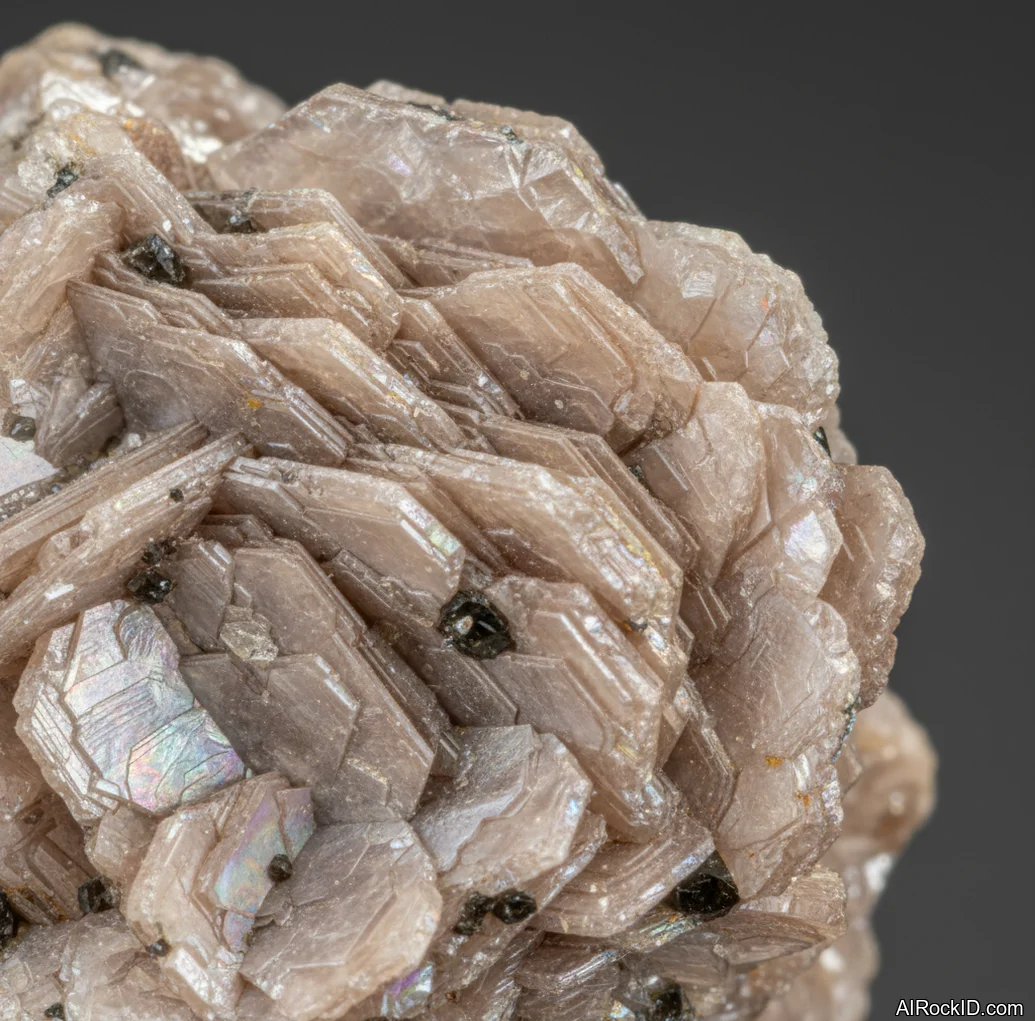
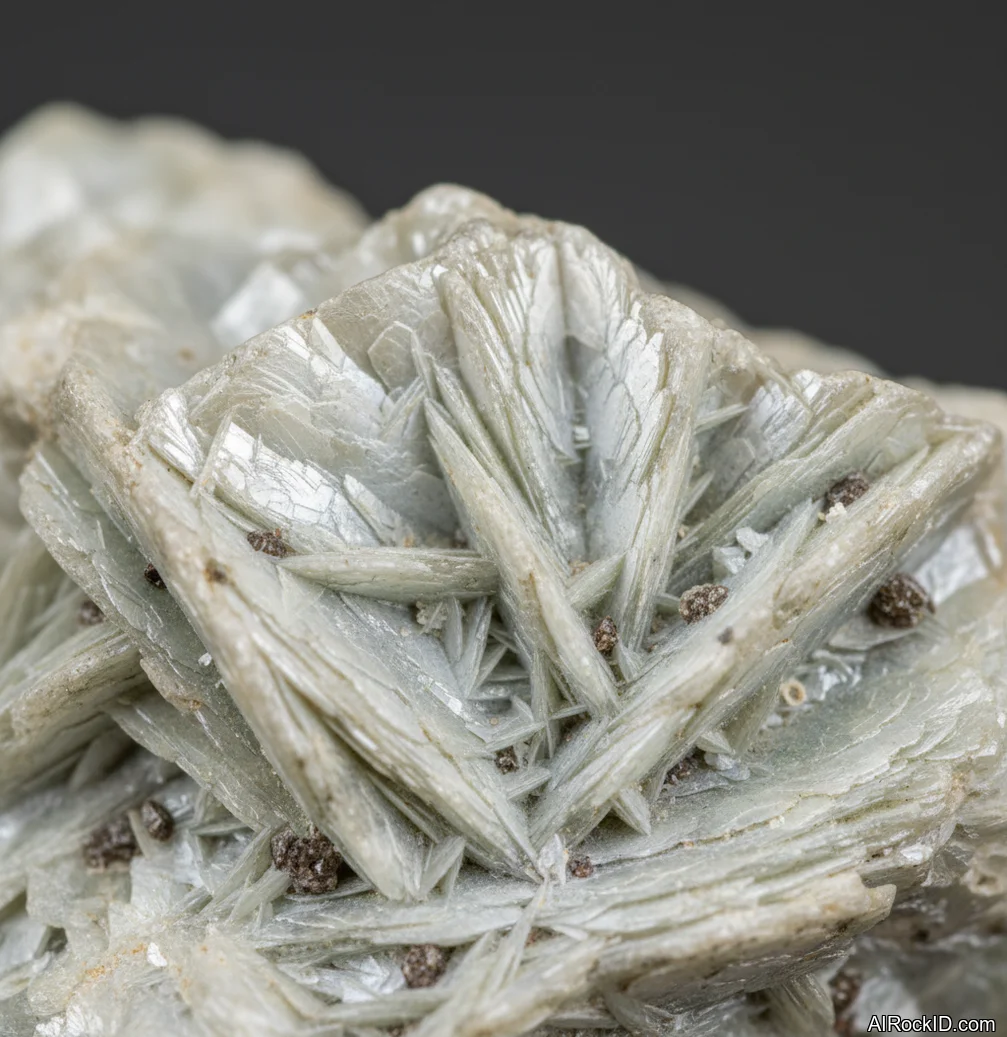
Paragonite is a sodium-rich mica with the formula NaAl2(AlSi3O10)(OH)2. If you’ve ever messed with muscovite, you’ll recognize the vibe fast. Same “booky” mica feel in your fingers, only paragonite tends to be finer grained and, honestly, harder to pick out when you’re staring at a rock in the field.
Thing is, the texture gives it away before anything else does. You pick up a piece and those tiny plates just want to part into thin sheets. Fresh cleavage catches the light with this soft, pearly silver flash, sometimes with a faint green or blue-gray cast if you tilt it back and forth under a strong lamp (the kind that makes everything look a little too honest).
It’s not the mineral that shouts at you from across a dealer table. But hit it with a direct light and that sheen pops. Subtle, but there.
Most specimens I run into are sitting in schist or blueschist matrix, not big standalone “crystals” you can pluck out cleanly. And that’s kind of the point. It’s a field-geology mineral that ended up in collections because it tells you something about pressure, fluids, and the rock’s whole story.
Origin & History
Paragonite got its first proper description in 1843, thanks to Albrecht Breithaupt. The name comes from the Greek “paragon,” which basically means “misleading” or “deceptive,” since it’s so easy to mix up with other micas, especially muscovite.
And honestly, that name fits. I’ve stood at shows and heard people shrug and call it “just muscovite,” even while it’s flashing those same silky, sheet-like flakes under the booth lights. But then you’ll see the opposite too: sellers slapping the label paragonite on any pale mica sitting in schist (you know the kind, thin plates that want to split into little shiny pages when you touch them). Without testing, you can get fooled either way. Why wouldn’t you?
Where Is Paragonite Found?
You’ll run into paragonite in high-pressure metamorphic terrains, especially Alpine-type settings and blueschist belts. It’s usually reported as fine mica in schists rather than big, clean plates.
Formation
Look at the rocks paragonite likes to sit in and the same idea keeps popping up: pressure. It shows up during metamorphism when there’s sodium around and the conditions let mica grow, most often in blueschist and eclogite-adjacent assemblages or in certain pelitic schists.
Compared to muscovite, it’s basically the sodium end-member. And it can turn up alongside glaucophane, lawsonite, garnet, chlorite, albite, quartz, and sometimes kyanite, depending on the exact pressure-temperature path the rock took.
Thing is, it’s a pain to ID because the grains can be really tiny. In a lot of hand samples you just catch that silvery shimmer running along the foliation (the kind that flashes when you roll the rock under a lamp), and that’s all you get until you put a lens on it.
How to Identify Paragonite
Color: Usually colorless to pale gray, silvery white, or light greenish-gray. In some schists it reads as a cool blue-gray sheen rather than a strong “green mineral” color.
Luster: Pearly to vitreous on cleavage faces.
Pick up a piece and tilt it under a single strong light source. Paragonite gives a smooth, satiny flash on fresh cleavage, but the flakes are often finer than muscovite in the same style of rock. If you scratch it with a copper coin, it’ll mark pretty easily, and if you try to peel a flake with a pin, it wants to split into thin sheets. The real test is lab work: paragonite and muscovite can look almost identical without optical methods or XRD.
Properties of Paragonite
Physical Properties
| Crystal System | Monoclinic |
| Hardness (Mohs) | 2.5-3 (Soft (2-4)) |
| Density | 2.78-2.83 g/cm3 |
| Luster | Pearly |
| Diaphaneity | Transparent to translucent |
| Fracture | Uneven |
| Streak | White |
| Magnetism | Non-magnetic |
| Colors | Colorless, White, Silvery gray, Pale greenish gray, Bluish gray |
Chemical Properties
| Classification | Silicates |
| Formula | NaAl2(AlSi3O10)(OH)2 |
| Elements | Na, Al, Si, O, H |
| Common Impurities | Fe, Mg, K |
Optical Properties
| Refractive Index | 1.586-1.610 |
| Birefringence | 0.024 |
| Pleochroism | Weak |
| Optical Character | Biaxial |
Paragonite Health & Safety
Paragonite isn’t considered toxic, so you can handle it without worry. But like any mica, it’ll drop these tiny little flakes, especially if you’re dealing with a crumbly bit that feels a little dusty on your fingers. So don’t go rubbing your eyes right after handling it, okay?
Safety Tips
If you’re trimming matrix or scraping mica books, put on eye protection, and rinse your hands afterward. And just give your display shelf a fast wipe (I usually feel the gritty little flakes under the cloth) so the loose bits don’t end up everywhere.
Paragonite Value & Price
Price Range
Rough/Tumbled: $10 - $80 per specimen
Price usually follows how confident the label is and the story behind it. If it’s from a well-documented Alpine or blueschist locality and it’s sitting on a solid matrix (the kind that actually looks good in a case, not crumbly), it’ll cost more than some vague “mica in schist” with no real info. And big, clean, display-worthy plates don’t show up often, so when they do, the price climbs fast.
Durability
Nondurable — Scratch resistance: Poor, Toughness: Fair
It’s stable as a mineral, but the thin mica sheets bruise, flake, and shed at the edges if you handle it a lot.
How to Care for Paragonite
Use & Storage
Store it so nothing presses on the cleavage faces, because mica dents and peels. I like a perky box or a flat display with a little putty supporting the matrix, not the mica itself.
Cleaning
1) Blow off grit with a bulb blower or canned air from a distance. 2) Use a very soft brush to lift dust off the plates in one direction. 3) If you must use water, do a quick rinse and pat dry, then let it air dry fully before boxing it up.
Cleanse & Charge
If you do energetic cleansing, keep it gentle: smoke, sound, or moonlight are low-contact options. Skip salt piles, since salt grains love to wedge into mica layers.
Placement
Put it where light can rake across the surface, because the whole point is that pearly flash. Keep it away from high-traffic spots where people will pick at the edges.
Caution
Don’t put it in an ultrasonic cleaner, and don’t throw it in a tumbler either. Skip strong acids and any hard scrubbing; those plates can start lifting at the edges (you’ll see them curl up), and the specimen will look ragged really fast.
Works Well With
Paragonite Meaning & Healing Properties
Paragonite doesn’t scream “metaphysical shop” the second you see it. Most of the time it’s this pale, flaky mica stuck in schist, the kind of rock that looks more like a homework sample than something you’d put on an altar. But when people reach for mica-type minerals in that world, they usually latch onto the same themes: layers, reflection, and clearing out mental clutter.
Thing is, the feel of it is half the point. Grab a paragonite-bearing schist and lightly drag your thumb across the foliation. The texture shifts under your skin as you move, like the rock has a grain that flips direction, almost like riffling through pages. That little tactile moment is exactly why I’ve seen it show up in journaling sessions and those slow, quiet meditation setups. Not because it’s pretty. Because it makes you pause.
But look, if you’re expecting some huge “energy punch,” paragonite tends to read as subtle for most people, and that can get mistaken for nothing happening at all. I think of it more like a study mineral that happens to have a side benefit (nice, but not the main event). And if you’ve got anxiety, pain, or anything medical going on, treat crystals as comfort objects and a nudge to do the real-world basics too: sleep, food, and actual care. Sounds boring, sure. Still true.
Identify Any Crystal Instantly
Snap a photo and get properties, value, care instructions, and healing meanings in seconds.