Pink Banded Onyx
What Is Pink Banded Onyx?
Pink Banded Onyx is really a banded variety of calcite (and sometimes aragonite), even though in the stone trade it gets sold under the name “onyx.”
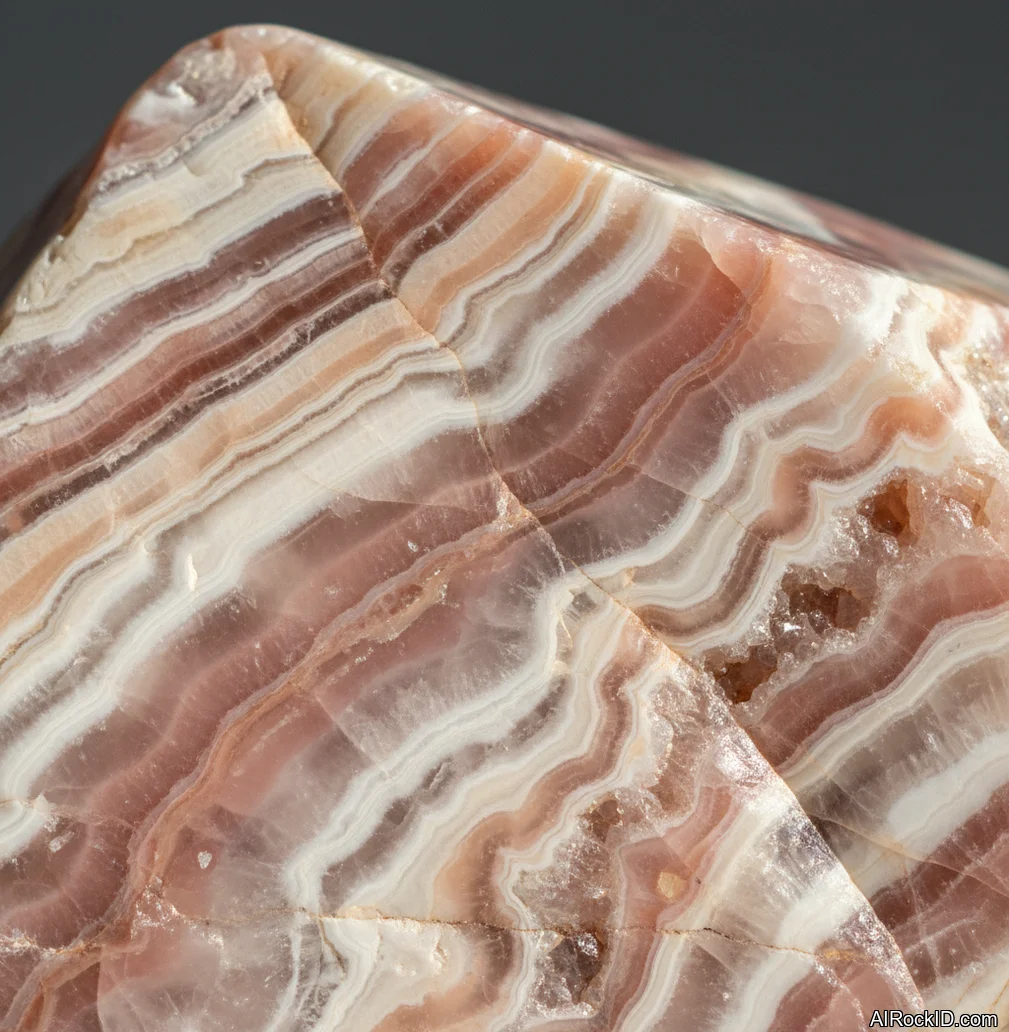
Hold a piece for a second and you can tell it’s softer than quartz without doing anything fancy. It just gives itself away. Polished, it has this smooth, almost creamy feel under your thumb, and the bands look like someone swirled a brush through strawberry milk and cream. And in my hand, the better stuff feels cool at first, then it warms up pretty quickly compared to agate.
Most of what you run into has been carved, tumbled, or cut into bowls and slabs, because those layers really pop on a flat, polished face. But don’t treat it like true onyx (the chalcedony kind). It scratches easier, the edges can bruise, and if you drop a thin carving on tile, you might hear that awful little “tick” that means it chipped. (You know the one.)
Origin & History
The word “onyx” comes from the Greek onyx, which means “claw” or “fingernail.” Kind of a weird image until you’ve seen those old banded stones used for cameos and seals, where the layers really do look like a nail edge when they’re cut and polished.
In proper mineral terms, “onyx” should be saved for banded chalcedony (microcrystalline quartz). But in the real world, especially around decorative stone yards where you’re looking at big slabs with saw marks still on the edges, “onyx” has been used for banded calcite for ages.
And nobody exactly sat down one day and “discovered” Pink Banded Onyx as some brand-new mineral, because it isn’t its own species. It’s calcite with attractive banding. Thing is, most dealers I know still call it onyx because people recognize that word, and you’ll commonly see tags like “Mexican onyx” or “Pakistan onyx,” depending on where the block was quarried.
Where Is Pink Banded Onyx Found?
Commercial blocks and carvings are commonly quarried in Mexico and Pakistan, with other decorative-stone sources in Turkey, Peru, and parts of the western United States.
Formation
This is a carbonate deposit that builds up when calcium-rich water snakes through little cavities and hairline fractures. Then the chemistry shifts a bit and calcite (or aragonite) drops out of the water in thin layers. That layering is what gives you the banding. Iron and manganese are usually what push it into those pink, peach, or salmon colors.
Look at the bands up close and you’ll notice they aren’t dead-flat the way agate bands tend to be. They can go wavy, feathery, sometimes sort of cloudy (like someone brushed milk through it). And if you’ve ever held a cut piece of cave flowstone or a stalagmite that’s been sliced open, it’s the same vibe. Same family of processes. Just sold in a form that fits the lapidary and decor market.
How to Identify Pink Banded Onyx
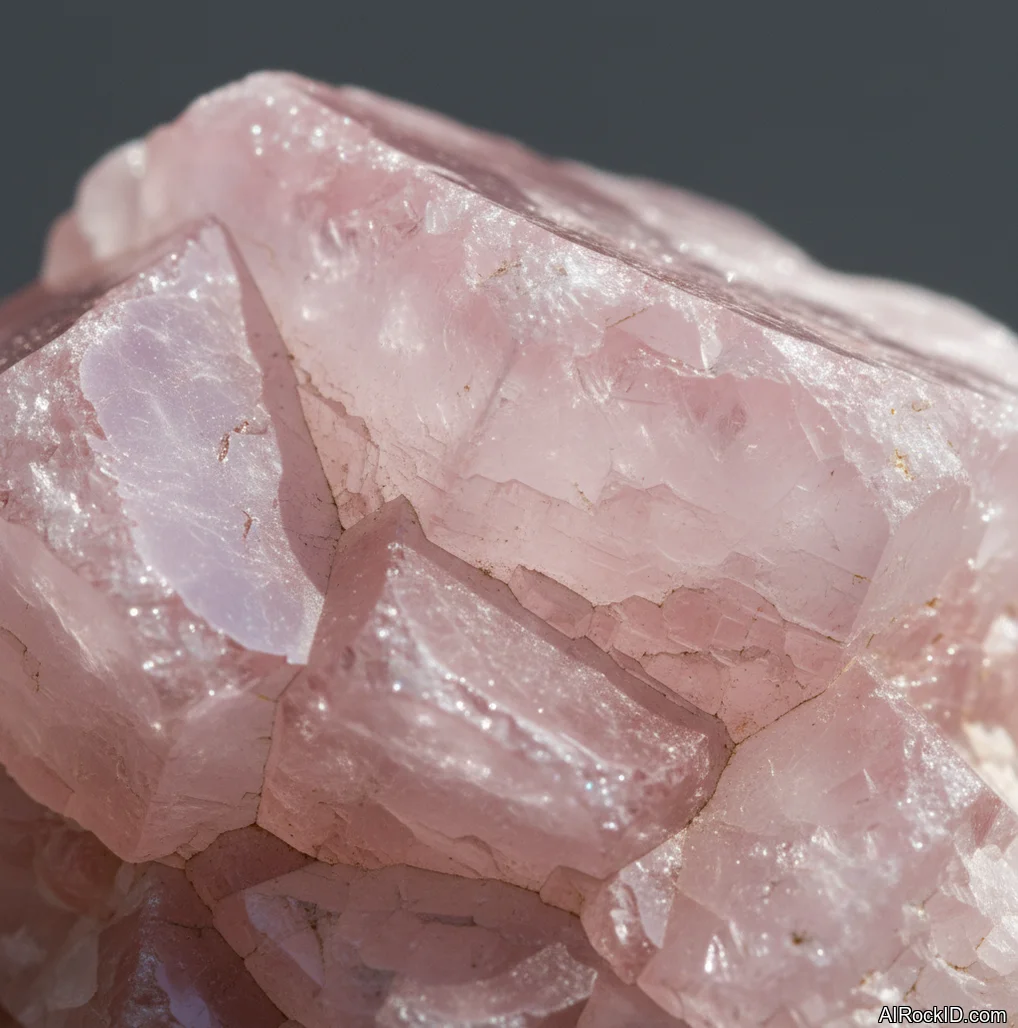
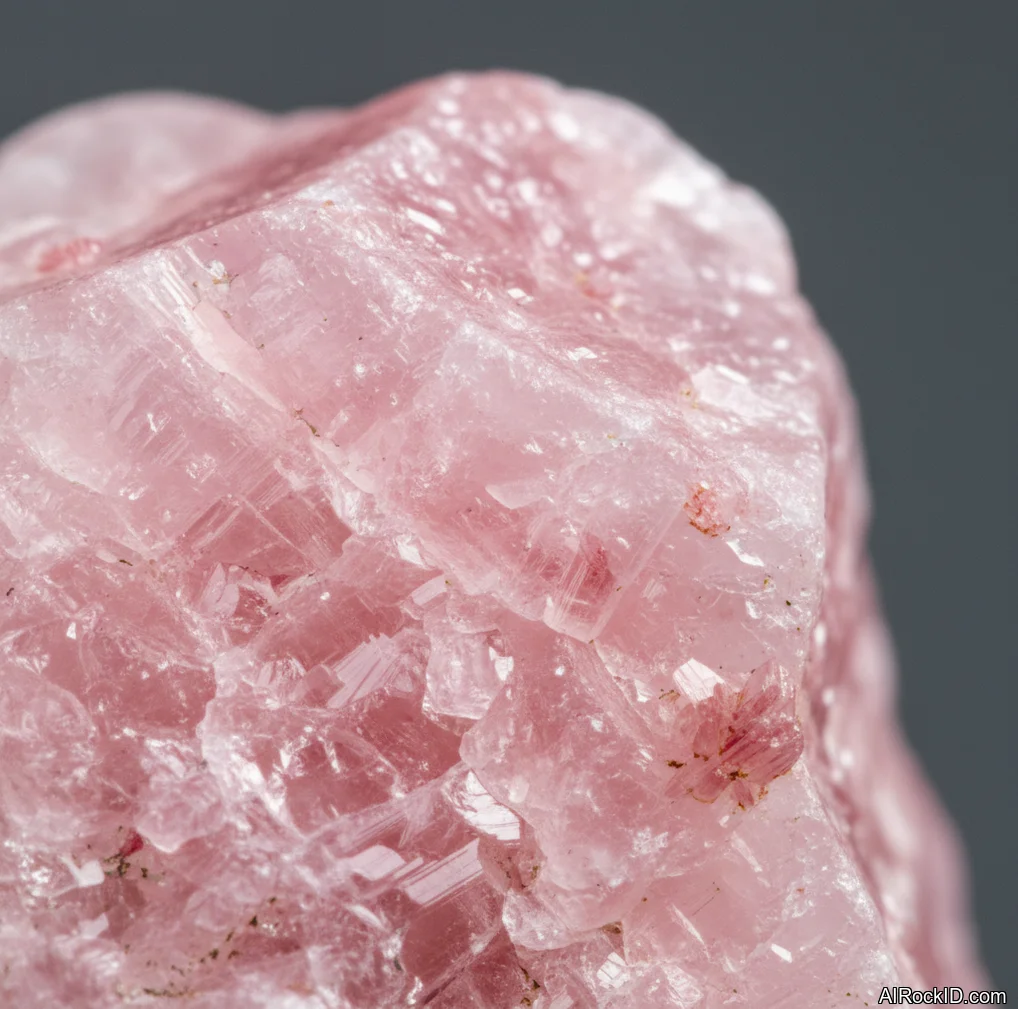
Color: Most pieces run pale pink to rose, with white or cream bands and occasional tan lines. The color is usually soft and milky rather than glassy-clear.
Luster: Polished surfaces show a vitreous to slightly waxy luster, while raw faces look dull to matte.
If you scratch it with a steel nail, it’ll usually mark, which is your first clue it’s calcite and not quartz onyx. Put a tiny drop of vinegar on an unpolished spot and you may see faint fizzing, especially if the surface is fresh. The real test is feel plus hardness: it doesn’t have that “hard, glassy” resistance agate has when you drag a point across it.
Properties of Pink Banded Onyx
Physical Properties
| Crystal System | Trigonal |
| Hardness (Mohs) | 3 (Soft (2-4)) |
| Density | 2.71 g/cm3 |
| Luster | Vitreous |
| Diaphaneity | Translucent |
| Fracture | Conchoidal |
| Streak | White |
| Magnetism | Non-magnetic |
| Colors | Pink, White, Cream, Peach, Tan |
Chemical Properties
| Classification | Carbonates |
| Formula | CaCO3 |
| Elements | Ca, C, O |
| Common Impurities | Fe, Mn, Mg |
Optical Properties
| Refractive Index | 1.486-1.658 |
| Birefringence | 0.172 |
| Pleochroism | None |
| Optical Character | Uniaxial |
Pink Banded Onyx Health & Safety
Pink Banded Onyx (calcite) is usually fine to handle, and a quick rinse or brief contact with water won’t hurt it. But don’t breathe in the dust if you’re cutting or grinding it (that chalky powder gets in your nose fast).
Safety Tips
When you’re shaping or polishing, keep things wet with water, and don’t skip the safety gear. Put on eye protection, and wear a proper respirator that’s actually rated for fine particulate (the kind that seals well, not a flimsy dust mask).
Pink Banded Onyx Value & Price
Price Range
Rough/Tumbled: $5 - $60 per palm stone/tumble
Cut/Polished: $1 - $8 per carat
Price mostly comes down to how crisp and tidy the banding looks, how deep the pink actually runs (washed-out pink doesn’t pull the same money), and if it’s a thick, carving-grade chunk that won’t surprise you with hairline cracks or those chalky, crumbly spots that show up when you rub it with your thumb.
Durability
Moderate — Scratch resistance: Fair, Toughness: Fair
It’s stable in normal household conditions, but it scratches easily and edges can chip or bruise if it gets knocked around.
How to Care for Pink Banded Onyx
Use & Storage
Store it away from harder stones like quartz and topaz, or it’ll get scratched in a mixed bowl. I keep calcite pieces in a soft pouch or wrapped in a cloth because the polish scuffs faster than people expect.
Cleaning
1) Rinse quickly with lukewarm water and a drop of mild soap. 2) Wipe with a soft cloth or a very soft toothbrush for grooves. 3) Dry right away; don’t soak it for long periods.
Cleanse & Charge
If you do energetic cleansing, stick to smoke, sound, or a quick rinse and dry. Salt soaks and acidic cleaners are a bad combo for calcite.
Placement
Looks best where light can skim across the bands, like a shelf with side lighting. Keep it out of splash zones near sinks if it’s a carved piece with thin edges.
Caution
Skip vinegar, lemon juice, bathroom cleaners, and any long soak in the sink. Acids etch calcite, and you’ll see the shine go flat fast (that dull, chalky look you can feel with a fingertip). And don’t just drop it loose in your pocket with keys or coins, unless you want it coming out scratched up.
Works Well With
Pink Banded Onyx Meaning & Healing Properties
In the shop, Pink Banded Onyx is one of those stones people keep reaching for when they want something soft-looking, but they also want it to feel solid in the palm. And I get it. The banding feels quiet, like stacked pages you can flip through at your own speed. After a long show day, when I’m back at the table sorting flats, I’ll sometimes leave a chunky piece sitting right there because that cool weight and the slick, polished face are weirdly calming in the most basic, physical way. Simple. Heavy. Real.
If you’re using it in a metaphysical way, I’d talk about it as emotional settling and building routine, not miracle stuff. It’s the kind of thing that fits alongside journaling, breath work, or anything where you’re trying to slow your reactions down (even a timer on your phone helps). But it’s still a rock. If you’re dealing with serious anxiety or health issues, that’s for a professional, and a pretty pink stone is just a support object. Helpful, maybe. A fix? No.
One practical thing people miss all the time: a lot of Pink Banded Onyx on the market has been dyed or “sweetened” to make the pink pop harder. Dyed pieces can look almost too perfect, like bubblegum stripes, and you’ll sometimes see the color pooling in tiny cracks or along little pits near the edge. I’ve also watched the color fade a bit after someone left a bowl in a sunny window for a whole season. So if you really love that exact shade, treat it the way you’d treat fabric. Some sunlight is fine. But don’t cook it. Why risk it?
Identify Any Crystal Instantly
Snap a photo and get properties, value, care instructions, and healing meanings in seconds.