Que Sera Galaxy Rhyolite
What Is Que Sera Galaxy Rhyolite?
Que Sera Galaxy Rhyolite is a silica-rich volcanic rock (rhyolite) sold under a trade name for its mottled, galaxy-like patterning.
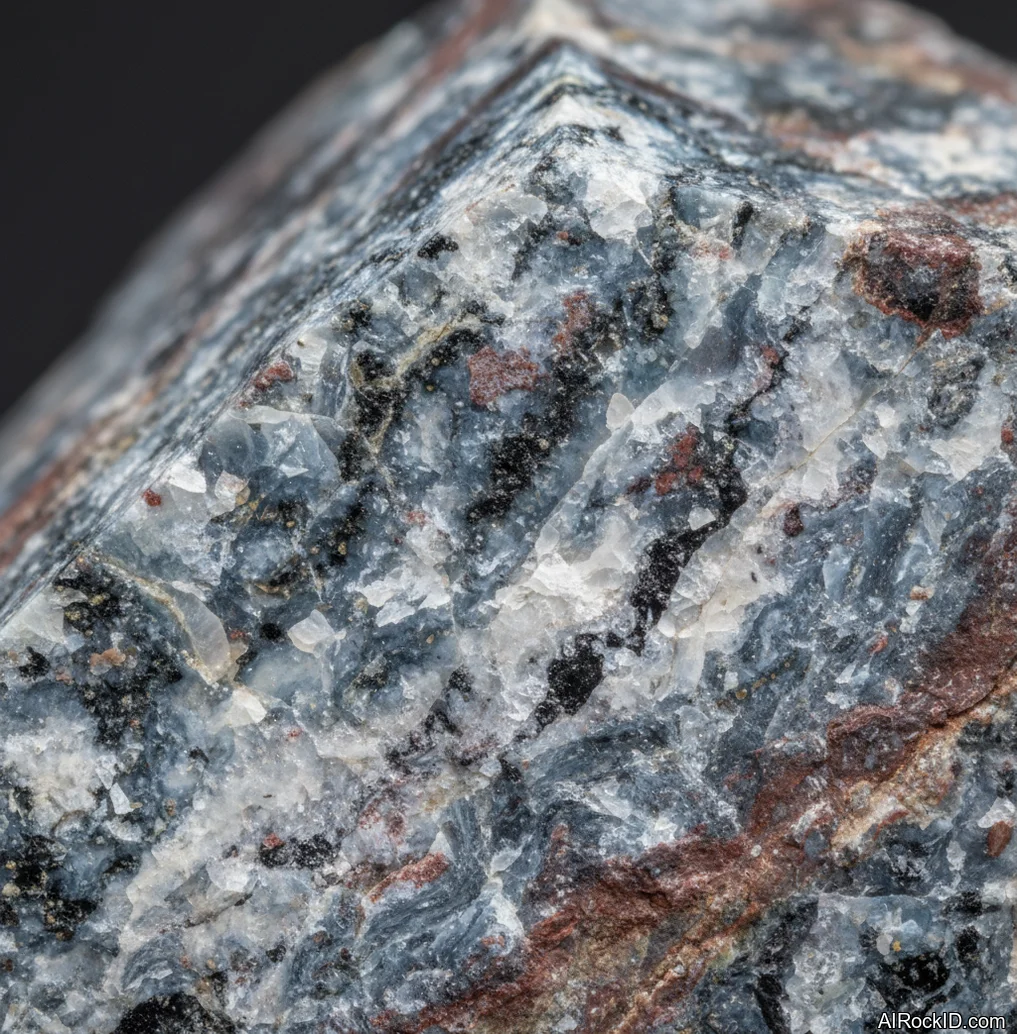
Grab a palm stone and you can tell right away it’s a real rock. Cool on your skin. A touch heavier than you’d guess, especially for how slick it gets after a good polish, and the pattern doesn’t have that printed, dyed look some material gets. Most pieces I’ve handled come out stormy blue-gray with cream and tan running through it, plus those tiny peppery dots you only really notice once you’re turning it in your fingers. Tip it under a shop light and the look shifts, not from glitter, but from contrast, like cloudy swirls sliding past each other.
And here’s the honest part: it’s not one single mineral with one neat set of properties. It’s a rock with a recipe that changes. So two stones both labeled “Que Sera” can feel like cousins, not twins.
Origin & History
“Que Sera” is a newer trade name you’ll see in the crystal world, not an official geologic variety name. Sellers usually slap it on a mottled rhyolitic rock, and it really took off with wholesalers and Instagram shops in the 2010s. Most of the time, the material gets reported as coming out of Brazil.
Rhyolite, though, has been in geology books since the 1800s. The name comes from Greek roots meaning “flow,” which fits because silica-rich lava can move slow and thick, then fold over on itself like paste. But “Galaxy” isn’t geology at all. It’s just a shop-floor nickname for that starry speckle look and the spacey color mix you notice once it’s been polished (the kind of shine that makes the little flecks pop when you tilt it under a lamp).
Where Is Que Sera Galaxy Rhyolite Found?
Most Que Sera material in the market is trade-reported from Brazil, commonly linked to Minas Gerais through dealer supply chains.
Formation
Rhyolite shows up when silica-rich lava erupts and then cools fast right at, or close to, the surface. Since it’s loaded with silica, the melt can turn really thick, trap gas, and move in streaky, swirled ribbons before it finally freezes in place. That’s a big part of where the “cloud” pattern comes from.
Look, if you study a few different pieces up close, you can tell it’s a messy mix. Some bits have tiny quartz or feldspar grains you can catch in the light if you tilt the slab, others have those darker iron-rich spots, and every so often you’ll run into micro-brecciated patches that look like the rock got bumped around while it was still hot. I’ve had a couple slabs where one face went glassy under the wheel, and the other side just wouldn’t clean up past a slightly patchy shine (same rock, just different micro-zones). How does that happen? That’s rhyolite for you.
How to Identify Que Sera Galaxy Rhyolite
Color: Typically blue-gray to gray with cream, tan, and white mottling and small darker speckles; patterning is swirly or clouded rather than banded.
Luster: Polished pieces show a waxy to vitreous surface shine, while rough surfaces look dull to slightly waxy.
Pick up two pieces side by side and compare the “depth” of the pattern. Real material looks like it has layers and cloudy pockets, not a flat printed design. If you scratch it with a steel nail, it usually won’t take the scratch easily, but it also doesn’t feel as glassy-hard as pure quartz. The problem with fakes is usually dye jobs: the blue can look too uniform and the white dots can look painted on, especially along cracks and drill holes.
Properties of Que Sera Galaxy Rhyolite
Physical Properties
| Crystal System | Amorphous |
| Hardness (Mohs) | 6-7 (Hard (6-7.5)) |
| Density | 2.4-2.7 |
| Luster | Waxy |
| Diaphaneity | Opaque |
| Fracture | Conchoidal |
| Streak | White |
| Magnetism | Non-magnetic |
| Colors | blue-gray, gray, cream, tan, white, black |
Chemical Properties
| Classification | Silicates |
| Formula | Variable (rock; commonly dominated by SiO2 with feldspars) |
| Elements | Si, O, Al, K, Na, Ca |
| Common Impurities | Fe, Mg, Mn, Ti |
Optical Properties
| Refractive Index | 1.48-1.54 |
| Birefringence | None |
| Pleochroism | None |
| Optical Character | Isotropic |
Que Sera Galaxy Rhyolite Health & Safety
It’s safe to pick up and it’s fine if it gets splashed or has brief contact with water. But if you cut it or grind it, you can kick up silica dust, that light, gritty powder that clings to your fingers. Don’t breathe that dust.
Safety Tips
If you’re shaping it, keep a bit of water on it, put on a real respirator (not a flimsy dust mask), and wipe the slurry off benches and floors while it’s still wet instead of letting it dry out and sweeping it up later.
Que Sera Galaxy Rhyolite Value & Price
Price Range
Rough/Tumbled: $5 - $40 per piece
Price mostly comes down to pattern contrast, how “galaxy” the speckling actually looks under light, and how clean the polish is when you tilt it and check for haze or tiny drag lines. And yeah, bigger freeforms and well-matched pairs run higher because finding good-looking rough in larger chunks (with the same vibe on both pieces) is just harder to sort.
Durability
Durable — Scratch resistance: Good, Toughness: Good
It’s generally stable in normal household conditions, but like most silica-rich rocks it can chip on sharp edges if you knock it off a shelf.
How to Care for Que Sera Galaxy Rhyolite
Use & Storage
Store it like you’d store jasper or agate: separated from softer stuff so it doesn’t scuff them, and padded if it has sharp corners. If it’s a tower, I keep it where it can’t get bumped.
Cleaning
1) Rinse with lukewarm water and a drop of mild soap. 2) Use a soft toothbrush to get into pits and little vugs. 3) Rinse well and dry with a towel; air-dry fully before putting it back on wood shelves.
Cleanse & Charge
For a simple reset, rinse and dry it, or leave it on a piece of selenite overnight. If you use sunlight, keep it short since heat can stress tiny fractures in any silica-rich rock.
Placement
I like it on a desk or near a work area because the pattern reads well in side light. A windowsill is fine, but don’t let it bake behind glass all summer if it has hairline cracks.
Caution
Skip ultrasonic cleaners and harsh acids. They can leave the surface feeling a bit sandpapery and open up tiny little pits you won’t notice until the light hits it just wrong. And if it’s drilled jewelry, don’t let it sit in water for days. Water can sneak into micro-fractures around the hole and turn it cloudy (kind of that milky look) until it finally dries out.
Works Well With
Que Sera Galaxy Rhyolite Meaning & Healing Properties
Most people reach for Que Sera Galaxy Rhyolite when they want something steady, but not dull. In my own stash, it’s the piece I snag when my brain’s pinballing and I need to land the plane. Not in a mystical fireworks way. More like, “sit down, breathe, pick the next tiny step.”
Grab a polished palm stone and run your thumb over it for a minute. It’s slick, almost like a worry stone that’s been handled a lot, but your eyes keep catching on the pattern, the swirls and speckles, like slow clouds sliding past. That mix is why it ends up in so many grounding and meditation kits, even for people who roll their eyes at big promises.
But look, I’ll say it straight: none of this is medical care. If you’re dealing with anxiety, sleep problems, or anything serious, treat it like a personal ritual object, not a stand-in for a professional. As a collector, I treat the “meaning” part as a way to aim my attention. The rock does the rock thing. You do the human thing. (Fair deal, right?)
Identify Any Crystal Instantly
Snap a photo and get properties, value, care instructions, and healing meanings in seconds.