Silver Lace Agate


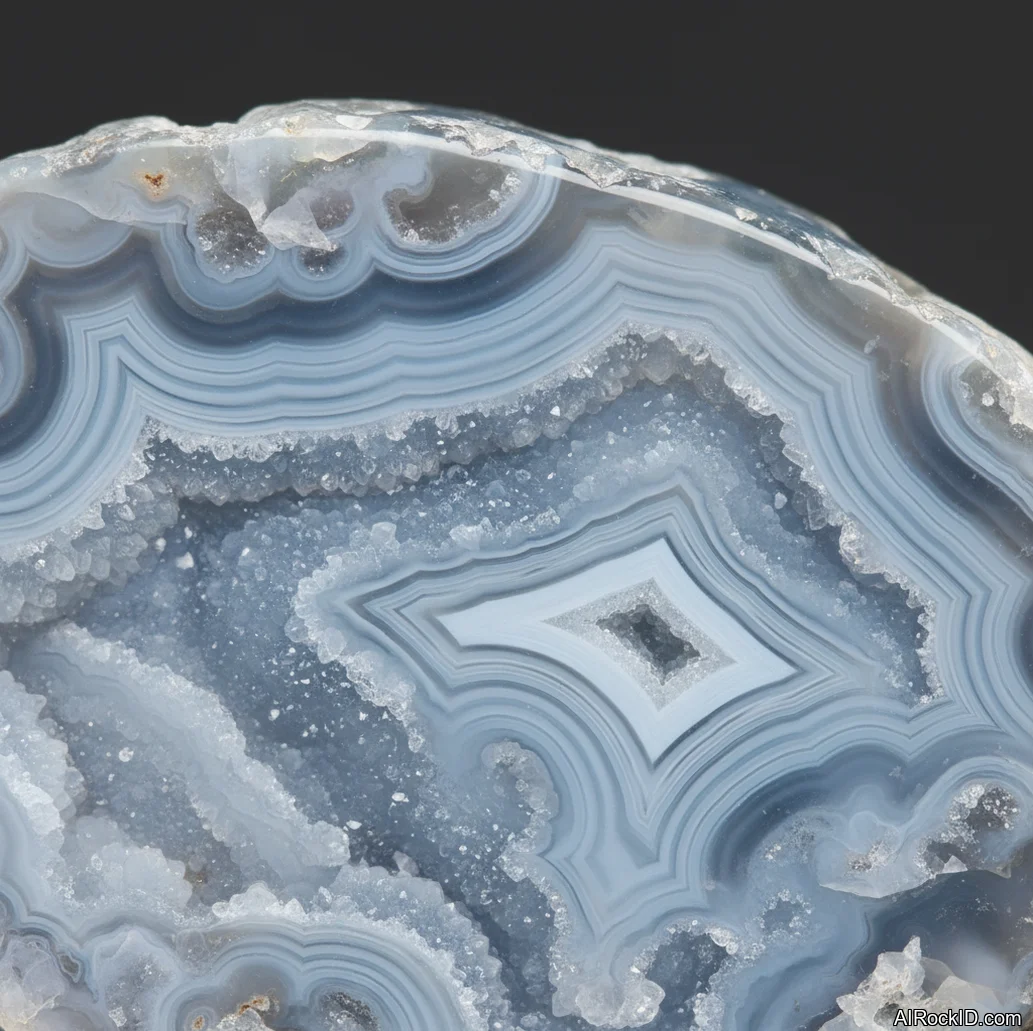
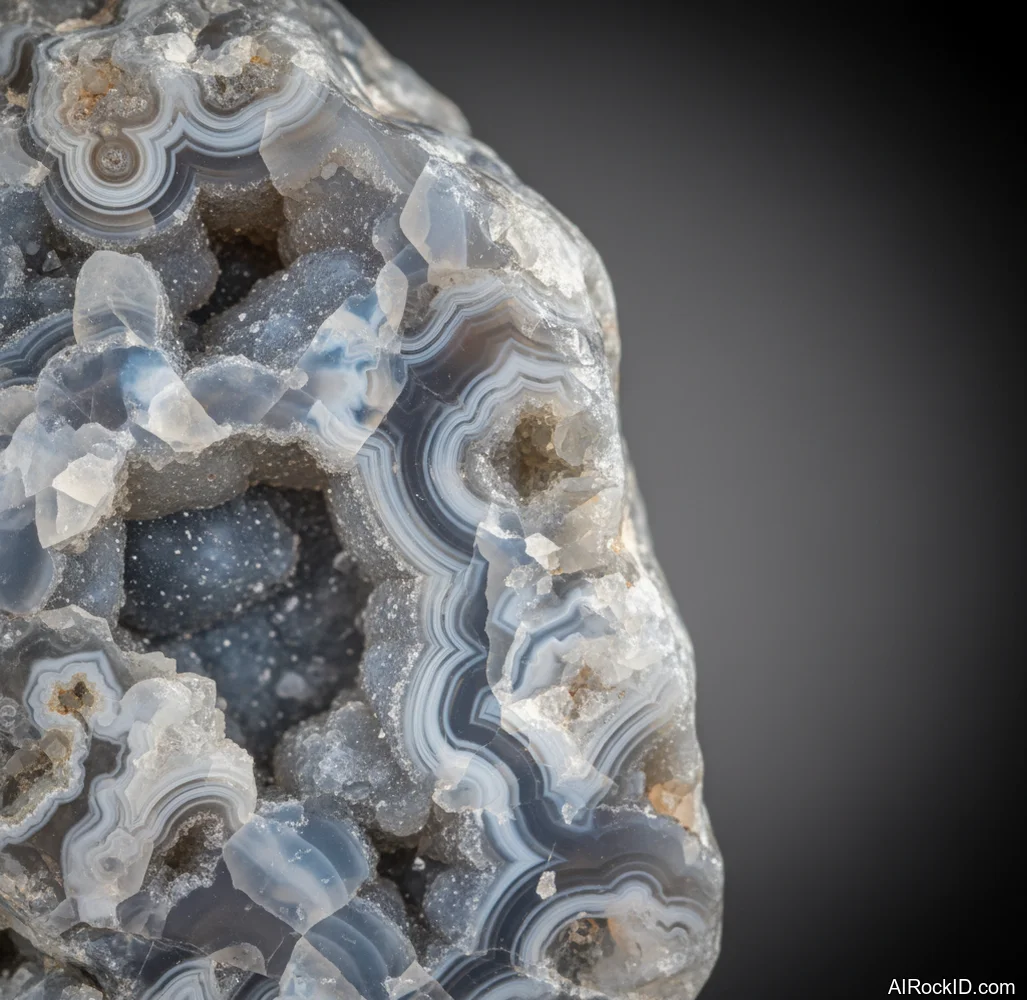
Quick answer: Silver Lace Agate is a gray, white, and silvery-looking banded agate valued for its lace-like patterns. It is best identified by its waxy chalcedony luster, fine banding, and hardness around 6.5–7 rather than by metallic shine.
AI Rock ID can help compare Silver Lace Agate with visually similar banded chalcedony, jasper, onyx, and dyed agate from a clear photo. RockIdentifier.io provides identification support, but final confirmation may still require hardness testing, close visual inspection, or a gemologist for valuable pieces.
Good fit
- Collectors who like gray, white, and silver-toned banding
- Jewelry buyers looking for durable cabochons, beads, or pendants
- Beginners who want an easy-care quartz-family material
- Display-piece buyers who prefer subtle neutral colors
Not a good fit
- Buyers looking for a naturally metallic silver mineral
- Anyone needing a rare or high-value investment gemstone
- People who want a transparent faceted gemstone
- Collectors who prefer bright, saturated colors
Most commonly confused with
- Botswana Agate: Often has gray, pink, brown, or apricot bands, while Silver Lace Agate is usually more neutral gray-white.
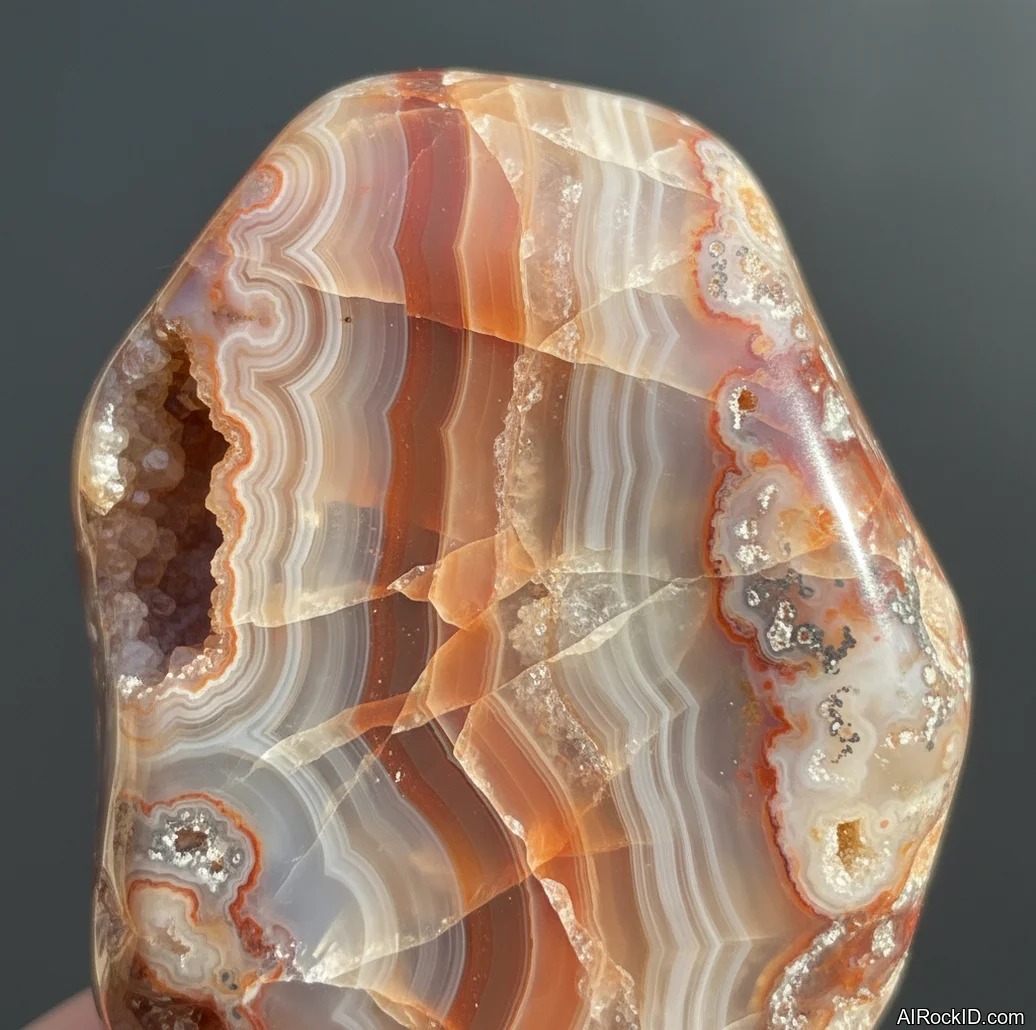
- Crazy Lace Agate: Usually shows busy swirling patterns with cream, red, yellow, or brown tones rather than silvery gray lace bands.
- Gray Agate: May be broadly gray with simpler banding, while Silver Lace Agate is named for fine lace-like patterning.
- Black Onyx: Typically appears solid black or sharply layered, not soft gray-white with lace-like agate bands.
Silver Lace Agate Lookalike Comparison
| Material | Typical Look | Key Difference |
|---|---|---|
| Silver Lace Agate | Gray, white, and silvery-looking lace bands | Waxy chalcedony luster; not truly metallic |
| Botswana Agate | Fine bands with gray, pink, brown, or apricot tones | Often warmer or more multicolored |
| Crazy Lace Agate | Busy swirls and irregular lace patterns | Usually cream, red, yellow, or brown rather than silver-gray |
| Black Onyx | Solid black or strong black-white layers | More uniform and higher contrast |
| Dyed Agate | Very even or unusually intense color | Color may pool in fractures or drill holes |
AI identification confidence
AI identification confidence is usually moderate for Silver Lace Agate when the photo clearly shows fine gray-white banding and a polished chalcedony surface. Confidence drops when the piece is tumbled, overexposed, heavily dyed, or photographed under cool lighting that makes ordinary gray agate look silver.
When AI gets it wrong
- The photo is taken under strong blue, silver, or reflective lighting
- Only one close-up area is shown and the full banding pattern is not visible
- The stone is dyed, coated, or resin-stabilized
- The sample is a bead or cabochon with no natural surface or edge visible
Final recommendation
Choose Silver Lace Agate for its calm gray-white banding, durable quartz-family hardness, and suitability for polished jewelry or display pieces. For buying, prioritize natural-looking band patterns, clean polish, and seller transparency about dyeing or treatments.
How to Check Silver Lace Agate Before Buying
Look for fine gray, white, and translucent bands with a waxy to vitreous polish. Avoid pieces with color concentrated in cracks, drill holes, or surface pits if the seller claims the stone is completely natural. A uniform metallic silver coating is not typical of natural agate and may indicate plating, paint, or another decorative treatment.
Natural vs. Dyed Silver Lace Agate
Natural Silver Lace Agate usually has soft gray-white banding with subtle contrast. Dyed agate may show sharper artificial color, staining along fractures, or darker color around bead holes. Dye disclosure matters most for collectors and jewelry buyers who want untreated material.
Best Photo Tips for Identification
Photograph Silver Lace Agate in daylight or neutral white light on a plain background. Include one close-up of the banding, one full-stone image, and one image showing the edge or surface texture. Avoid flash glare because polished agate can reflect light and hide diagnostic banding.
What Is Silver Lace Agate?
Silver Lace Agate is a banded variety of chalcedony (microcrystalline quartz) with fine gray, white, and silvery, lace-like layers.
Grab a palm stone and you notice the feel before you even really see it. It stays cool in your hand longer than glass does, and the polish has that slightly waxy quartz slickness, not that plasticky shine some tumbled stuff gets. The banding is the whole reason anyone cares. On good pieces, the lines are tight and even, like somebody ran a pencil over the surface a hundred times, then softened it with a breath of fog (hard to explain, but you know it when you see it).
People sometimes expect it to look like Blue Lace Agate, just “silver.” But it’s usually moodier than that. You’ll get smoky grays, milky whites, and sometimes a faint tan or brown seam where iron got involved. And since it’s agate, cutters slice it to show the pattern at its best, so the exact same rough can look totally different depending on the slice. Funny how that works, right?
Origin & History
“Silver lace agate” is just a trade name. It isn’t a formally defined mineral species. Dealers use it for gray banded agate that has that lacy, ribbon-like look, the kind you can actually see as tight, rhythmic bands when the stone’s been cut and polished and the surface gets that smooth, slightly glassy feel.
And the whole “lace” thing didn’t come out of nowhere. Blue Lace Agate sold really well, so sellers leaned into the same naming style, mostly because customers already had a handle on what “lace” meant in agate terms.
Agate itself has been described and traded for a very long time. The name traces back to the Achates River (now the Dirillo) in Sicily, where banded stones were collected in antiquity. Silver Lace Agate doesn’t have one famous discovery story the way some minerals do, but it still sits in that same agate tradition: lapidary use, carving, seals, and later on, cabbing and beads. What else would you do with a stone that takes a polish like that?
Where Is Silver Lace Agate Found?
Most “silver lace” on the market is cut from banded chalcedony found in volcanic and sedimentary settings, with a lot of commercial material moving through Brazil and the USA.
Formation
Look at the bands up close and it’s basically a slow, repetitive filling job. Agate forms when silica-rich fluids slip through cavities or fractures, then leave behind tiny, micro-layers of chalcedony over time. It reminds me of mineral scale crusting up inside an old pipe, except this is happening in little rock pockets, and the layers can take ages to pile up.
Raw pieces from volcanic areas often began as gas bubbles trapped in lava, and later those spots turn into small geodes or seam agates. The chemistry nudges a bit, the flow rate speeds up or drags, and small amounts of iron or other trace stuff drift in, which is how you end up with alternating light and darker lines. But here’s the thing: not every gray banded agate gets called “silver lace.” That name usually sticks to material where the banding is really fine and textile-like, not the thick, chunky fortification bands.
How to Identify Silver Lace Agate
Color: Silver Lace Agate ranges from light gray and white to smoky charcoal bands, sometimes with beige or brown seams. Bands are usually thin and parallel, with a soft, lacy look.
Luster: Polished surfaces show a waxy to vitreous luster typical of chalcedony.
If you scratch it with a steel nail, it shouldn’t take the scratch easily. A real piece will feel cool and dense in the palm, and the polish won’t feel greasy or soft like resin. The real test is the banding depth: tilt it under a lamp and you should see layers that look like they continue below the surface, not just a printed pattern.
Common Look-Alikes
Silver Lace Agate is sometimes confused with these materials:
- Botswana Agate (tight gray/white banding, often sold in the same bins)
- Crazy Lace Agate (busier lace patterns; sometimes mislabeled as “silver lace” when it’s mostly gray)
- Gray/White Onyx marketed as “onyx marble” (banded calcite or aragonite, softer and more translucent)
- Dyed banded agate/chalcedony (gray stones pushed toward charcoal or “silver” with dye)
- Banded glass or “smoke glass” cab material (too uniform, bubbles or flow lines under a loupe)
Market Cautions & Treatments
When AI Can Get This Wrong
In photos, AI mixes Silver Lace Agate up with Botswana agate and gray banded calcite sold as onyx because all three read as gray-white stripes under shop lighting. The real test is hardness: Silver Lace Agate should scratch glass cleanly, while calcite “onyx” will scuff and powder with a steel blade and won’t hold a crisp scratch line. A quick loupe check helps too, agate bands look like tight, micro-grain layers, but glass may show flow lines or tiny bubbles that cameras miss.
Properties of Silver Lace Agate
Physical Properties
| Crystal System | Trigonal |
| Hardness (Mohs) | 6.5-7 (Hard (6-7.5)) |
| Density | 2.58-2.64 |
| Luster | Waxy |
| Diaphaneity | Translucent to opaque |
| Fracture | Conchoidal |
| Streak | White |
| Magnetism | Non-magnetic |
| Colors | Silver, Gray, White, Smoky gray, Beige, Brown |
Chemical Properties
| Classification | Silicates |
| Formula | SiO2 |
| Elements | Si, O |
| Common Impurities | Fe, Mn, Al |
Optical Properties
| Refractive Index | 1.530-1.540 |
| Birefringence | 0.004 |
| Pleochroism | None |
| Optical Character | Uniaxial |
Silver Lace Agate Health & Safety
Silver Lace Agate is non-toxic, so you can handle it without worrying, and it’s totally fine around water in normal use. But if you’re cutting or grinding it, that’s when you need to be careful, because the real hazard is breathing in silica dust (that fine, chalky grit that sticks to your fingers and leaves a dusty film on the tool).
Safety Tips
If you’re going to cut or grind this stuff, don’t do it dry. Run plenty of water, keep the area ventilated (a fan pulling dust away helps), and wear a real respirator rated for fine silica dust, not just a paper mask.
Silver Lace Agate Value & Price
Price Range
Rough/Tumbled: $5 - $40 per piece
Cut/Polished: $1 - $8 per carat
Tight, crisp bands with punchy contrast usually drive the price up, especially when the cutter’s lined the slice up just right to get the most “lace” (you can see it the second you tilt it under a light). Big slabs with that same pattern running clean and consistent across the whole face cost more than little tumbled stones.
Durability
Durable — Scratch resistance: Excellent, Toughness: Good
It’s stable in normal household conditions, but the polish can dull if it’s stored rubbing against harder quartz or gritty dust.
How to Care for Silver Lace Agate
Use & Storage
Keep it in a soft pouch or a divided box if you’ve got a bunch of quartz pieces together. Agates are hard, but they can still scuff each other’s polish over time.
Cleaning
1) Rinse with lukewarm water to remove grit. 2) Use a drop of mild soap and your fingers or a soft brush, then rinse well. 3) Dry with a soft cloth so water spots don’t haze the shine.
Cleanse & Charge
If you do energetic cleansing, running water or a quick smoke cleanse works fine, and moonlight won’t hurt it. I skip long sunny windowsills because heat can stress some dyed or treated agates.
Placement
On a desk or nightstand, it reads as calm and neutral because the color doesn’t scream for attention. And it photographs well under soft light if you like sharing your pieces.
Caution
If the piece has fractures or it’s been glued into a jewelry setting, skip the harsh cleaners and don’t toss it in an ultrasonic cleaner either. And if you’re cutting or sanding it, don’t breathe in the dust (it gets everywhere, even that fine powder you end up wiping off the bench). Why risk it?
Works Well With
Silver Lace Agate Meaning & Healing Properties
Next to the loud, flashy stones, Silver Lace Agate is basically the quiet background music you forget is even on until it’s gone. Folks who are into agates tend to reach for it when they want something steady and not too spiky. And in my own stash, it’s the one I grab when I’m sorting flats at a show, my fingers are dusty from handling slabs, and my brain’s just cooked. Cool stone. Simple pattern. It slows me down.
Most dealers talk about it the same way they talk about other banded agates: steadiness, smoothing out emotional swings, keeping your words measured. I can live with that as a vibe, not some guarantee. If somebody’s telling you it’ll “fix” anxiety or replace therapy, come on, that’s a sales pitch. But as a tactile tool? Yeah, it works. Those fine little stripes give your eyes something repetitive to lock onto, and that can feel grounding in a totally normal human way (no magic required).
Thing is, the market gets messy because “silver lace” gets thrown around pretty loosely, and some gray agates are dyed to punch up the contrast. Dyed pieces aren’t evil. They just feel different to me. Natural material tends to have softer transitions and this cloudy depth you can actually see when you tilt it under a lamp and the bands sort of shift as the light moves. So if you’re using it for meditation, or you just want something to fidget with in your pocket, pick the one that feels best in your hand. That matters more than any label, honestly.
Common mistakes
- Assuming any gray banded agate is Silver Lace Agate without checking the lace-like pattern
- Mistaking a silvery surface reflection for natural metallic content
- Overlooking dye in cracks, pits, or bead holes
- Calling black-and-white onyx Silver Lace Agate when the banding is sharp and uniform
- Judging authenticity from color alone instead of banding, luster, hardness, and treatment signs
Identify Silver Lace Agate from a photo
Compare Silver Lace Agate traits, care tips, value clues, and common lookalikes with a clear photo.