Sonora Sunrise
What Is Sonora Sunrise?
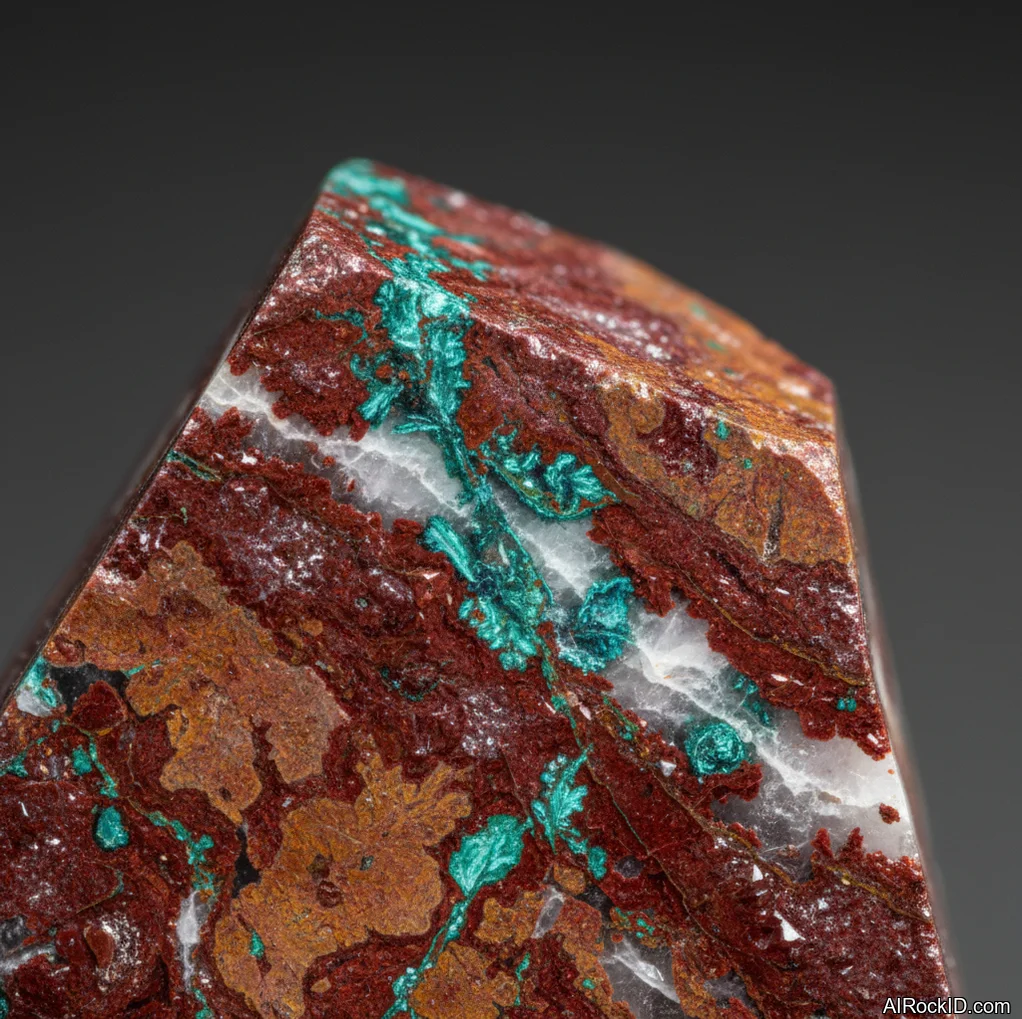
Sonora Sunrise is a copper-rich lapidary rock, built out of red cuprite sitting in blue-green chrysocolla, and every so often you’ll spot black tenorite in there too.
Pick up a decent slab and the first thing that hits you is the heft. It feels weirdly heavy for how small it is. The polish on the chrysocolla goes slick and almost glassy under your thumb, but the cuprite reads different, like little red islands floating in a blue-green pool.
People glance at it and call it a “stone,” but it’s really a mix. And honestly, that mix is the whole deal. The nicest pieces have sharp contrast: true brick red (not that rusty brown) against blue that tips more turquoise than green. But you’ll also run into scrappier material where the colors smear together and turn kind of muddy, and that’s the stuff you see dumped in cheap buckets at shows.
Origin & History
Most dealers I’ve talked to trace the name “Sonora Sunrise” back to the lapidary world, tied to material coming out of Sonora, Mexico that got marketed for that sunrise color combo. I started seeing it all the time on dealer tables in the 1990s and 2000s, usually cut as cabs and those small polished freeforms you can feel warm up in your palm, not really as true “specimens.”
Thing is, the mineral components were described long before anybody slapped a trade name on it. Cuprite (Cu2O) has been known as a copper ore mineral for centuries. And chrysocolla has been used for ages too, a copper silicate gel-like material that shows up around old copper workings (that dusty blue-green stuff in the cracks). The trade name stuck because it’s way easier to remember than “cuprite in chrysocolla,” and honestly, it matches what your eye sees. Why fight it?
Where Is Sonora Sunrise Found?
Sonora Sunrise is sold as material from Sonora in northwestern Mexico, typically from copper-oxide zone workings and nearby lapidary rough sources.
Formation
Look at the colors for a second and you’re basically reading a weathering story. This stuff forms in the oxidized zones of copper deposits, right up near the surface where copper-bearing fluids can creep through fractures and tiny pore spaces. Oxygen does most of the work. And as the conditions shift, the copper minerals change into new forms.
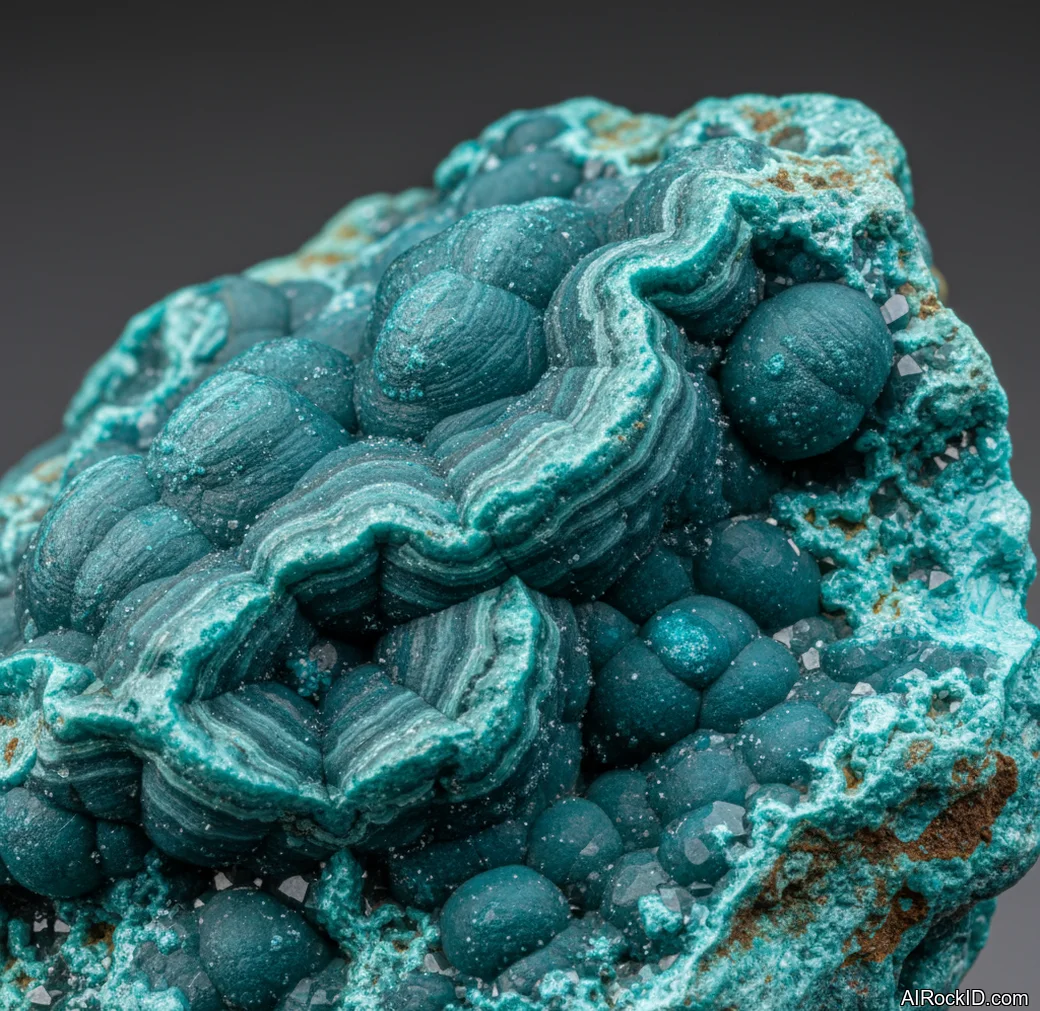
The red, more crystalline chunks are usually cuprite. The blue-green material, on the other hand, is often chrysocolla, and it tends to smear, fill gaps, and coat everything as a more massive matrix (almost like a thin paint layer in spots).
And those little black seams or peppery specks you sometimes catch when you tilt the rock in the light? That’s commonly tenorite (CuO) or other dark copper oxides. The overall pattern can come out brecciated, blotchy, or vein-like, depending on how the rock got cracked up in the first place and then glued back together by later copper-rich fluids.
How to Identify Sonora Sunrise
Color: Typical Sonora Sunrise shows brick-red to cherry-red cuprite against blue-green chrysocolla, often with scattered black tenorite streaks or dots. Colors are usually opaque and high-contrast when the material is good.
Luster: Polished pieces range from waxy to vitreous, depending on how silica-rich and well-cemented the chrysocolla is.
Pick up a piece and tilt it under a strong light. Real cuprite areas stay a solid red and don’t “flash” like glass or resin, while dyed composites often look too even and too saturated. The real test is the feel: good Sonora rough is cool to the touch and has that dense copper-mineral heft, not the lightweight warmth you get with plastic or resin blocks. And if you’ve got a loupe, check the borders between red and blue. Natural material usually has messy, irregular boundaries, not crisp cartoon outlines.
Properties of Sonora Sunrise
Physical Properties
| Crystal System | Cubic |
| Hardness (Mohs) | 3.5-4 (Soft (2-4)) |
| Density | 3.6-4.0 g/cm3 |
| Luster | Waxy |
| Diaphaneity | Opaque |
| Fracture | Uneven |
| Streak | Reddish brown to greenish (varies by area) |
| Magnetism | Non-magnetic |
| Colors | brick red, cherry red, blue-green, turquoise, black |
Chemical Properties
| Classification | Oxides and silicates (mixture) |
| Formula | Cu2O + (Cu,Al)2H2Si2O5(OH)4·nH2O (mixture) |
| Elements | Cu, O, Si, H, Al |
| Common Impurities | Fe, Mn |
Optical Properties
| Refractive Index | 1.90-2.85 |
| Birefringence | None |
| Pleochroism | None |
| Optical Character | Isotropic |
Sonora Sunrise Health & Safety
Handling is usually fine. But the moment you start cutting, grinding, or sanding, you can kick up copper-bearing dust. I’ve seen that fine powder settle on the bench and cling to your fingertips (and it gets in the creases). So, keep it wet when you can, and use basic dust control. It really does matter.
Safety Tips
Use water while you’re shaping or polishing (it keeps the dust down and the grit from flying everywhere). And for lapidary work, wear a respirator that actually fits right, not one that leaks around your nose when you breathe in. Then wash your hands after you’ve handled rough stone or slurry, especially once that gray paste has dried on your fingers.
Sonora Sunrise Value & Price
Price Range
Rough/Tumbled: $10 - $80 per piece
Cut/Polished: $3 - $20 per carat
Prices climb fast when the red and blue are crisp and clean, there aren’t many fractures, and the polish doesn’t dig in and “orange peel” the softer spots. And yeah, big, solid hunks of stable rough cost more, because they hold together, unlike those thin, cracky slabs that practically beg to chip the second you touch an edge.
Durability
Moderate — Scratch resistance: Fair, Toughness: Fair
It can take a nice polish, but the mixed hardness means edges and thin points are the first things to bruise or chip.
How to Care for Sonora Sunrise
Use & Storage
Store it so it can’t knock into harder stones. I keep mine in a padded tray because the cuprite-heavy corners love to get tiny dings.
Cleaning
1) Rinse quickly in lukewarm water. 2) Use a drop of mild soap and your fingers or a very soft brush on polished surfaces. 3) Pat dry and let it air dry fully before putting it away.
Cleanse & Charge
Smoke cleansing and sound are both low-risk options for this material. If you use moonlight, keep it out of harsh sun since some chrysocolla-rich pieces can look a little duller after long window time.
Placement
Looks best where light rakes across the polish from the side, not straight down. A shelf spot at eye level shows off the red-blue boundary lines way better.
Caution
Skip ultrasonic cleaners, strong acids, or going at it with a stiff brush, especially if the surface is rough or pitted. That’s where stuff can catch and you’ll end up grinding the high spots down while the little pits just hold onto whatever you’re trying to remove. And if you’re doing any lapidary work, handle it the way you would copper-mineral material. Keep the dust under control. Seriously, you don’t want that fine powder floating around (it gets everywhere).
Works Well With
Sonora Sunrise Meaning & Healing Properties
Next to a lot of the “pretty blue stones” out there, Sonora Sunrise just feels… planted. It’s heavy. Dense. The kind of weight you notice right away when it drops into your palm. When I carry a palm stone of it, I don’t mess with it as much. I mostly just hold it like a worry stone, thumb sliding over the slick blue, then catching on those red patches.
In crystal-healing circles, people tie the blue-green chrysocolla side to calm communication, and the red cuprite side to drive and stamina. I keep that idea pretty down-to-earth. If a stone gets you to slow your breathing and actually pay attention for a minute, that’s useful. But it’s not medicine. And it’s not going to replace therapy, sleep, or real treatment. Come on.
But here’s the part people rarely say plainly: this stuff is a mix, so different pieces feel different because they literally are different. Some are mostly chrysocolla with just a couple red freckles. Some are cuprite-heavy and darker, almost moody-looking. So, if you’re picking one for personal work, don’t buy from a stock photo. Hold it if you can. The one that clicks is usually obvious in about ten seconds.
Identify Any Crystal Instantly
Snap a photo and get properties, value, care instructions, and healing meanings in seconds.