Tiger Eye
What Is Tiger Eye?
Tiger Eye is a chatoyant type of quartz. It forms when fibrous crocidolite gets replaced by silica, but the stone hangs onto that silky, banded texture.
Pick up a decent palm stone and you feel it right away. Cool to the touch. Cooler than glass, at least at first. And if it’s polished well, it’s got that slick, almost slippery feel like it might scoot right out of your fingers if your hands are a little dry. Tip it under a lamp and that bright “eye” slides across the surface like someone’s sweeping a small flashlight back and forth. That moving stripe is the whole trick. In real life, a good Tiger Eye looks weirdly alive, but in a flat photo it can come off kind of… meh.
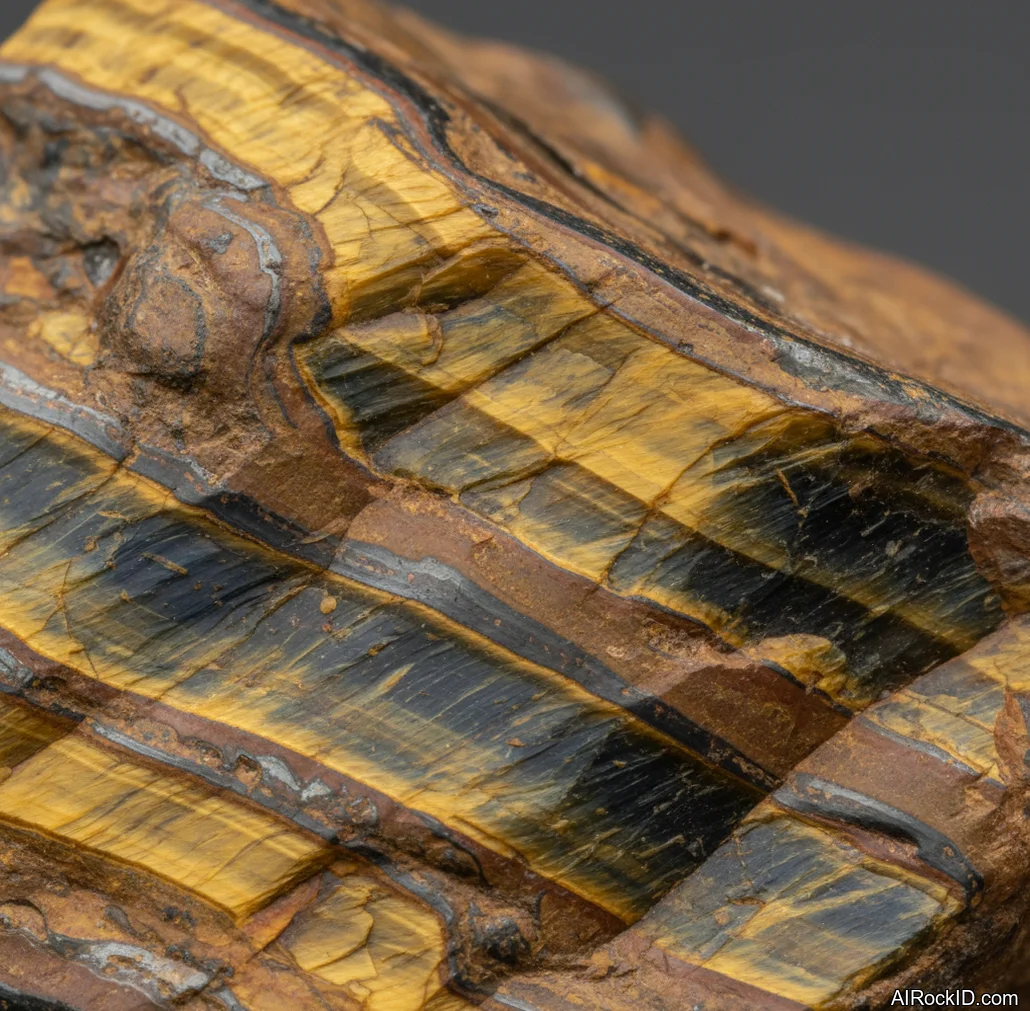
Most of what you’ll run into in shops is cut as cabochons, beads, or tumbled stones, because the effect needs a curved surface to really show off. Raw chunks are around too, but they’re usually dull on the outside, and you won’t see the full shimmer until you cut it or polish a face. And yes, it’ll scratch glass. Not instantly like corundum, but if you press down and drag it, it leaves a mark.
Origin & History
“Tiger Eye” isn’t some strict mineral species name. It’s basically a straight-up description used in the gem trade, and yeah, it’s literal: you get that eye-like band of light sliding across the surface, the same little optical trick you see in cat’s-eye stones.
In older lapidary and mineral books, it’s usually described as quartz after crocidolite, and the iron oxides are what give it that familiar golden-to-brown look. And it’s been used forever for beads, carvings, and seal-type stones, mostly because it’ll take a really hard, glassy polish (the kind you can feel when you run a fingertip over it) and the pattern still pops even from across a room.
Where Is Tiger Eye Found?
Most commercial Tiger Eye on the market is sourced from South Africa, with other material coming from Australia, Namibia, India, and smaller deposits elsewhere.
Formation
Out in the field, Tiger Eye traces back to an iron-rich, fibrous amphibole called crocidolite that later gets swapped out for silica. Thing is, that swap doesn’t just bulldoze everything. It happens slowly enough that the original fiber structure stays put, almost like the stone keeps the crocidolite’s “grain” even after it’s gone.
So what you’re holding ends up being quartz, but it still has that tight, aligned, hair-like texture running through it. And that alignment is the whole trick behind the chatoyancy, the cat’s-eye sheen you see when you tilt it under the sun (or even a headlamp).
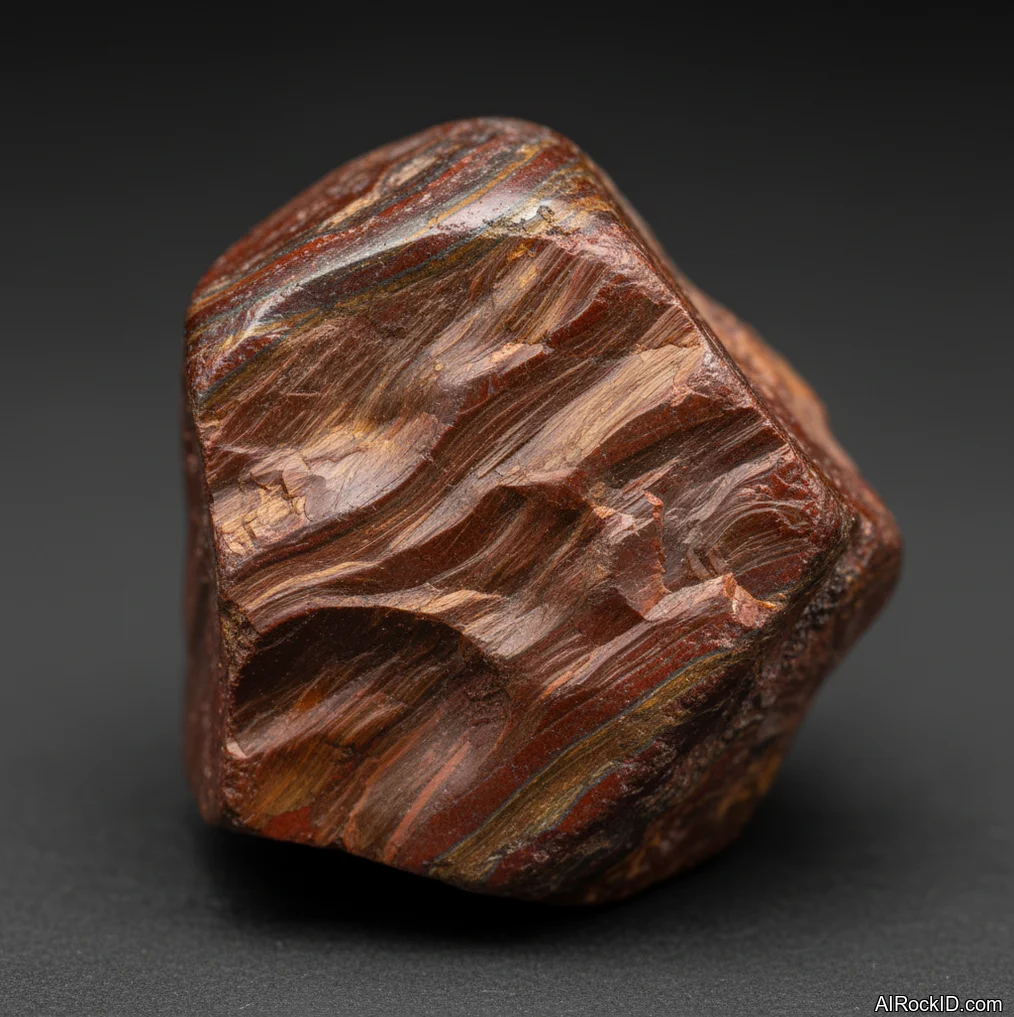
The color comes from iron oxides and hydroxides staining the material during or after the silica replacement. That’s why the classic pieces land in that honey-gold to deep brown range. But if the iron chemistry shifts, you’ll see red Tiger Eye with more hematite influence, or a blue-gray “Hawk’s Eye” where the oxidation hasn’t gone as far. And yeah, the fiber structure is still the backbone of all of it.
How to Identify Tiger Eye
Color: Most Tiger Eye ranges from golden yellow to caramel brown, often with darker brown bands; some pieces show red tones or a blue-gray base (often sold as Hawk’s Eye).
Luster: Silky to vitreous, with a bright moving band of reflected light on polished surfaces.
Look closely at the “eye” band and rotate the stone under one light source. On real Tiger Eye, the band is tight and directional, not a glittery sparkle in every direction. The real test is warmth: many plastic or resin fakes feel warm fast, while a real quartz-based stone stays cool for a bit. And if you scratch it with a steel nail, you shouldn’t get much of a mark, but the nail will slide and leave metal streak before it actually gouges the stone.
Properties of Tiger Eye
Physical Properties
| Crystal System | Trigonal |
| Hardness (Mohs) | 6.5-7 (Hard (6-7.5)) |
| Density | 2.60-2.65 g/cm3 |
| Luster | Silky |
| Diaphaneity | Opaque |
| Fracture | Conchoidal |
| Streak | white |
| Magnetism | Non-magnetic |
| Colors | golden yellow, honey, brown, reddish brown, blue-gray |
Chemical Properties
| Classification | Silicates |
| Formula | SiO2 |
| Elements | Si, O |
| Common Impurities | Fe |
Optical Properties
| Refractive Index | 1.544-1.553 |
| Birefringence | 0.009 |
| Pleochroism | Weak |
| Optical Character | Uniaxial |
Tiger Eye Health & Safety
Tiger Eye’s generally fine to handle, and for everyday stuff it’s also fine in water. Just treat it like you would any other quartz stone. And if you’re cutting or grinding it, don’t breathe in the dust.
Safety Tips
If you’re doing lapidary work, keep water running on the cut. Seriously. Make sure you’ve got decent ventilation, too, because that rock dust gets everywhere (you’ll find it on the bench, on your hands, in your nose). And don’t cheap out on the mask. Use a proper respirator rated for fine particulates.
Tiger Eye Value & Price
Price Range
Rough/Tumbled: $3 - $30 per tumbled stone/palm stone
Cut/Polished: $1 - $10 per carat
Price mostly comes down to how strong the chatoyancy is, how clean the polish looks under light, and whether the banding stays tight, straight, and consistent. Big cabochons with that “eye” dead-center (the kind that snaps on and off as you tilt it in your hand) and hardly any fractures go for more than pieces that look flatter or have patchy, uneven areas.
Durability
Durable — Scratch resistance: Good, Toughness: Good
It holds up well in daily wear, but sharp blows can chip edges because quartz has conchoidal fracture.
How to Care for Tiger Eye
Use & Storage
Keep it in a pouch or a separate compartment if it’s polished jewelry, because it can still get scuffed by harder stuff like corundum or diamond. I don’t leave mine rattling around in a mixed bowl with metal chains.
Cleaning
1) Rinse with lukewarm water and a drop of mild soap. 2) Use a soft toothbrush to get oils out of grooves or drill holes. 3) Rinse well and dry with a microfiber cloth to bring the band back.
Cleanse & Charge
If you do ritual-style cleaning, running water and a quick wipe works fine. I avoid long salt soaks mainly because it’s pointless and can rough up settings, not because the stone can’t take it.
Placement
Angle matters. Put it where a single light source hits it from the side, and the eye will roll when you move past it. Flat overhead lighting can make it look dead.
Caution
Skip harsh cleaners and ultrasonic machines on set jewelry. They can rattle things loose, especially prongs, or put extra stress on tiny fractures you might not even see unless you catch the light just right. And don’t leave it sitting in direct sun for weeks on end if you care about the color staying consistent. A windowsill does it faster than you’d think.
Works Well With
Tiger Eye Meaning & Healing Properties
Tiger Eye comes off as a “confidence stone” right away, and honestly, that’s exactly how I’ve watched people use it. They’ll grab one before an interview, an exam, day-one jitters, stuff like that. And the look isn’t just for show. When the banding is crisp and you can spot the little flash (the “eye”) without turning it forever, it’s pretty easy to stare at it for a second, breathe, and let your shoulders drop.
But look, the market side gets messy. Some sellers talk about it like it fixes everything, and that’s where people end up annoyed. What it can do, in a practical way, is give you a physical reminder you can keep on you. It’s smooth, has that cool-to-warm shift when it’s been in your hand a minute, and it’s got a nice weight for its size. I’ve carried a Tiger Eye worry stone on long drives, and that slick surface plus the way the band flips when you roll it under your thumb gave my brain something to lock onto besides spiraling.
So if you’re using it in a metaphysical way, I’d keep it simple and grounded: focus, boundaries, staying steady when you’re being pulled in six directions. And thing is, if you’re dealing with real anxiety or panic, treat the stone like a routine tool, not a substitute for medical care. A crystal can’t do therapy for you. It just can’t.
Identify Any Crystal Instantly
Snap a photo and get properties, value, care instructions, and healing meanings in seconds.