Red Tiger Eye
What Is Red Tiger Eye?
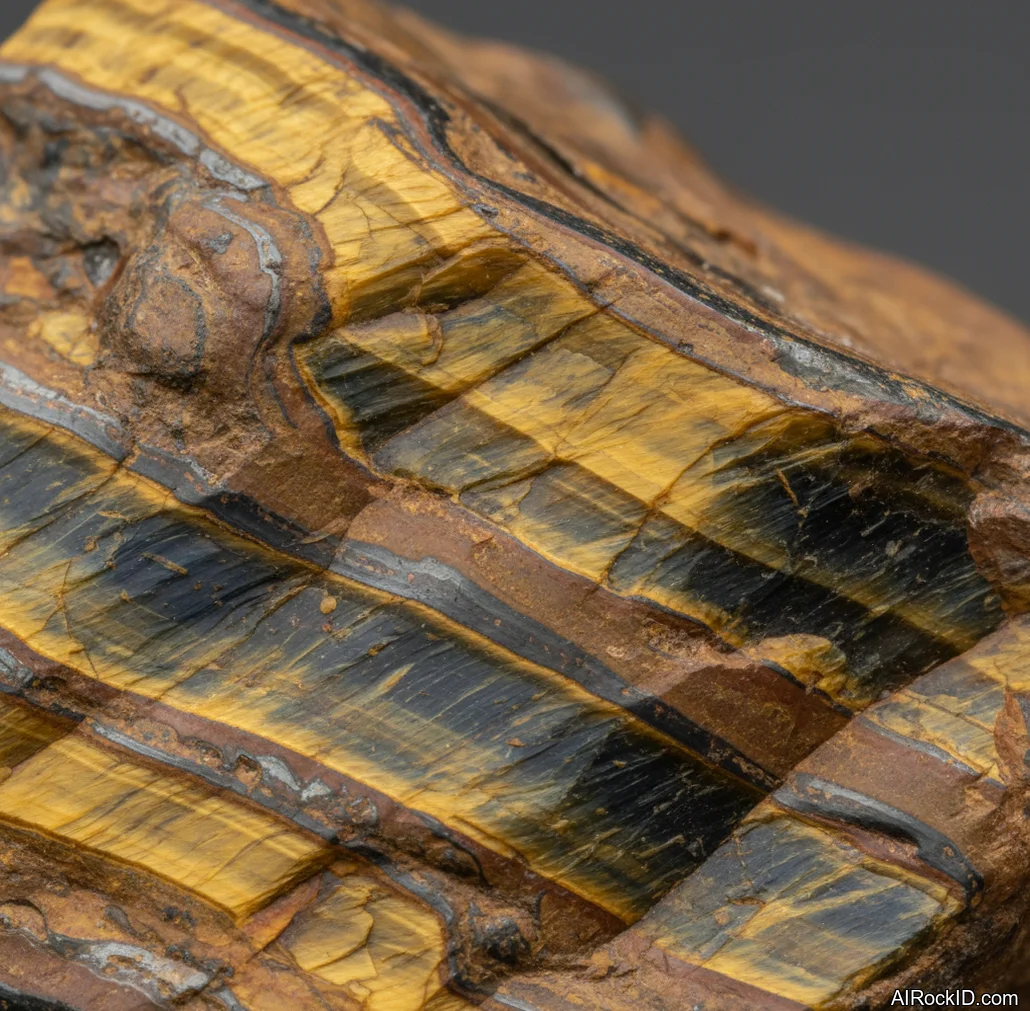
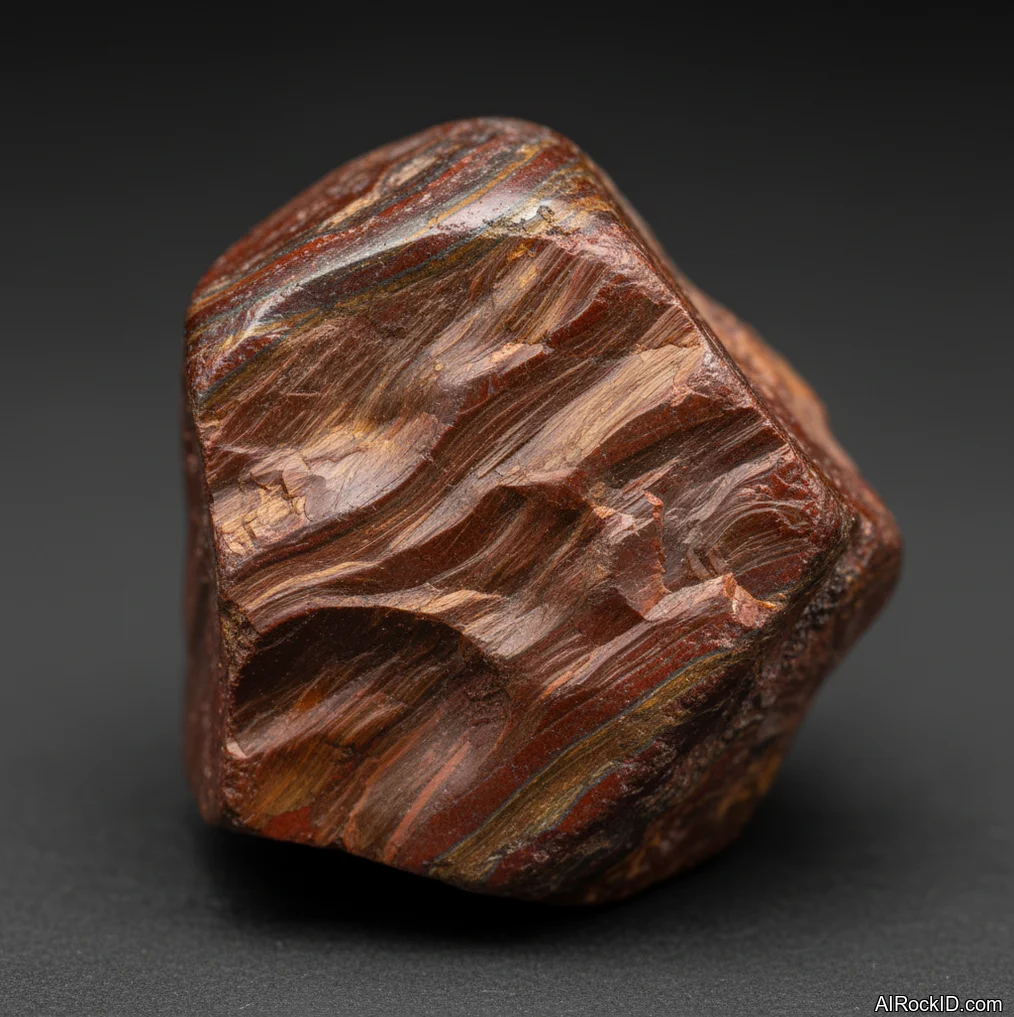
Red Tiger Eye is a red-brown, chatoyant kind of quartz. It forms from fibrous material, and that’s what gives it that moving band of light.
Pick up a tumbled piece and you feel it right away. Smooth, sure, but it’s not that cold, slick glassy smooth. It’s got a slightly waxy drag under your thumb (especially along the curve where it’s been polished the most). And it sits a little heavier than people expect for its size, like it’s got some honest density. When the light hits it, that bright line slides across the surface like a flashlight beam. I’ve bought plenty at shows where the seller calls it “natural red,” but most of the red pieces sitting in bowls on dealer tables have been heated from golden tiger eye. That doesn’t make it fake. Just common.
At first glance it can look like mahogany obsidian, or even a weirdly banded jasper. But the giveaway is the “eye.” Tilt it slowly under a single overhead LED and you’ll see that silky band tighten up, then spread out again. If the band looks painted on and doesn’t move, something’s off. And if the color is screaming cherry red with no brown at all, I start asking questions. Why so loud?
Origin & History
Tiger eye, as a name, starts popping up in the 1800s gem trade, and it’s tied to that cat’s-eye look people were already hunting down in chrysoberyl. Red Tiger Eye is basically just the trade’s color-variant label. And you’ll also see it called ox eye or bull’s eye, especially if you’re flipping through older bead catalogs with those tiny type blocks.
There’s no single “first describer” here like you’d get with a brand-new mineral species, because it’s quartz at the end of the day. Thing is, the story is really about how the lapidary crowd ended up sorting it out: golden tiger eye, blue hawk’s eye, plus the red material that’s either naturally oxidized or turned red by heat. Most dealers won’t say the quiet part out loud, but in my experience, most of the red stuff on the market is heat-treated golden tiger eye.
Where Is Red Tiger Eye Found?
Most commercial tiger eye comes out of southern Africa, with other material from Australia, India, Brazil, China, and the western United States. Red material is often produced by heating golden tiger eye, so the “where” can be the same as regular tiger eye.
Formation
Look closely at a banded piece and you’re basically staring at an old fiber bundle that got swapped out for silica. The classic model is quartz replacing fibrous crocidolite (a blue amphibole) but keeping that tight, parallel, hair-like texture, the kind you can almost “see” run the length of the stone when you tilt it under a lamp. Those packed fibers are what give you chatoyancy. Light hits, then snaps back in one direction, like a narrow stripe sliding across the surface.
The red color usually comes from iron oxides. Sometimes it happens the slow, natural way as the material weathers and oxidizes, shifting golden-brown into deeper red-brown over time. But a lot of the red on the market is that same oxidation pushed fast with heat, which nudges the iron coloring into more of a brick-red tone. And you can spot it sometimes in the strands: the banding looks fantastic, but the color’s a little too even. Like every piece in the lot matched a paint chip, right down to the last slice.
How to Identify Red Tiger Eye
Color: Red Tiger Eye runs from rust red to deep red-brown, usually with darker brown or black bands. The best pieces still show some golden or bronze tones at the edges when you tilt them.
Luster: Silky to vitreous with a strong chatoyant sheen.
Pick up the stone and rotate it under one light source. A real piece shows a single moving “eye” band that slides cleanly across the surface. If you scratch it with a steel knife, it shouldn’t take a scratch easily, but it will scratch glass with a bit of effort. The problem with dyed imitations is the color collects in tiny pits and along fractures, so check with a loupe around edges and drill holes on beads.
Properties of Red Tiger Eye
Physical Properties
| Crystal System | Trigonal |
| Hardness (Mohs) | 6.5-7 (Hard (6-7.5)) |
| Density | 2.60-2.65 g/cm3 |
| Luster | Silky |
| Diaphaneity | Opaque |
| Fracture | Conchoidal |
| Streak | White |
| Magnetism | Non-magnetic |
| Colors | Red-brown, Rust red, Mahogany, Reddish bronze, Brown, Black |
Chemical Properties
| Classification | Silicates |
| Formula | SiO2 |
| Elements | Si, O |
| Common Impurities | Fe |
Optical Properties
| Refractive Index | 1.544-1.553 |
| Birefringence | 0.009 |
| Pleochroism | Weak |
| Optical Character | Uniaxial |
Red Tiger Eye Health & Safety
As a finished, polished stone you can hold in your hand, Red Tiger Eye is low risk and non-toxic. The one thing to watch out for? Dust in the air if you’re grinding or cutting it (that fine powder that hangs around and you can taste in the back of your throat).
Safety Tips
If you’re doing lapidary work, stick with wet cutting, and don’t skip the respirator. You want one that’s actually rated for silica dust, not just a flimsy paper mask that goes soft and sweaty on your face after five minutes.
Red Tiger Eye Value & Price
Price Range
Rough/Tumbled: $3 - $30 per piece
Cut/Polished: $1 - $10 per carat
Pricing mostly comes down to how crisp the chatoyancy looks, how clean the polish is (no hazy spots or those tiny drag lines you catch when you tilt it under a lamp), and the size. Super dark pieces can look kind of flat in low light, so the brighter, bandy material usually moves faster.
Durability
Durable — Scratch resistance: Good, Toughness: Good
It holds up well in daily wear, but a hard knock can chip an edge because quartz fractures conchoidally.
How to Care for Red Tiger Eye
Use & Storage
Store it in a soft pouch or separate slot so it doesn’t get scuffed by harder stuff like corundum or diamond. If it’s a polished slab, I keep paper between pieces so the faces don’t rub.
Cleaning
1) Rinse with lukewarm water and a drop of mild soap. 2) Gently scrub with a soft toothbrush, especially around grooves or bead holes. 3) Rinse well and dry with a microfiber cloth.
Cleanse & Charge
If you do the metaphysical side, smoke cleanse or a quick rinse works fine. I avoid leaving it baking in direct sun for days, mostly because the polish can look tired over time.
Placement
On a desk it looks best where a single lamp can hit it from the side, so the eye actually moves. In a bowl of tumbles, it disappears unless the light is strong.
Caution
Skip harsh chemicals and ultrasonic cleaners, and don’t just drop it loose in your pocket rattling around with keys. Heat can mess with the color (you can literally see the tone shift), so don’t leave it baking on a car dashboard if you want it to stay the exact same shade.
Works Well With
Red Tiger Eye Meaning & Healing Properties
Most people who pick up Red Tiger Eye are after a specific feeling: steady, sparked, ready to get moving. In shop talk, it gets linked to motivation and confidence, like a little push to quit circling the idea and just do it already. And honestly, I get the appeal. Just looking at it feels like motion, that chatoyant band sliding across the surface like it’s in a hurry.
But I’m pretty practical about it. If you use crystals as a focus object, Red Tiger Eye works because it’s visually active. You can sit there, turn it in your hand, roll it between your fingers, and that sheen keeps grabbing your attention and pulling it back. That’s half the fight when you’re trying to concentrate. I’ve handed it to customers who fidget nonstop, and they’ll start rubbing that bright band with their thumb without even noticing. It’s a real, physical interaction. Not magic.
One catch, though. People expect the red version to feel more intense than regular golden tiger eye, and they can read a ton into that expectation. If your piece is heat-treated (and yeah, lots are), it doesn’t change how it wears or how the “eye” looks, but some collectors care for labeling reasons. And look, none of this is medical advice. If you’re dealing with anxiety, pain, or anything serious, crystals can be a comfort object, sure, but they’re not a replacement for treatment.
Identify Any Crystal Instantly
Snap a photo and get properties, value, care instructions, and healing meanings in seconds.