Villiaumite
What Is Villiaumite?
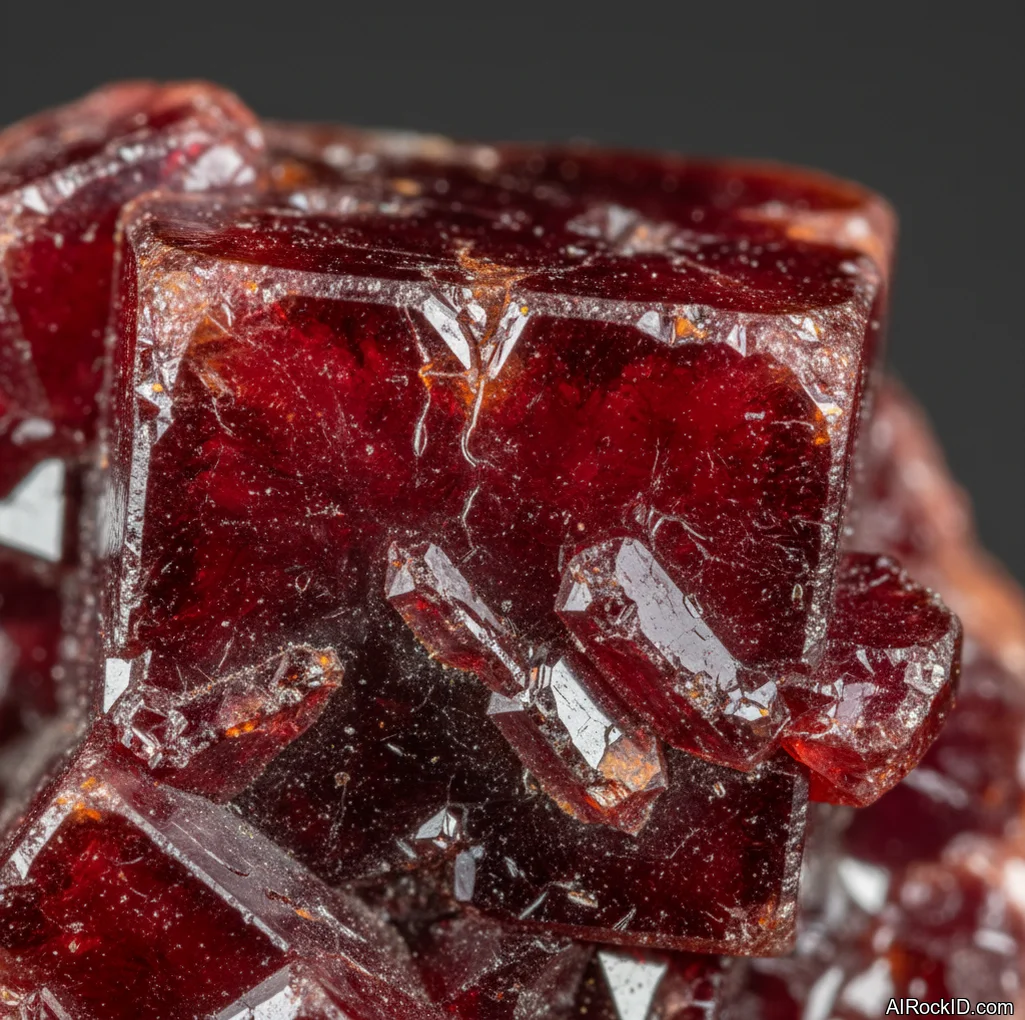
Villiaumite is a seriously rare halide mineral made of sodium fluoride (NaF), and people mostly know it for those red to orange-red crystals.
Hold an actual piece and two things jump out right away. One, it feels weirdly light for something that looks so solid. Two, it’s soft enough to make you tense up, like you’ve got a hard candy in your fingers and you’re one bad squeeze away from a little red crunch. Most specimens I’ve had in hand show that glassy, almost wet-looking shine when you catch a fresh face in the light, but the skin of it dulls out quick if it’s been rattling around in a box with tougher minerals (you can kind of see the scuffed, cloudy patches along the edges).
People mix it up at first with red halite, red fluorite, or small bits of cinnabar or realgar when they’re sorting through a mixed lot. But villiaumite just feels different. You can tell there’s cleavage, and every so often you’ll get those clean little breaks that hint at a cubic habit, yet it doesn’t have that properly blocky look that good halite can show. And the annoying bit? Leave it in strong light and some pieces fade. Not all of them, but I’ve watched a bright red chip shift toward orange and look kind of washed out after a season sitting on a sunny shelf.
Origin & History
Villiaumite got its official write-up in 1908, based on material from the Los Archipelago off Guinea in West Africa. The name’s a nod to Maxime Villiaume, a French colonial administrator who picked up specimens in the area and made sure they ended up in scientific hands instead of just disappearing into someone’s drawer.
Collectors mostly ignored it for ages. It usually isn’t a “showy cabinet” mineral, and it can be fussy to keep looking good (it doesn’t always stay clean and crisp once it’s out in the open, which is annoying). But then clean crystals started turning up from places like Mont Saint-Hilaire in Canada, plus a few alkaline complexes in Russia, and that’s when it earned that “grab it when you see it” reputation. Because, honestly, how often do you run into one you’ll get another shot at in the next few years?
Where Is Villiaumite Found?
Villiaumite turns up in alkaline igneous complexes and related rocks, with classic collector material from Mont Saint-Hilaire (Canada), Lovozero (Russia), and Ilímaussaq (Greenland).
Formation
Most of the villiaumite you see in collections comes out of alkaline complexes, and that isn’t some coincidence. Villiaumite shows up late, when the system’s gone sodium-heavy, there’s fluorine in the mix, and the chemistry starts getting a little strange. Think nepheline syenites. Or pegmatitic zones. Or those tight little pockets where the very last fluids get squeezed out, then cool down and start spitting out oddball halides and carbonates.
And if you actually pay attention to what it’s sitting next to, the whole story’s right there. It hangs around sodalite, nepheline, aegirine, natrolite, plus the other usual “alkaline suite” suspects. I’ve seen it as tiny scattered grains peppered through the matrix, and I’ve also seen the cleaner, easier-to-spot crystals tucked back in vugs where nothing’s been grinding on them. The sharpest faces almost always come from those protected pockets (no surprise). But once it’s exposed? It doesn’t take much. It’s soft, a bit sensitive, and it picks up etching and scuffs fast. Who hasn’t watched a nice surface go dull quicker than expected?
How to Identify Villiaumite
Color: Most villiaumite is red to orange-red, sometimes leaning pinkish or brick-red, and it can be translucent to transparent in small crystals.
Luster: Fresh surfaces are vitreous, but worn pieces turn dull pretty quickly.
If you scratch it with a copper coin, it’ll mark more easily than you expect for something that looks glassy. The real test is to check the setting and association minerals: villiaumite in alkaline rock matrix with sodalite or nepheline makes a lot more sense than a lone “red crystal” in a random parcel. And don’t do the water test people love with halite. Villiaumite isn’t a bath crystal and water can mess it up.
Properties of Villiaumite
Physical Properties
| Crystal System | Cubic |
| Hardness (Mohs) | 2-2.5 (Soft (2-4)) |
| Density | 2.79-2.82 |
| Luster | Vitreous |
| Diaphaneity | Transparent to translucent |
| Fracture | Uneven |
| Streak | White |
| Magnetism | Non-magnetic |
| Colors | Red, Orange-red, Pinkish red, Brick red |
Chemical Properties
| Classification | Halides |
| Formula | NaF |
| Elements | Na, F |
| Common Impurities | Ca, Mg, Fe |
Optical Properties
| Refractive Index | 1.326 |
| Birefringence | None |
| Pleochroism | None |
| Optical Character | Isotropic |
Villiaumite Health & Safety
Handling it is okay as long as your hands are clean and you’re gentle, but treat it like you would any fluoride: don’t breathe in the dust, and keep it out of reach of kids and pets. And don’t get it wet. Water can mess up the specimen (you’ll see it start to look dull or chalky) and it can also carry dissolved fluoride.
Safety Tips
Wash your hands after you handle it. Keep it in a closed box (lid that actually snaps shut, not the loose kind). And don’t cut it, grind it, or tumble it unless you’ve got proper PPE on and real dust control in place.
Villiaumite Value & Price
Price Range
Rough/Tumbled: $30 - $400 per specimen
Cut/Polished: $15 - $80 per carat
Price jumps around a lot depending on color, clarity, and if the crystal faces are still protected by the matrix. Clean, transparent red crystals are hard to find. And because the mineral’s so soft, even a little nick or rub (the kind you get just from sliding it across foam in a box) can tank the value fast.
Durability
Fragile — Scratch resistance: Poor, Toughness: Poor
Villiaumite is very soft and can degrade or fade with rough handling, moisture, and prolonged bright light.
How to Care for Villiaumite
Use & Storage
Keep it in a perky box or a closed display case, separate from anything harder that can scratch it. I also keep mine out of sunny windows because fading is real on some pieces.
Cleaning
1) Skip water and soaps. 2) Use a dry, soft brush or a clean air blower to remove dust. 3) If there’s grime, wipe lightly with a barely damp microfiber, then dry right away and don’t soak the specimen.
Cleanse & Charge
For a “no drama” cleanse, use smoke, sound, or a quick pass over a selenite plate without leaving it in humidity. Avoid salt bowls and running water.
Placement
A shaded shelf or closed cabinet is best, especially if the crystal is transparent and strongly colored. If you display it, keep it away from heat vents and humid bathrooms.
Caution
Don’t soak villiaumite. Don’t drop it into elixirs. And don’t tumble it, either. Skip scratch tests too. If a bit chips off and you see that fine, powdery dust clinging to the edge (it sticks like flour), don’t breathe it in. Why risk it?
Works Well With
Villiaumite Meaning & Healing Properties
Next to the usual shop crystals, villiaumite feels like a specialist mineral, not an everyday carry. When I pick up a clean red piece, it hits my eyes as sharp and bright, like a mental highlighter that you can’t ignore. Short sessions are better. Ten minutes is plenty, then it goes right back in the box.
But I’m careful about the stories people spin around it. Villiaumite is literally sodium fluoride, so I’m not doing any water “charging,” no soaking, and I don’t want it living in my pocket all day. As a sit-and-look stone, though, I’ve used it for focus while journaling, just propped where I can see it. The color alone does half the work. It yanks your attention in.
If you use crystals in a metaphysical way, I’d treat this more like a display ally than a daily companion. I’ll set it next to calmer pieces when my brain’s already running hot (because, yeah, that happens). And if anything medical is going on, this is personal practice and tradition, not treatment.
Identify Any Crystal Instantly
Snap a photo and get properties, value, care instructions, and healing meanings in seconds.