Angel Aura Quartz
What Is Angel Aura Quartz?
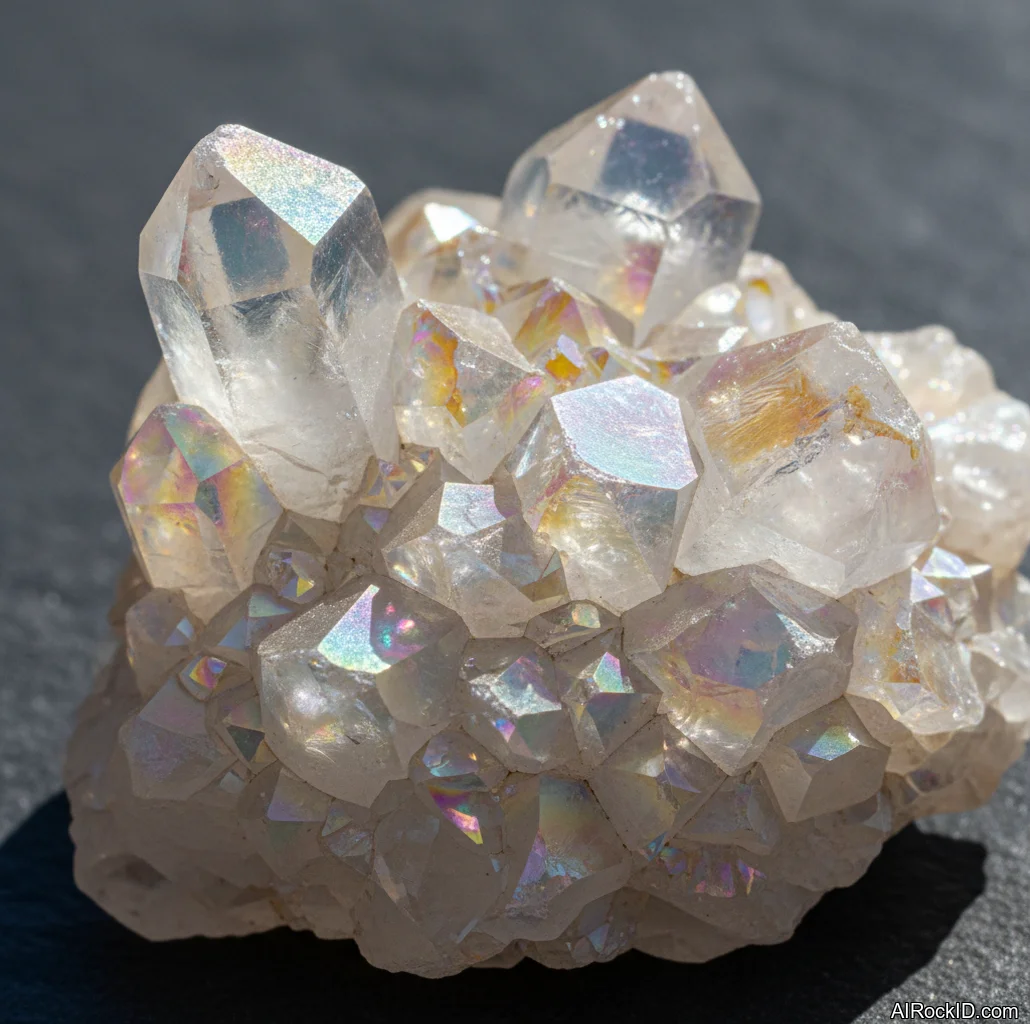
Angel Aura Quartz starts out as natural clear quartz. Then it gets heat-treated and vacuum-coated with a microscopic layer of metals, usually titanium, and sometimes silver or platinum, which is what gives it that iridescent skin.
Look, the first time you see it, it honestly looks like somebody trapped an oil-slick rainbow on a quartz point. Hold it under a single lamp and tilt it a little. The colors skate from icy blue to pink to gold, then they disappear on one face and hit hard on another. Weird, right? That shift is the coating causing thin-film interference. It’s not the quartz itself changing color.
And when you pick one up, it still reads as quartz in your hand. Cool, glassy, and about the same weight as any other clear point from Brazil. But if you run a fingernail along the ridges, you can sometimes feel the tiniest bit of drag where that coating sits on the surface (especially on sharper edges). On worn tumbles, the rainbow layer usually goes thin along the edges first. That’s normal.
Origin & History
Most “aura quartz” you see out there basically goes back to late 20th-century lab work, when people started using vacuum deposition and sputtering on decorative glass, and then moved on to quartz points. There’s no single classic “first describer” like you get with an actual new mineral species, because Angel Aura Quartz isn’t a new mineral at all. It’s treated quartz.
And the name? Pure marketing. Dealers wanted something gentler than “titanium-coated quartz,” so “Angel Aura” ended up sticking, especially for that pale, opalescent coating that skews icy-blue instead of the louder peacock colors you’ll see on other aura styles.
Where Is Angel Aura Quartz Found?
The quartz base material commonly comes from Brazil, Madagascar, Arkansas (USA), China, and Russia, then it’s coated in a lab afterward.
Formation
Clear quartz starts out pretty simple: silica-rich fluids snake through tiny cracks in the rock. Then the pressure, temperature, or chemistry shifts, and quartz begins growing right there, building points that line pockets and veins. That’s where you get those classic terminations, the faint striations you can catch when you tilt the crystal in the light, plus the occasional phantom. All of it. It’s basically the crystal’s growth history locked in place, which is why collectors obsess over it.
Angel Aura comes later. And this is the part people mix up: that rainbow shine didn’t “grow” in the earth. The quartz gets put into a vacuum chamber, and vaporized metal is bonded onto the outside at high heat, leaving a coating so thin it’s measured in nanometers. The quartz underneath is still quartz. The outer skin is the special effect (pretty, sure, but it’s a coating).
How to Identify Angel Aura Quartz
Color: Iridescent rainbow sheen over a clear or milky quartz base, often with a soft blue-white cast on the main faces. Color is strongest on flat faces and weaker on chipped edges.
Luster: Vitreous with a slick, iridescent surface flash from the coating.
Look closely at chips and dings. On real coated quartz, the rainbow sits on the surface and you can see plain quartz in tiny bruises or at fresh fractures. If you scratch it with a steel pin, the quartz won’t budge much, but the coating can get a faint scuff line. And if a seller claims the rainbow is “natural,” that’s your red flag.
Properties of Angel Aura Quartz
Physical Properties
| Crystal System | Trigonal |
| Hardness (Mohs) | 7 (Hard (6-7.5)) |
| Density | 2.65 g/cm3 |
| Luster | Vitreous |
| Diaphaneity | Transparent to translucent |
| Fracture | Conchoidal |
| Streak | White |
| Magnetism | Non-magnetic |
| Colors | Clear, White, Iridescent rainbow, Blue, Pink, Gold |
Chemical Properties
| Classification | Silicates |
| Formula | SiO2 |
| Elements | Si, O |
| Common Impurities | Al, Fe, Li, Na, K, Ti |
Optical Properties
| Refractive Index | 1.544-1.553 |
| Birefringence | 0.009 |
| Pleochroism | None |
| Optical Character | Uniaxial |
Angel Aura Quartz Health & Safety
Handling is pretty low-risk. But if you’re cutting or grinding quartz, don’t breathe in the dust, it gets everywhere and you’ll feel it in your throat. The coating? It’ll scratch if you’ve got grit rubbing on it (think sandy bits stuck on a rag), but plain water won’t do anything to it.
Safety Tips
If you’re polishing or drilling, keep a little water running, make sure you’ve got decent ventilation, and wear a proper respirator that’s actually rated for silica dust. It matters.
Angel Aura Quartz Value & Price
Price Range
Rough/Tumbled: $5 - $60 per piece (typical small points and tumbles); $80 - $250+ for large, clean clusters
Price mostly comes down to the quartz quality underneath, like how clear it is, whether the termination is clean, and how big the piece actually is when you’ve got it in your hand. And then there’s the coating. If it lays on evenly with no bare patches and none of those cloudy, slightly scorched-looking spots, it’ll usually cost more.
Durability
Durable — Scratch resistance: Excellent, Toughness: Good
Quartz holds up well, but the thin aura coating can scuff, wear on edges, or get dulled by abrasives and harsh cleaners.
How to Care for Angel Aura Quartz
Use & Storage
Store it like you’d store any coated jewelry. Wrap it or keep it in a soft pouch so the surface doesn’t rub against harder stones or sand in a drawer.
Cleaning
1) Rinse briefly in lukewarm water with a drop of mild soap. 2) Use your fingers or a very soft cloth, no scrub pads. 3) Rinse and pat dry, then air-dry fully before putting it away.
Cleanse & Charge
If you do energetic cleansing, stick to gentle methods like smoke, sound, or moonlight. Salt scrubs and rough tumbling are what chew up the sheen.
Placement
Put it where it gets angled light, like a shelf near a lamp, not in direct sun all day. The rainbow reads best when you can tilt it and catch a single bright source.
Caution
Skip ultrasonic cleaners. Don’t use abrasive polishing compounds either, and definitely don’t go at it with gritty salt. Also, don’t just toss it loose in your pocket with your keys. The coating will pick up those tiny scuff tracks, the kind you can feel with a fingernail when you tilt it under a light.
Works Well With
Angel Aura Quartz Meaning & Healing Properties
Most dealers lump Angel Aura in with “high vibration,” but here’s the plain, feet-on-the-floor take. It’s still quartz underneath, so if you already use clear quartz as a focus stone, Angel Aura feels pretty similar in your hand. Clean. Bright. And that rainbow coating gives your eyes something obvious to grab onto when you’re trying to settle your attention (and your brain’s bouncing around).
Pick up a point on a busy shop day and, honestly, the shimmer does most of the heavy lifting. Your gaze catches that oily little flash on the facets, you stop doom-scrolling in your head for a second, and you remember to breathe. Is that medicine? Nope. I’m not treating anything with it. It’s just a small, shiny cue to slow down.
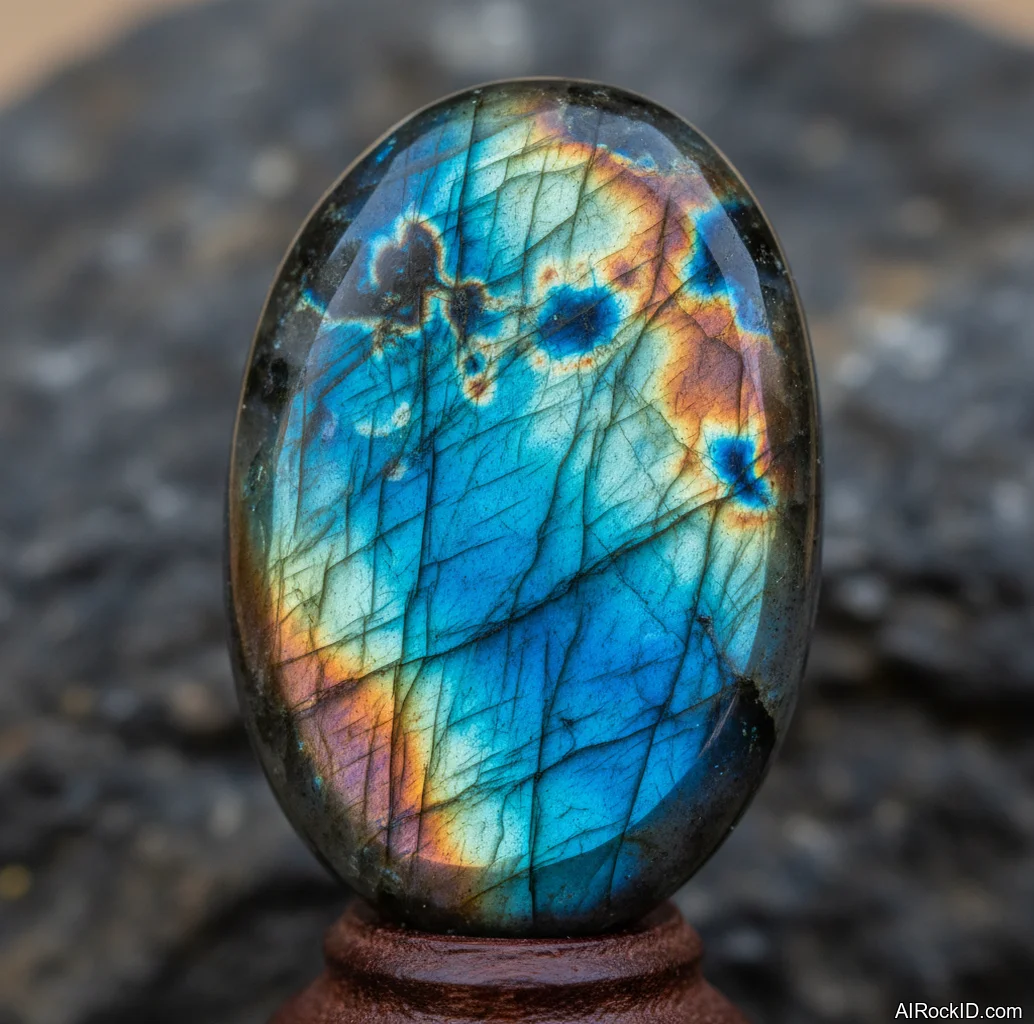
But there’s a catch people skip. Because it’s coated, some folks end up bummed when the surface starts to dull over time, especially with tumbles that ride in a pocket with keys and loose change. If you want a “forever finish,” grab a coated point that mostly lives on a shelf, or go with natural rainbow makers like labradorite if wear is going to bug you.
Identify Any Crystal Instantly
Snap a photo and get properties, value, care instructions, and healing meanings in seconds.