Green Kyanite
What Is Green Kyanite?
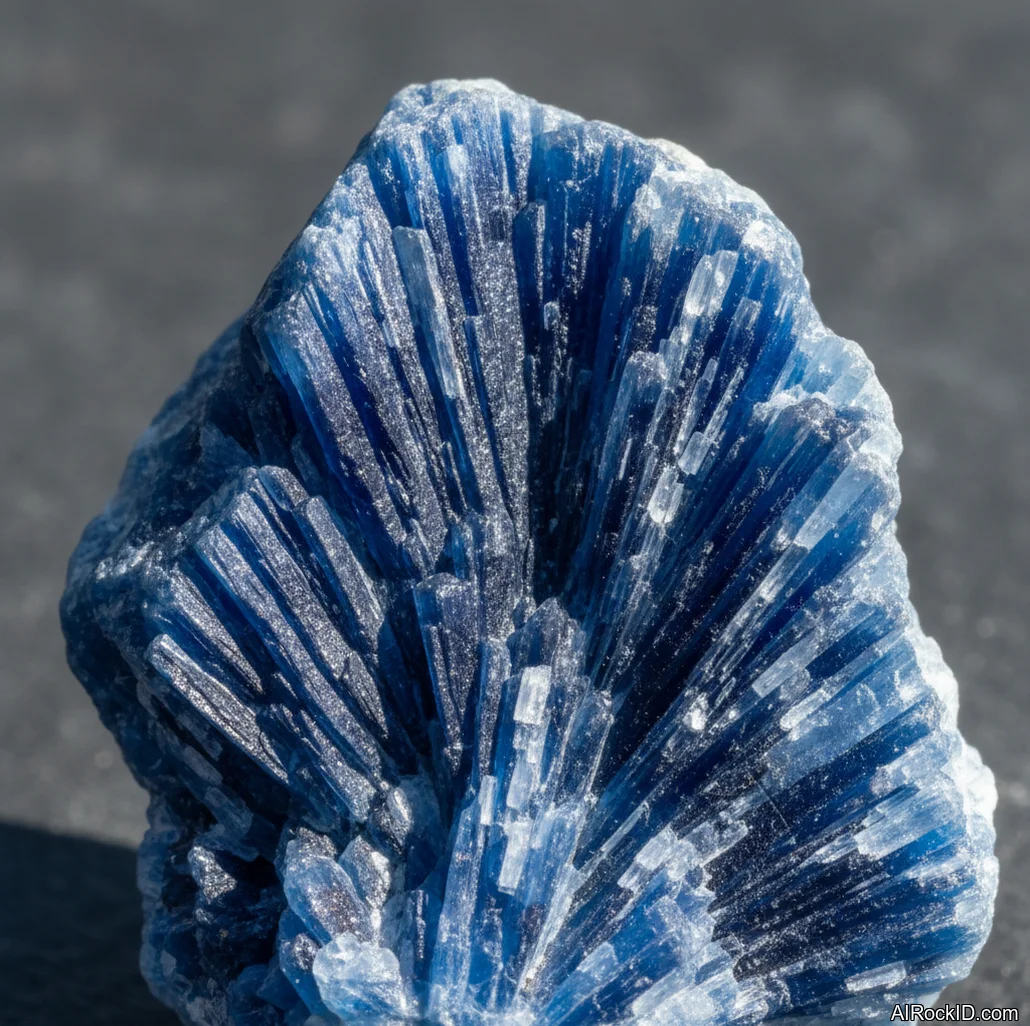
Green kyanite is just kyanite that happens to be green, and kyanite itself is an aluminum silicate mineral (Al2SiO5) that grows those bladed crystals and has hardness that depends on which way you’re testing it.
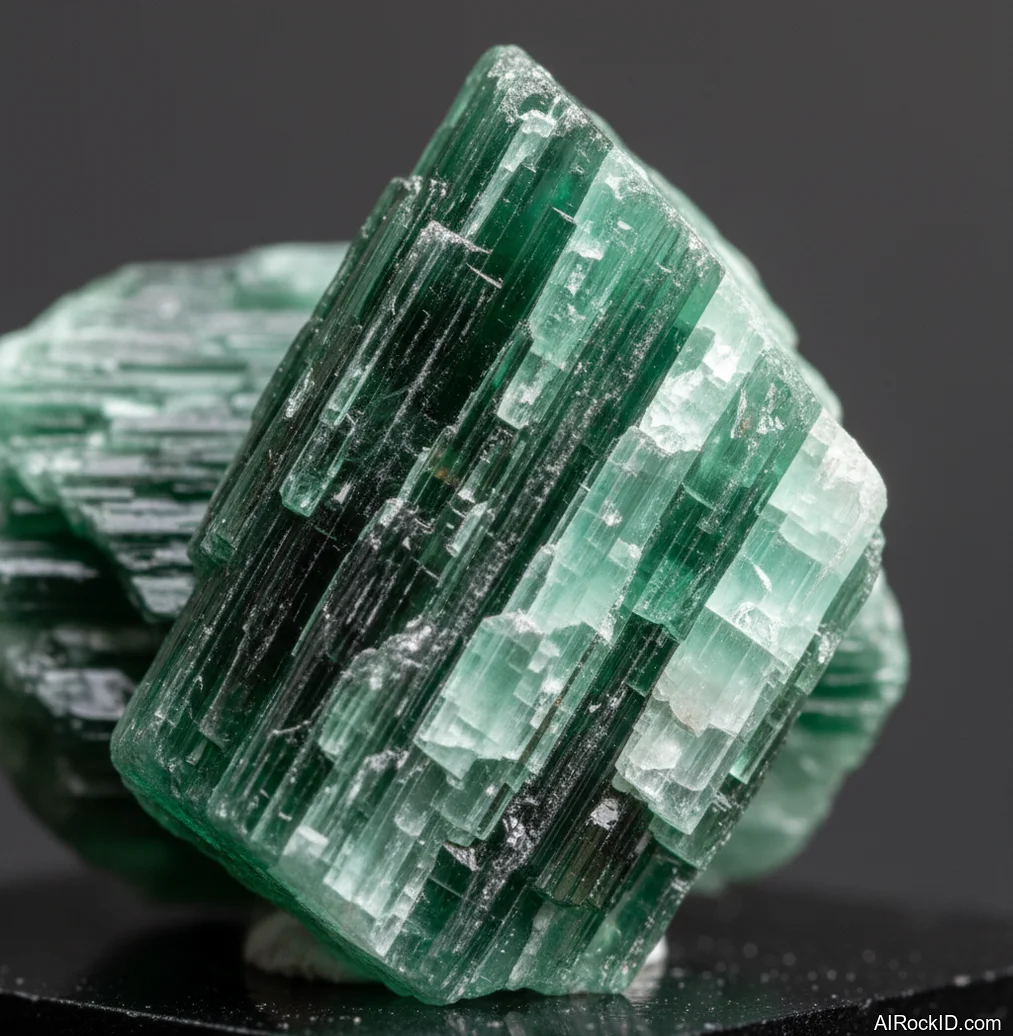
Pick up a decent blade and you feel that odd mix of lightness and stiffness right away. It isn’t hefty like garnet or tourmaline. And the shape gives it away. Long, flat, almost knife-like crystals, with fine lines running straight down the length like somebody took a needle and lightly scored it.
People glance at it and expect it to act like quartz, but it won’t. Scratch it along one direction and it can mark easier than you’d guess, then go across the blade and it suddenly fights back. Tilt it under a shop light and the green shifts, too. Some pieces read yellow-green head-on, then flip to a deeper forest tone as you change the angle. That little color change is a big part of the appeal, even when the crystal’s kind of scruffy at the edges (chips happen).
Origin & History
Kyanite got its official mineral-species write-up in 1789, thanks to Abraham Gottlob Werner. The name comes from the Greek “kyanos,” meaning blue, which feels a little ironic when you’ve got a green bladey chunk sitting in your palm and it flashes olive instead of blue. But that’s the deal. It was named for the color you see most often.
The green stuff hasn’t been treated as a separate species for ages, just a color variety, and it turns up in the same metamorphic settings where kyanite shows up anyway. Dealers will sometimes slap “chrome kyanite” on the really bright, chromium-colored pieces (the ones with that almost slick, glassy sheen on the cleavage faces), but it’s still just kyanite. That name’s basically a trade quirk, not a new mineral.
Where Is Green Kyanite Found?
Green kyanite turns up in high-grade metamorphic terrains, especially in schists and gneisses. Good blades are commonly sold from Brazil, with other occurrences across Europe, Russia, and parts of the United States.
Formation
Raw chunks from metamorphic belts spell it out pretty plainly. Kyanite shows up when aluminum-rich rocks get shoved into high-pressure conditions during regional metamorphism, most often in pelitic rocks that started out as clay-heavy sediments. Pressure climbs, the mineral lineup reshuffles, and kyanite ends up being the stable one.
Look, if you stare at a kyanite blade sitting in its matrix, you’ll usually catch it hanging around quartz and mica, and you might spot garnet close by too. The green tint usually comes from trace elements, most often chromium (and sometimes iron). And those crystals grow in that tight, bladed habit, so in hand sample you’ll see them stacked, crossed, or even fanned out like shingles when the rock actually had space to let them form. Kind of hard to miss once you’ve seen it once.
How to Identify Green Kyanite
Color: Green kyanite ranges from pale yellow-green to medium grass green to deeper forest green, often with visible color zoning along the blade. Many pieces show pleochroism, shifting greener or more gray-green as you rotate them.
Luster: Vitreous to silky on crystal faces, especially along the lengthwise striations.
Pick up the blade and run a fingernail across it. Those parallel grooves are real and they line up with the crystal length. If you scratch it with a steel pin, it may mark more easily along one direction than across, which is classic kyanite behavior. The real test is to rotate it under a single light source and watch the color shift, because dyed fakes usually look flat and one-note.
Properties of Green Kyanite
Physical Properties
| Crystal System | Triclinic |
| Hardness (Mohs) | 4.5-5 parallel to length; 6.5-7 perpendicular to length (Hard (6-7.5)) |
| Density | 3.53-3.67 g/cm3 |
| Luster | Vitreous |
| Diaphaneity | Transparent to translucent |
| Fracture | Uneven |
| Streak | White |
| Magnetism | Non-magnetic |
| Colors | Pale green, Yellow-green, Grass green, Forest green, Gray-green |
Chemical Properties
| Classification | Silicates |
| Formula | Al2SiO5 |
| Elements | Al, Si, O |
| Common Impurities | Cr, Fe, Mn, Ti |
Optical Properties
| Refractive Index | 1.712-1.734 |
| Birefringence | 0.012-0.020 |
| Pleochroism | Strong |
| Optical Character | Biaxial |
Green Kyanite Health & Safety
Green kyanite is generally safe to handle, and it doesn’t contain the usual toxic metals in a form that turns everyday handling into a problem. But still, use basic rock-and-mineral common sense. Wash your hands after you’ve been sorting pieces (especially if you’ve got that fine, gritty dust on your fingers), and don’t eat a sandwich right after handling it. Why tempt fate?
Safety Tips
If you’re going to cut or sand it, handle it the same way you would any silicate mineral. Keep the dust out of your lungs. I usually run a little water over the work so the grit turns into slurry instead of hanging in the air (you’ll see it collect as a gray paste), and I’d still wear proper respiratory protection. Why risk it?
Green Kyanite Value & Price
Price Range
Rough/Tumbled: $8 - $120 per piece
Cut/Polished: $20 - $150 per carat
Prices jump fast when the blades are clean and unbroken, and when the green runs brighter, especially in chromium-rich material. Big crystals with no dings or chips are the ones that make you freeze at a show table (you can almost feel that sharp edge catching the light), and yeah, they’re priced like it.
Durability
Moderate — Scratch resistance: Fair, Toughness: Fair
It’s stable in normal indoor conditions, but the bladed habit and perfect cleavage mean it can chip or split if it takes a knock.
How to Care for Green Kyanite
Use & Storage
Store it where blades won’t rub against harder stones, because the edges chip before you notice. I keep kyanite in little boxes or wrapped in tissue, not loose in a bowl.
Cleaning
1) Rinse briefly in lukewarm water if needed. 2) Use a soft toothbrush with a drop of mild soap to get dirt out of striations. 3) Rinse well and pat dry, then air-dry fully before storing.
Cleanse & Charge
If you do energy-style cleansing, smoke, sound, or a quick rinse and dry are the low-drama options. Avoid long soaks if the piece has fractures or a crumbly matrix.
Placement
Set it on a shelf where it won’t get bumped, and angle it so the striations catch light. A small stand helps a lot because blades love to tip over.
Caution
Don’t just shove it in your pocket next to your keys or a few quartz points. And don’t crank down on it in a vise, either. Kyanite’s got this habit of splitting straight along its cleavage if you press on it the wrong way.
Works Well With
Green Kyanite Meaning & Healing Properties
Compared to the blue stuff, green kyanite gets framed in a more heart-centered way. When I’ve handled it, it comes off calmer and softer, like it’d rather sit in the background than light up the whole room. That’s just a vibe I’m picking up, not some lab number, and it’s not medical care.
Grab a blade and you’ll notice it stays cool longer than most tumbled stones. I’ve leaned on that as a simple grounding cue during breath work: cool stone in your hand, thumb rubbing along those faint lengthwise striations, attention drops into the texture, breathing slows. But look, here’s the honest bit. If you want something you can keep palmed all day, kyanite isn’t always the one because the edges can feel sharp and kind of splintery, especially with raw pieces (ask me how I know).
Thing is, the main headache with green kyanite in the marketplace is people expect uniform, polished perfection. Most natural blades show up with tiny nicks, that stepped cleavage you can feel when you tilt it and run a fingernail along the side, or a little mica stuck on that flashes when the light hits it. I actually like that. It’s a reminder you’re holding a pressure-formed metamorphic mineral, not a factory product. So if you’re using it for meditation or intention work, treat it like a tactile tool: rotate it, watch the pleochroism shift as the angle changes, and let that slow your brain down. Keep it in the realm of personal practice, not promises.
Identify Any Crystal Instantly
Snap a photo and get properties, value, care instructions, and healing meanings in seconds.