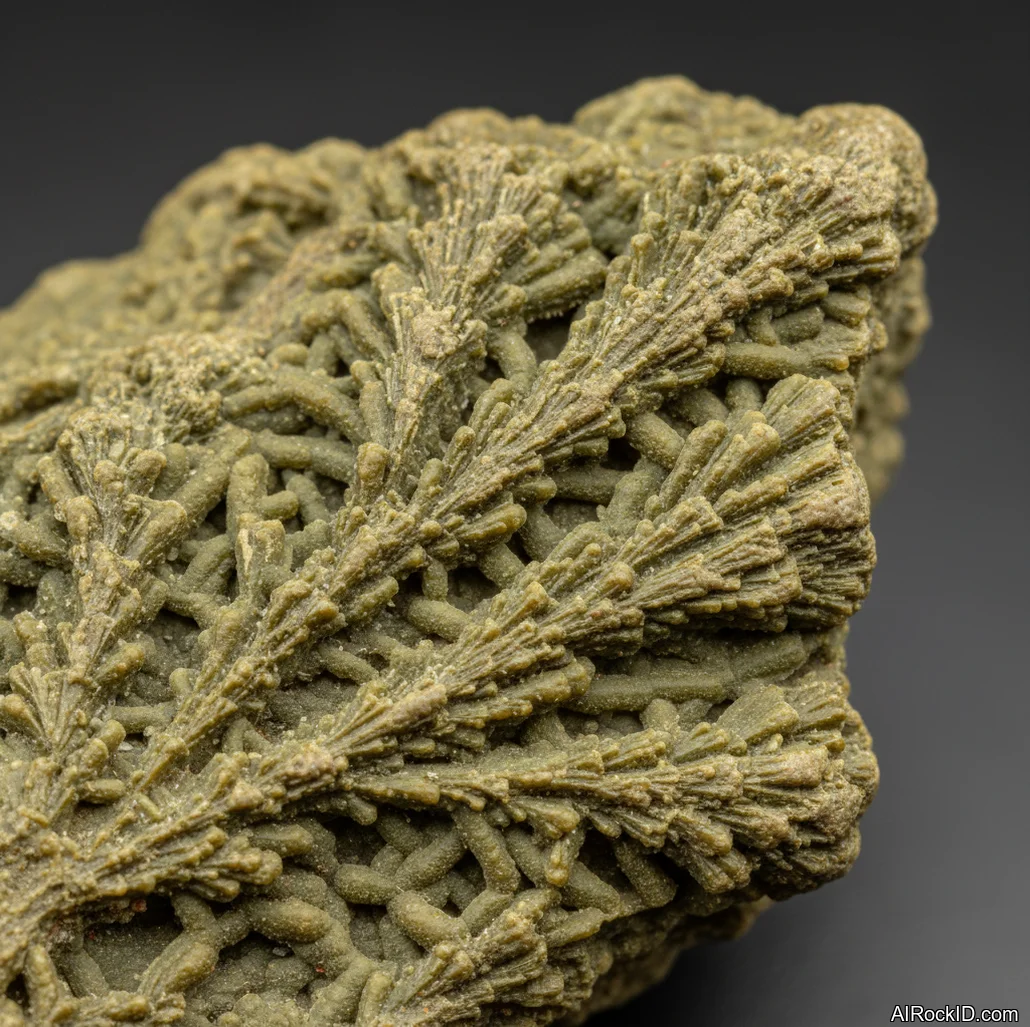
Nontronite
What Is Nontronite?
Nontronite is an iron-rich smectite clay mineral in the montmorillonite group. You almost never see it as a tidy crystal you’d prop up in a display case. It usually shows up as a soft green skin on rock, a crumbly little seam, or just a lump of clay.
At first glance, yeah, it can look like plain old “green dirt.” That’s kind of the point (and kind of the appeal), if you’re the type who gets excited about clay minerals.
Grab a piece and you notice the feel right away. It isn’t cold and glassy like quartz. It’s dry, a bit chalky, and if it’s friable it’ll leave a light green smear on your fingers, like you brushed pastel dust. I’ve handled nontronite-rich chunks that felt almost soapy, then other ones that were gritty because they had silica, limonite, or tiny sand-sized grains mixed through.
Next to flashy cabinet minerals, nontronite’s a quiet one. But it still tells you what happened: water moved through rock, iron got mobilized, and a clay alteration zone formed. And when it hits that good apple-to-olive green, it’s honestly pretty in that natural pigment way.
Origin & History
France gets to take the naming credit here. Nontronite was described in 1827 by Pierre Berthier, and he named it for Nontron in the Dordogne region, where people had already spotted the material.
Older books sometimes talk about it like some weird “green earth.” And honestly, I get it. In a hand sample it can look a lot like other green clays or those old-school “earth pigments” (same muddy green, same soft, earthy feel). But the modern take is pretty clear: it sits with the smectites, the sheet silicates that swell up, hang onto water, and tend to turn up in places where fluids have been busy doing their thing.
Where Is Nontronite Found?
You run into nontronite in altered volcanic terrains, basalt cavities, hydrothermal alteration zones, and iron-rich soils. It’s also well documented in basalt-hosted settings and weathering profiles.
Formation
Look at how it’s sitting in the rock and you can usually tell what happened. Nontronite shows up as an alteration product when iron-rich fluids and water get into silicate rocks, especially basalts and volcanic tuffs. Its smectite structure grows in sheets, with water slipping in between the layers, and that’s why it swells and why it feels clayey instead of crisp and crystalline.
Thing is, nontronite almost never comes by itself. Out in the field it’s often mixed with other clays like montmorillonite or saponite, plus iron oxides such as goethite or limonite, and sometimes you’ll see silica gel or chalcedony riding along too. So what you actually find is green seams, thin coatings along fracture faces, or soft material filling vesicles. If you’ve ever split open a piece of basalt and there’s that dull green, earthy lining stuck to the inside (the kind that looks like it could’ve been scooped from the bottom of a paint jar), yep, you’re in the right neighborhood.
How to Identify Nontronite
Color: Most nontronite is yellow-green to olive-green, sometimes with brownish tones when iron oxides are mixed in. Fresh material can look brighter green, but weathered surfaces often go dull and earthy.
Luster: Dull to earthy, sometimes slightly waxy on compact surfaces.
Pick up a little and rub it between your fingers. If it feels like a clay that wants to smear rather than crumble like a dry sandstone, that’s a strong hint. If you scratch it with a fingernail, it’ll mark easily, and the streak is usually pale green to greenish-white. But don’t trust color alone, because saponite, celadonite, and plain old iron-stained clays can fool you fast.
Properties of Nontronite
Physical Properties
| Crystal System | Monoclinic |
| Hardness (Mohs) | 1-2 (Very Soft (1-2)) |
| Density | 2.1-2.4 g/cm3 |
| Luster | Dull |
| Diaphaneity | Opaque |
| Fracture | Earthy |
| Streak | pale green to greenish-white |
| Magnetism | Non-magnetic |
| Colors | yellow-green, olive-green, greenish-brown, gray-green |
Chemical Properties
| Classification | Silicates (phyllosilicate, smectite) |
| Formula | Na0.3Fe2(Al,Si)4O10(OH)2·nH2O |
| Elements | Na, Fe, Al, Si, O, H |
| Common Impurities | Mg, Ca, K, Mn |
Optical Properties
| Refractive Index | 1.50-1.57 |
| Birefringence | 0.02 |
| Pleochroism | Weak |
| Optical Character | Biaxial |
Nontronite Health & Safety
Handling is usually safe. But don’t inhale the dust if a piece is crumbly, or if you’re brushing off that chalky, dried clay that clings to the specimen and turns into a fine powder.
Safety Tips
Rinse it gently instead of brushing it dry. And if you absolutely have to scrape or trim the matrix, put on a mask and do it outside, or at least under decent ventilation (you don’t want to be breathing that dust, right?).
Nontronite Value & Price
Price Range
Rough/Tumbled: $5 - $40 per specimen
Most pieces don’t cost much, mostly because they’re kind of earthy and fragile. You pick one up and it feels a bit chalky, like it’ll scuff if you rub it with your thumb, so yeah, it’s not that display-crystal stuff. But the price climbs fast if you’ve got a clean, saturated green seam sitting in decent host rock, or if it’s a well-labeled locality sample. That label matters, right?
Durability
Fragile — Scratch resistance: Poor, Toughness: Poor
It can dry out, crumble, or shed dust, and it doesn’t like rough handling or repeated wet-dry cycles.
How to Care for Nontronite
Use & Storage
Keep it in a small box or a specimen jar so it doesn’t get rubbed into other minerals. A little padding helps, because edges chip and the green coating can flake.
Cleaning
1) Blow off loose grit with a bulb blower or gentle air. 2) If it needs water, do a quick rinse with cool water and let it air-dry completely. 3) Skip ultrasonic cleaners and skip harsh soaps, because the surface can turn to mush.
Cleanse & Charge
If you do energy-style care, treat it like a clay: brief smoke cleansing or a short sit on a dry selenite plate works fine. Avoid long soaks and avoid salt.
Placement
A stable shelf is better than a sunny windowsill. I keep mine away from heat vents because repeated drying can make the surface crackier.
Caution
Super soft stuff. Don’t polish it. Don’t tumble it. And please don’t go at it with a dry brush, because that’s the quickest way to end up with that annoying little pile of green dust.
Works Well With
Nontronite Meaning & Healing Properties
Most dealers won’t even bother putting nontronite in the “healing stones” tray, because, well, it looks like what it is. Clay. A little dull, a little humble. But that’s exactly why some people are into it, the same way they’re into mud masks or those mineral clays that leave a faint dusty ring around the sink if you’re not careful.
On a rough day, if you pick up a piece of nontronite, you almost can’t help but ease off the gas a bit. It’s soft and matte in your fingers, kind of like a dry, smooth chalky smear without the squeak. No glitter. No flash. No “ooh shiny” distraction. I’ve kept it on my desk when I’m buried in paperwork, mostly because it pulls my brain back to field sites and road cuts (that sun-baked smell, the crumbly edges), not because I think it’s going to fix anything medical. Not that.
Thing is, there’s a real limit here: it’s fragile. And if you fuss with it too much, it gets messy, like you’ll notice a fine powder on your fingertips or a little grit where you set it down. So if you want it for meditation or as a touchstone, tuck it in a small pouch or a jar and handle it gently. And for anything health-related? It’s a collector item. It’s not a stand-in for a doctor or a therapist.
Identify Any Crystal Instantly
Snap a photo and get properties, value, care instructions, and healing meanings in seconds.