Ocean Jasper
What Is Ocean Jasper?
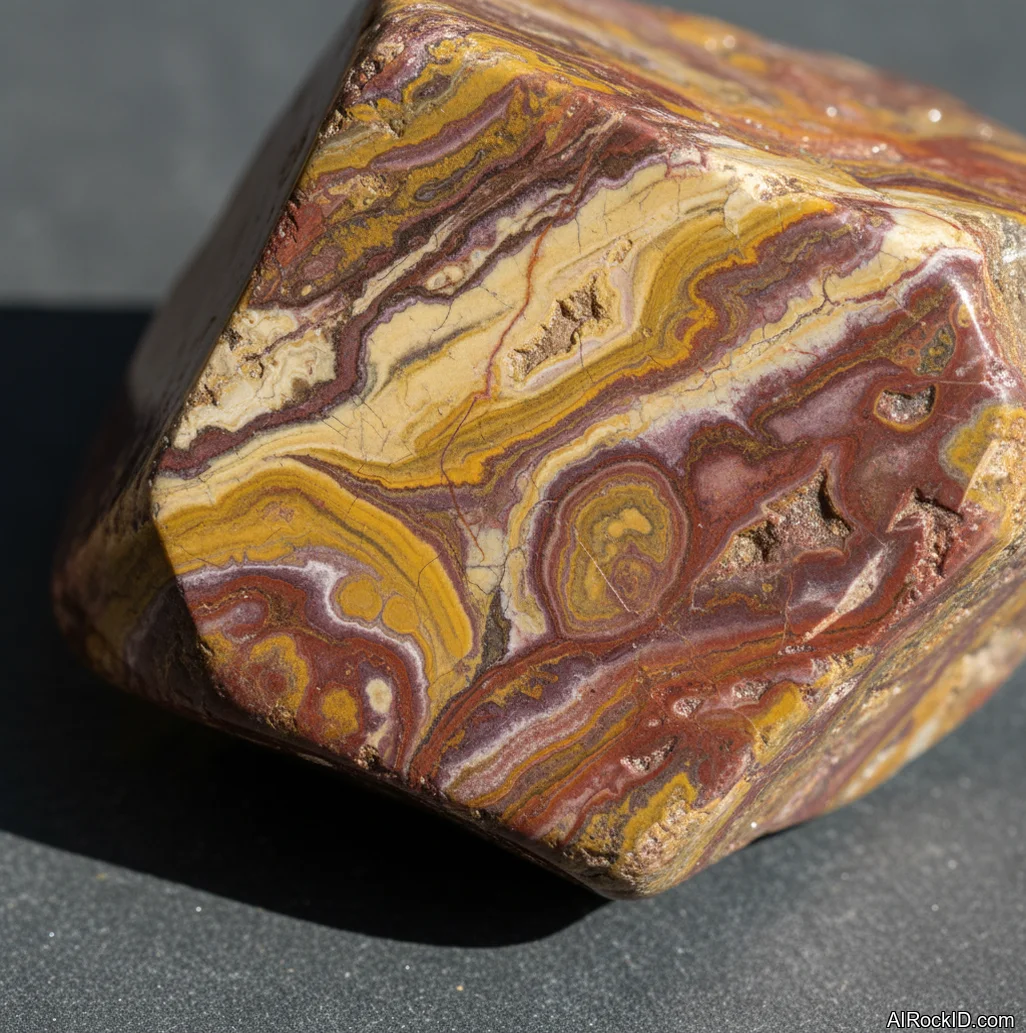
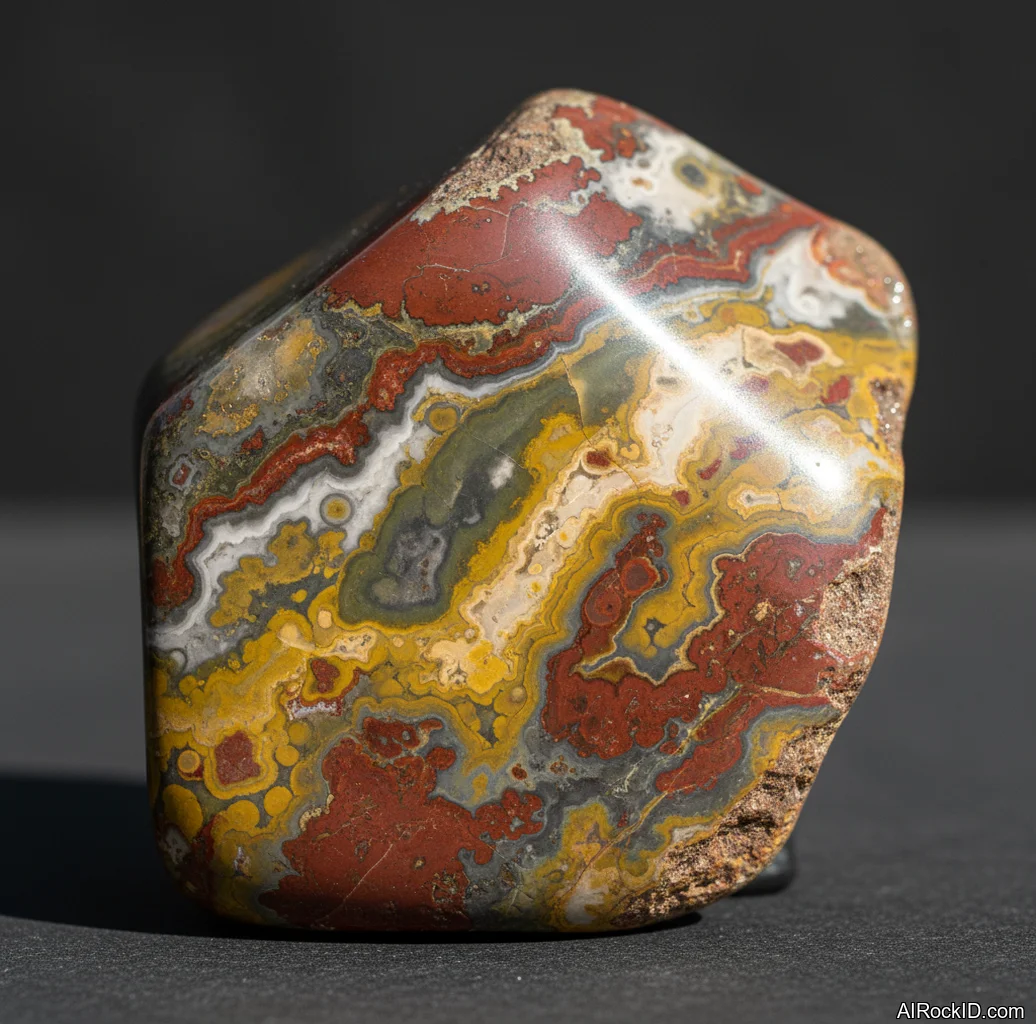
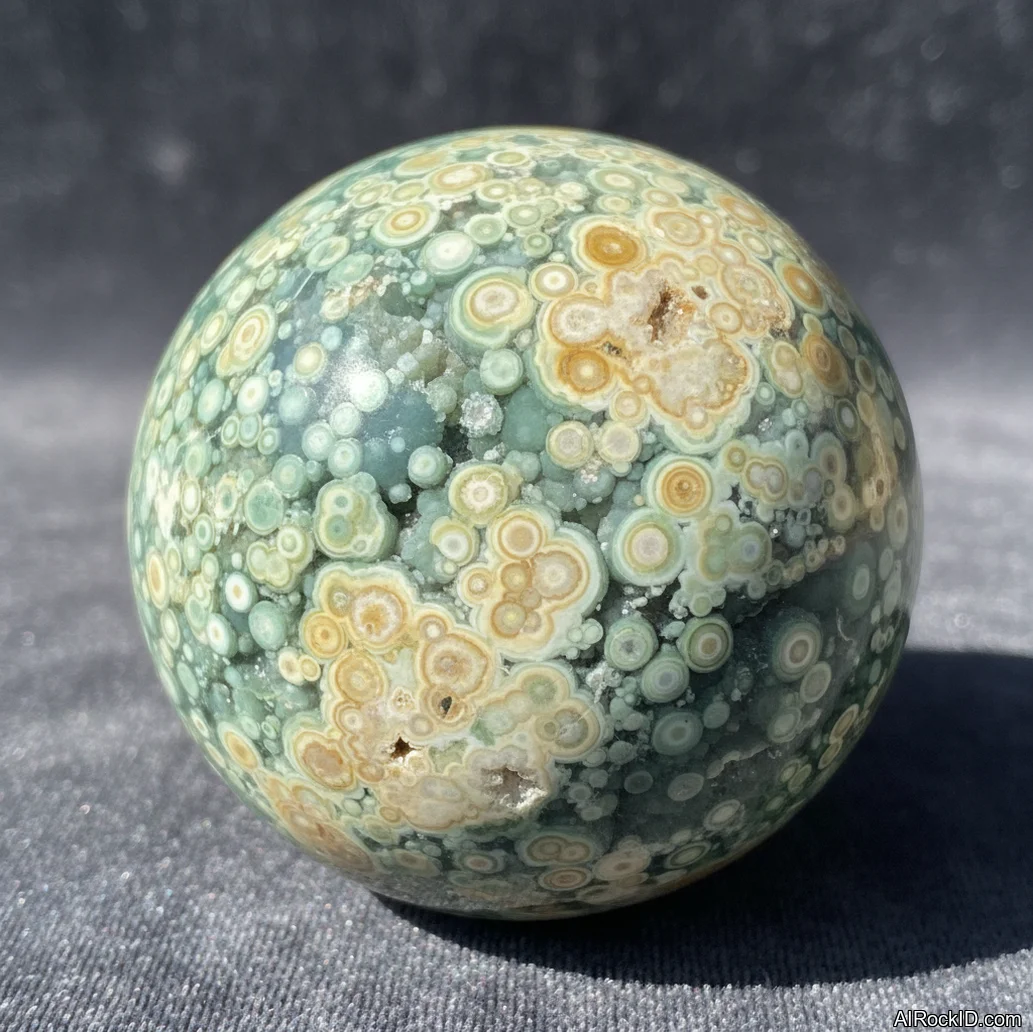
Ocean Jasper is an orbicular kind of jasper (microcrystalline quartz/chalcedony), and people recognize it fast because of those round, eye-like spots and the occasional little druzy pockets.
Grab a decent palm stone and you feel it immediately. Classic quartz weight. It’s cool the second it hits your skin, then it takes its sweet time warming up in your hand, kind of like agate. Most of what you see for sale is polished, so the orbs jump out like tiny planets, and every now and then you’ll spot small vugs the cutter didn’t seal up, lined with glittery quartz crystals.
A lot of folks glance at it and go, “Okay, another jasper.” But it really doesn’t look like most jasper once you actually stare at it. The circles might be sharp and tidy, or they can look soft, hazy, and stacked in layers, and the colors can run sea-green and cream, then flip to mustard, brick red, or that weird lavender-gray that only shows up in a few seams. Some pieces take on a super glassy shine, and some stay more satiny even after a long polish (which, honestly, is part of why it’s fun to handle).
Origin & History
Most dealers will point you to northwest Madagascar for the modern Ocean Jasper story. That’s where those orbicular jasper nodules got picked up right along the coast, then packed up and shipped out through the late 1990s and into the early 2000s. The “ocean” name wasn’t some poetic thing, either. It stuck because the early material was literally reached near the shoreline, and sometimes the only way in was by boat when the tide was low enough and the surf wasn’t trying to knock you over.
Thing is, “jasper” in this case is a trade label for an opaque, patterned chalcedony. And “orbicular” is that old lapidary term for the round spots and bullseye-looking circles. You’ll also hear sellers say “Ocean Jasper 1st vein, 2nd vein, 3rd vein, 4th vein.” That’s mostly just market shorthand for different mining areas and batches, not some official geological ranking, and yeah, it gets abused when someone wants to talk you into paying more.
Where Is Ocean Jasper Found?
Ocean Jasper is primarily sourced from northwest Madagascar, with classic material coming from coastal deposits near the Marovato region.
Formation
Look at the patterns up close and you can tell it didn’t happen all at once. It built up in pulses. Ocean Jasper forms when silica-rich fluids work their way into cavities and fractures in volcanic rock, then lay down microcrystalline quartz in layers. And those layers can wrap around tiny nuclei, which is why you get those orb shapes instead of straight banding.
But it’s never as neat as the textbook drawings. In one piece you’ll see crisp orbs, then you hit a patch of brecciated jasper, then there’s a seam of translucent chalcedony, then, out of nowhere, a little pocket of drusy quartz. I’ve cut slabs where the saw suddenly drops into a hollow and the whole shop gets that faint wet-stone smell, and you just know you cracked open a vug about the size of a grape.
How to Identify Ocean Jasper
Color: Typically green, cream, white, yellow, brown, red, and pink, often with multicolored orbicules; some pieces show gray-lavender tones and clear chalcedony edges.
Luster: Waxy to vitreous when polished, often with a softer satin look in more opaque areas.
Pick up a polished piece and tilt it under a single overhead light. Real Ocean Jasper often shows depth in the orbs, like stacked rings, and you’ll sometimes see tiny quartz sparkle in vugs that catches and drops as you move it. The real test is texture: it should feel like quartz, cool and hard, not plasticky or warm like resin. And if you’ve got a loupe, look for microcrystalline structure and natural pits around druzy pockets instead of perfectly smooth “bubbles.”
Properties of Ocean Jasper
Physical Properties
| Crystal System | Trigonal |
| Hardness (Mohs) | 6.5-7 (Hard (6-7.5)) |
| Density | 2.58-2.64 g/cm3 |
| Luster | Waxy |
| Diaphaneity | Opaque |
| Fracture | Conchoidal |
| Streak | White |
| Magnetism | Non-magnetic |
| Colors | Green, Cream, White, Yellow, Brown, Red, Pink, Gray, Lavender |
Chemical Properties
| Classification | Silicates |
| Formula | SiO2 |
| Elements | Si, O |
| Common Impurities | Fe, Mn, Al, Ca |
Optical Properties
| Refractive Index | 1.530-1.539 |
| Birefringence | 0.004 |
| Pleochroism | None |
| Optical Character | Uniaxial |
Ocean Jasper Health & Safety
Ocean Jasper is non-toxic, so you can handle it without worrying. And if it gets splashed or rinsed off, that’s usually totally fine. Thing is, the only real risk is the standard silica issue. If you cut or grind it and end up breathing the dust, that’s where the problem can start.
Safety Tips
So, if you’re sanding or shaping it, keep it wet with water, put on a proper respirator (not just a flimsy mask), and wipe up the slurry when you’re done instead of sweeping up dry dust.
Ocean Jasper Value & Price
Price Range
Rough/Tumbled: $10 - $120 per palm stone or small polished piece
Cut/Polished: $2 - $15 per carat
Prices jump when the orbs look sharp and high-contrast, when you get those rarer color mixes (clean pinks and purples are the big ones), and when the piece still has its natural druzy pockets intact instead of that gritty stuff flaking out or crumbling.
Durability
Durable — Scratch resistance: Good, Toughness: Good
It’s generally stable like other chalcedony, but sharp impacts can chip edges and open vugs can snag or shed tiny crystals if you knock them around.
How to Care for Ocean Jasper
Use & Storage
Store it like you’d store agate. Keep polished pieces in a soft pouch if they’ll rub against harder stones, and don’t let druzy pockets bang around in a box.
Cleaning
1) Rinse with lukewarm water and a drop of mild soap. 2) Use a soft toothbrush for pits and around druzy vugs. 3) Rinse well and dry fully before putting it away.
Cleanse & Charge
If you do energetic cleansing, simple methods like running water, smoke, or leaving it on a shelf overnight work fine. Avoid saltwater if the piece has open druzy or fractures that can trap residue.
Placement
It looks best where light skims across the surface, like near a lamp, so the orb layers and any sparkle show up. If it’s a display slab, a small stand keeps it from rolling and chipping corners.
Caution
Skip ultrasonic cleaners and stay away from harsh acids. And if a piece has druzy, don’t park it somewhere it can get bumped around, because those tiny crystals chip fast. Thing is, if the stone has fractures or any filled spots, long soaks can sneak in and cause problems, so keep an eye on the time.
Works Well With
Ocean Jasper Meaning & Healing Properties
Most folks grab Ocean Jasper when they want something calming that still isn’t boring. In my own stash, it’s the piece I pass to the jittery person at a show. The little orbs give your eyes a track to run on, and when you roll it in your hand your thumb keeps landing in those tiny dips and bumps without you even thinking about it. Cool stone, a little weight to it. You can feel it.
On the metaphysical side, people link it with steadying emotions and dialing down stress, like a quiet “hey, breathe, you’re okay.” But look, I’m not going to pretend it’s a medical tool. It doesn’t replace therapy, meds, or sleep. What it’s actually great at is being a physical anchor. When the piece is cold and solid in your palm, you catch yourself and unclench your jaw. Half the time you didn’t even realize you were doing it.
And there’s a social angle too. Ocean Jasper has that friendly, beachy vibe, so people use it for communication and for mood lifting. But here’s the snag: the market gets messy. Sellers will hype up rare “veins” and then slap the name on other orbicular jaspers. If you’re buying because you like the feel and the pattern, perfect. If you’re buying because someone promised it’ll flip your whole life around… yeah. Keep your feet on the ground, alright?
Identify Any Crystal Instantly
Snap a photo and get properties, value, care instructions, and healing meanings in seconds.