Stromatolite


Quick answer: Stromatolite is a layered fossil rock formed by microbial mats, commonly preserved in carbonate minerals such as calcite or dolomite and sometimes replaced by silica. It is collected for its banded fossil structure, scientific interest, and decorative lapidary use.
AI Rock ID can help screen a stromatolite specimen by checking for layered, domed, or wavy fossil textures against common lookalikes. RockIdentifier.io provides visual identification support, but fossil confirmation is strongest when paired with locality information and close inspection of the layering.
Good fit
- Collectors interested in fossils, ancient life, or sedimentary rocks
- People who want a patterned display stone with natural banding
- Lapidary users seeking cabochons, slabs, or polished specimens with fossil texture
- Educational collections focused on microbial fossils and Earth history
Not a good fit
- Anyone expecting a transparent or faceted gemstone
- Buyers who need a rare mineral species rather than a fossil rock
- Situations where exact geologic age is required without provenance or documentation
- Outdoor placement in freeze-thaw conditions if the specimen is porous or fractured
Most commonly confused with
- Chert: Chert can show bands or nodules, but it usually lacks the repeated microbial mat laminations typical of stromatolite.
- Agate: Agate has silica banding in cavities or veins, while stromatolite has fossil layering formed by microbial growth.
- Limestone: Limestone may be massive or fossiliferous, but stromatolite has distinctive laminated or domal microbial structures.
- Onyx: Banded calcite or onyx is usually flowstone or cave-related material, not a fossil microbial mat.
Stromatolite vs. Common Lookalikes
| Material | Typical Pattern | Key Difference |
|---|---|---|
| Stromatolite | Wavy, layered, domed, or columnar laminations | Fossil structure made by microbial mats |
| Agate | Curved or concentric silica bands | Forms in cavities or fractures, not as microbial layers |
| Chert | Massive, nodular, or irregular bands | Siliceous rock without clear stromatolitic growth forms |
| Banded calcite or onyx | Straight, parallel, or flow-like bands | Typically chemical deposition rather than fossil mat growth |
| Fossiliferous limestone | Shell fragments, grains, or mixed fossils | Contains fossils but may lack continuous microbial lamination |
AI identification confidence
AI identification confidence for stromatolite is moderate when the specimen shows clear wavy, domal, or finely laminated fossil structures. Confidence is lower for polished pieces, isolated slabs, or stones sold without locality data because several banded rocks can appear similar in photos.
When AI gets it wrong
- Polished slabs may hide grain texture and make ordinary banded rock look fossiliferous.
- Agate, jasper, or chert with curved bands can be mistaken for stromatolite in a single photo.
- Lighting glare on glossy surfaces can obscure fine lamination.
- Specimens without scale, locality, or side-view images are harder to distinguish from decorative carbonate stone.
Final recommendation
Choose stromatolite if you want a fossil rock valued for visible layering, geologic context, and ancient microbial origin. For authenticity, prioritize specimens with clear lamination, reliable locality information, and seller photos showing both polished and unpolished surfaces when available.
How to Identify Real Stromatolite
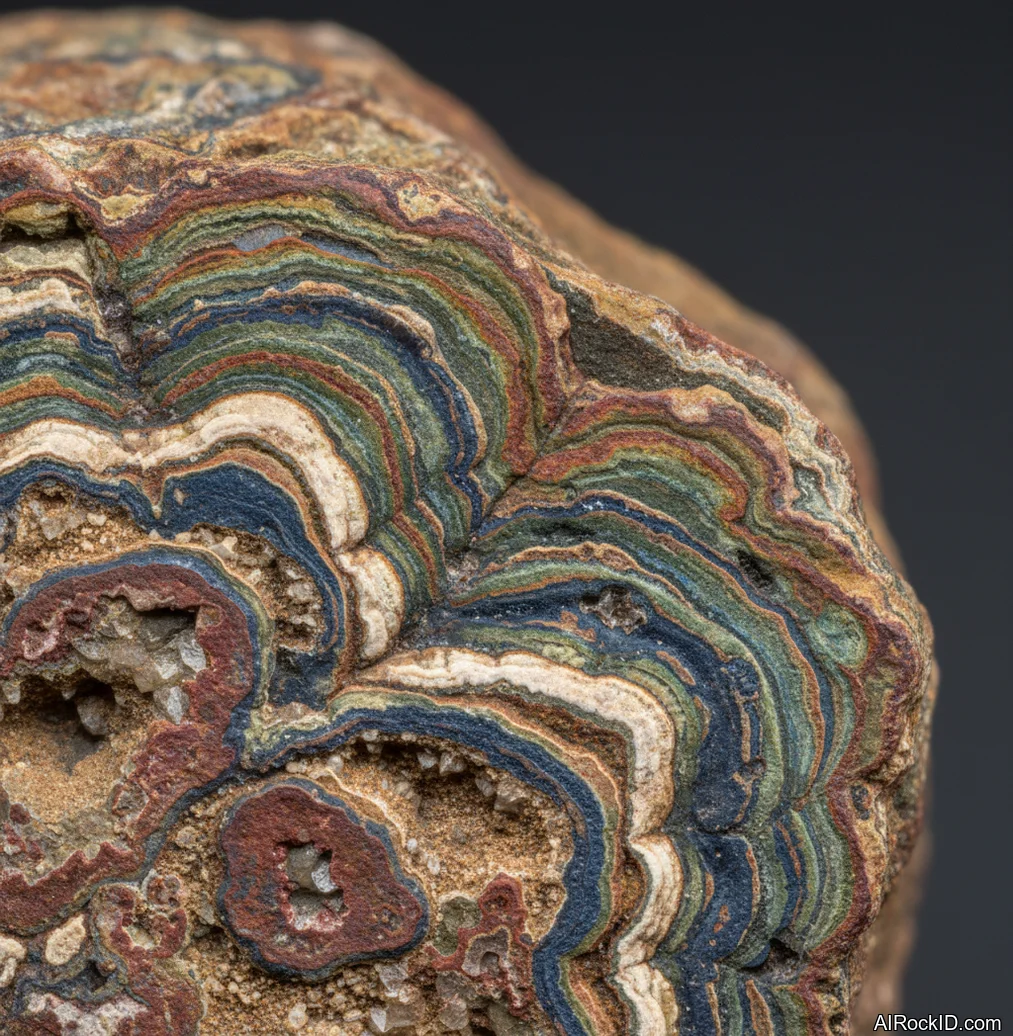
Real stromatolite usually shows repeated, fine layers that may be wavy, domed, columnar, or irregular rather than simple straight bands. Locality information is important because known stromatolite-bearing formations provide context for the fossil interpretation. A cut or polished face may show attractive patterning, while an unpolished edge can help reveal natural sedimentary texture.
Buying Tips for Stromatolite
Look for listings that state the source locality, whether the piece is natural, cut, polished, stabilized, or dyed, and whether it is a fossil stromatolite or a stromatolitic-patterned decorative stone. Be cautious with vague labels such as “ancient stone” or “fossil jasper” if no fossil structure or provenance is shown. Higher prices are more justified when the specimen has strong visual lamination, documented origin, good preparation, and stable condition.
Natural vs. Treated Stromatolite
Most stromatolite specimens are sold as natural rock that has been cut, tumbled, or polished rather than chemically treated. Some porous pieces may be stabilized with resin to improve durability, and dyed decorative material can occasionally be mislabeled. A natural-looking color range, visible layering through the stone, and disclosure from the seller are useful indicators when evaluating a purchase.
What Is Stromatolite?
A stromatolite is a layered fossil rock made by ancient microbial mats (usually cyanobacteria). Those mats trapped sediment and helped carbonate minerals precipitate out, building up thin, repeating laminae over time.
Pick up a polished piece and you’ll spot the pattern before anything else. It’s not “crystal pretty” like quartz points. But the bands have this slow, organic vibe, like tiny stacked pancakes or ripples that got stuck mid-motion and never moved again. And yeah, it feels like a rock because it is one. Most of what you see in shops is cut into palm stones or flat slabs, and the better pieces have crisp lamination you can literally track with your fingertip as it bumps over the faint ridges (you can feel where one layer ends and the next begins).
Compared to a lot of fossils, stromatolite has a satisfying heft, and when it’s polished it sits in your hand smooth and kind of comforting. Thing is, it’s not a single mineral species, so two pieces can act totally different. I’ve had one that behaved like soft limestone, and another that was so silicified it took a sharp edge like jasper. How can the “same” fossil do that? It just can.
Origin & History
“Stromatolite” comes from Greek roots that basically mean “layered rock.” The word showed up in the scientific literature in the early 1900s, when Ernst Kalkowsky used it and argued these laminated structures were biological in origin.
Stromatolites matter because they’re one of the clearest fossil records of early life on Earth. And when you’ve got a decent specimen in your hand, you can actually feel those stacked laminae with your thumb, like tiny pages pressed into stone (the layers catch the light when you tilt it). You’re basically holding a snapshot of microbial communities that shaped shallow-water environments long before anything with bones existed. That’s the hook for collectors, even if the piece looks kind of plain at first glance.
Where Is Stromatolite Found?
Stromatolites occur worldwide in ancient carbonate platforms, with famous fossil material from Australia, North America, South Africa, and Brazil, plus living examples in places like Shark Bay.
Formation
Look closer at those layers and you’ll notice it’s basically one simple trick done over and over an absurd number of times. Microbial mats spread across shallow seafloors or along lake edges, and you can almost picture the gritty film they leave behind as they trap fine sediment and kick off carbonate precipitation. Then the mat grows again. More gunk, more minerals. Another wafer-thin line. Repeat. Forever.
After enough time, those little laminae harden up and turn into limestone or dolostone, and in some cases later fluids move through and silicify the rock into chert (you can feel the difference when you tap it, too, that sharper, glassier bite).
Thing is, “stromatolite” gets tossed around in the marketplace for a few different looks, and that’s where it gets messy. Some pieces really are domal stromatolites, with obvious columns and those rounded heads. Others are “just” nicely banded microbial laminite. Both can be legit. But when the pattern looks too perfect, like it was printed on there in clean swirls and there’s zero sediment texture to grab your eye, I start wondering what I’m actually looking at. Why’s it so flawless?
How to Identify Stromatolite
Color: Most stromatolite is tan, cream, brown, gray, or black, with banding that alternates light and dark layers. Some slabs show rusty red or greenish tones from iron staining or other inclusions.
Luster: Polished surfaces range from dull to waxy, and silicified pieces can look slightly vitreous on a fresh cut.
Pick up a piece and tilt it under a single overhead light. Real laminae look like actual layers with tiny texture changes, not just color stripes. If you scratch it with a steel nail, many carbonate-rich pieces will mark pretty easily, but a cherty, silicified stromatolite will fight back closer to quartz-like toughness. And if you’ve handled enough fossils, the “feel” gives it away: limestone-based pieces feel a bit softer and warmer, while silicified ones stay cooler and sharper around edges.
Common Look-Alikes
Stromatolite is sometimes confused with these materials:
- Banded jasper (especially picture or landscape jasper)
- Fossilized coral (agatized coral)
- Rhythmically banded chert or chalcedony
- Petrified wood (polished sections)
- Dyed onyx or marble
- Resin composites with layered dyes
Market Cautions & Treatments
When AI Can Get This Wrong
AI image tools often mix up stromatolite with banded jasper or fossil coral, especially when the bands are tight and wavy. Photos don't show the fossil texture—real stromatolite has tiny pits and matte patches, not the glassy smoothness of jasper. If you can, hit it with a steel nail: carbonate stromatolite scratches easy, but silicified stuff bites back.
Properties of Stromatolite
Physical Properties
| Crystal System | Amorphous |
| Hardness (Mohs) | 3-4 (carbonate-rich) or 6.5-7 (silicified/cherty) (Soft (2-4) to Hard (6-7.5)) |
| Density | 2.7-2.9 g/cm3 |
| Luster | Waxy |
| Diaphaneity | Opaque |
| Fracture | Uneven |
| Streak | white |
| Magnetism | Non-magnetic |
| Colors | tan, cream, brown, gray, black, rust red |
Chemical Properties
| Classification | Carbonates (commonly), sometimes Silicates if silicified |
| Formula | CaCO3 (common), CaMg(CO3)2 (common), or SiO2 (silicified) |
| Elements | Ca, Mg, C, O, Si |
| Common Impurities | Fe, Mn, Al |
Optical Properties
| Refractive Index | 1.49-1.66 (varies with calcite/dolomite/quartz content) |
| Birefringence | None |
| Pleochroism | None |
| Optical Character | Isotropic |
Stromatolite Health & Safety
Stromatolite is usually safe to pick up and handle. It isn’t toxic on its own. But if you’ve got a carbonate-based piece, acids can make it fizz or etch the surface (you’ll sometimes see tiny bubbles), so don’t let it come into contact with harsh cleaners.
Safety Tips
If you’re going to cut or sand it, put on a dust mask. And use a little water to keep the dust down, especially if it’s silicified, because it can kick up that super-fine silica dust that gets everywhere (and you really don’t want to breathe it).
Stromatolite Value & Price
Price Range
Rough/Tumbled: $8 - $80 per palm stone or small slab
Price mostly follows what you can actually see: how crisp the pattern is, how clean the polish came out, and whether the piece shows those obvious domes or columns instead of just flat banding. Big display slabs with tight, high-contrast lamination can jump in price fast, especially when the cut lines everything up so the structure really shows.
Durability
Moderate — Scratch resistance: Fair, Toughness: Fair
Most pieces are stable in normal display conditions, but carbonate-rich material can scratch and etch more easily than silicified material.
How to Care for Stromatolite
Use & Storage
Store it like you would a soft fossil or a polished limestone: separated from harder stuff like quartz that can scuff it up. I keep my palm stones in little trays so they don’t grind against each other.
Cleaning
1) Rinse with lukewarm water and a drop of mild soap. 2) Use a soft toothbrush to get into small pits and grooves. 3) Rinse well and pat dry; avoid acids and vinegar because they can etch carbonate layers.
Cleanse & Charge
If you do energy-style cleansing, smoke cleanse or sound works fine and won’t mess with the surface. I skip saltwater for carbonate-heavy pieces just because it can leave a crust in tiny pores.
Placement
Looks best where side light can rake across the lamination, like on a shelf with a small lamp. Keep it out of splash zones if it’s a softer, chalkier piece.
Caution
Skip acidic cleaners, and don’t just chuck it into a bowl with harder tumbled stones, because it’ll come out with little scuffs and scratches (you can feel them with a fingernail). And if you can’t tell whether yours is carbonate or silicified, just handle it like it’s the softer one.
Works Well With
Stromatolite Meaning & Healing Properties
Stromatolite is one of those stones people grab when they’re craving that “deep time” feeling, and yeah, I get why. When you hold it, it’s grounding in a very literal sense. It’s heavy. It’s layered. And it’s not trying to pass as anything other than old rock with a story baked in.
Pick up a palm stone and run your thumb over the bands for a minute. Not in a dramatic way, either. Just slow, back and forth. The texture is subtle, almost like tiny ridges you notice more after a few passes, and there’s this steady rhythm to it that can tug you out of a spinny headspace, the same way a worry stone does. I’ve sold these to people who keep one on their desk through long work sessions because it feels steady and not flashy (no glitter, no shine, just stripes). If you’re expecting fireworks, you’ll be disappointed. But if what you want is something that feels slow and stable, it fits.
So, the boring part, said out loud: this isn’t medical advice, and stromatolite isn’t going to fix a condition. But as a focus object for meditation, journaling, or just a reminder that you’re part of a long timeline, it’s solid. And it’s a fun conversation starter when someone spots it and goes, “What is that weird layered rock?”
Common mistakes
- Assuming every banded stone is stromatolite without checking for microbial-style lamination.
- Using color alone for identification, since stromatolite can be tan, gray, brown, red, black, or silicified in varied colors.
- Ignoring locality information when buying a specimen claimed to be fossil stromatolite.
- Confusing polished decorative calcite, onyx, agate, or jasper with stromatolite.
- Expecting all stromatolite to show obvious fossils like shells or bones; the fossil evidence is usually layered microbial structure.
- Assuming a specimen’s age can be verified from appearance alone without geologic context.
Identify Stromatolite from a photo
Compare Stromatolite traits, care tips, value clues, and common lookalikes with a clear photo.