Trolleite
What Is Trolleite?
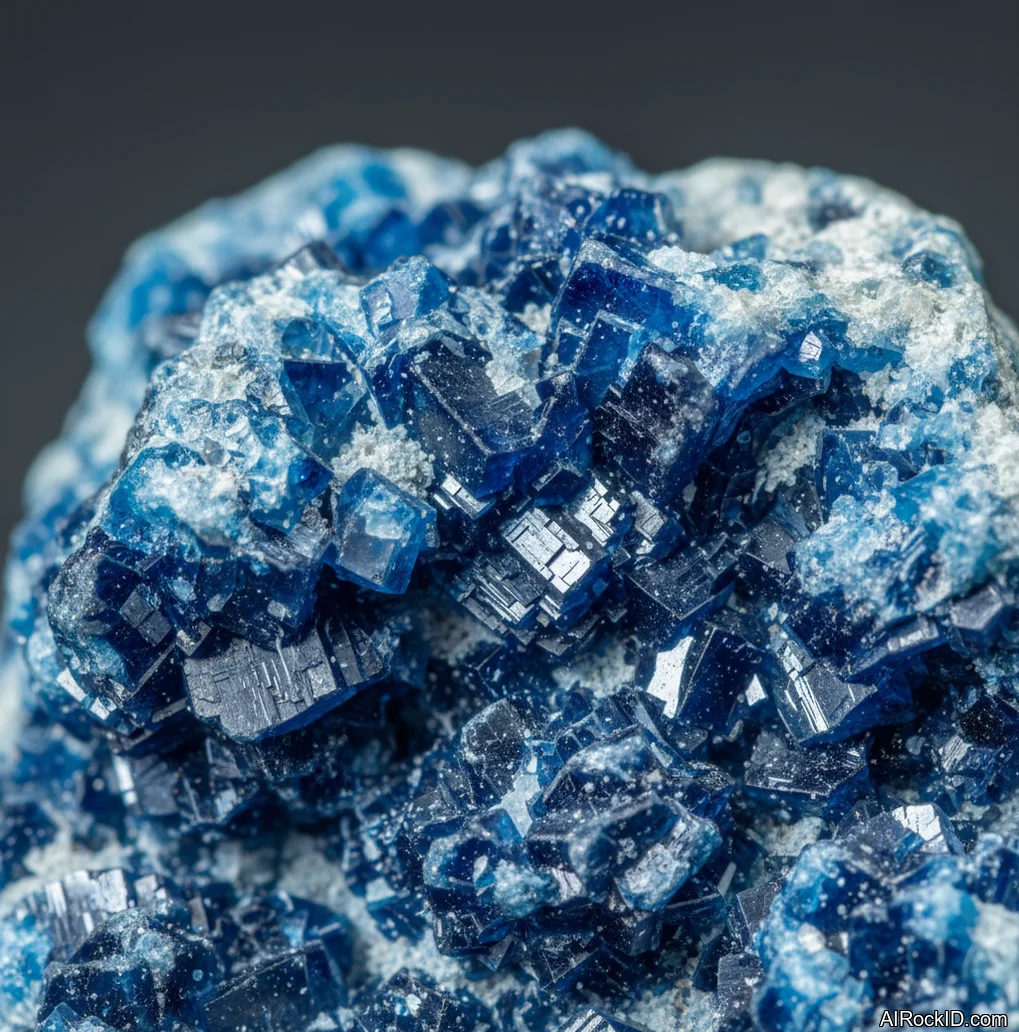
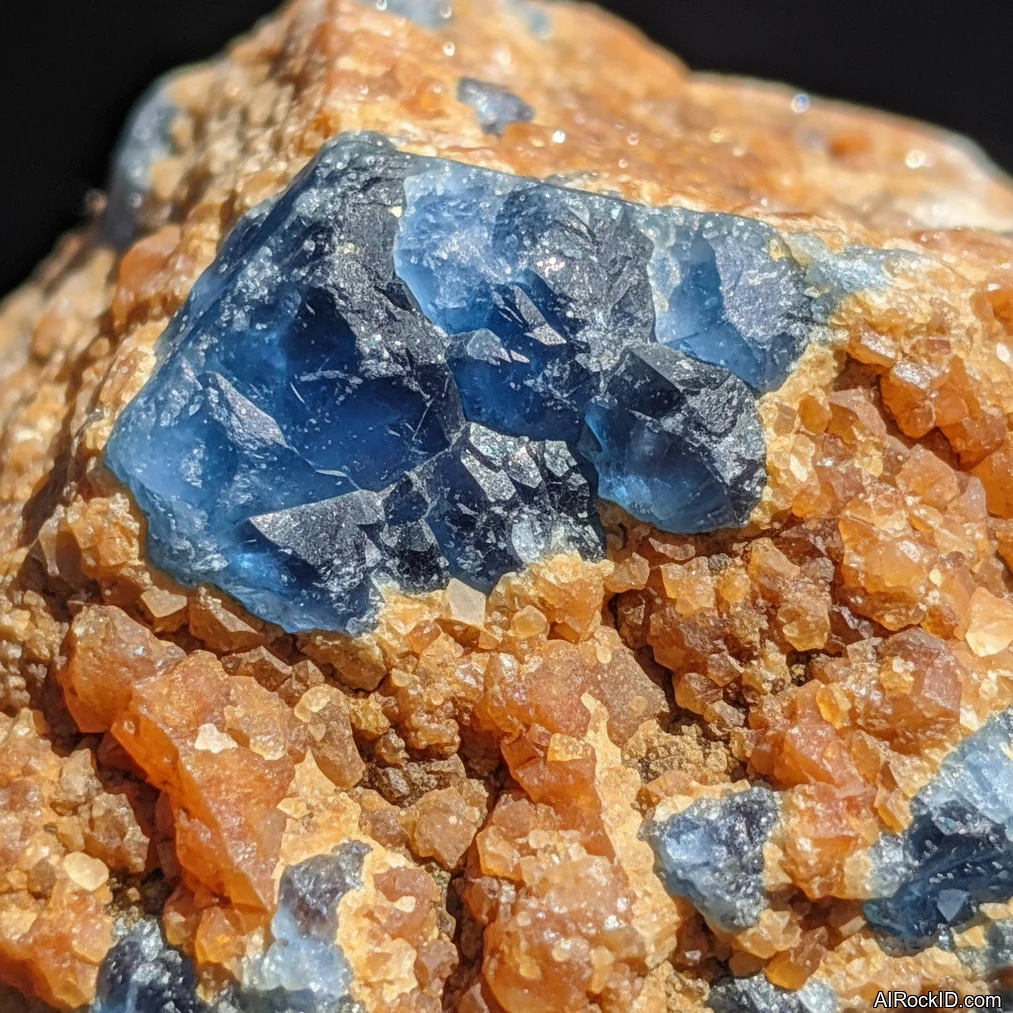
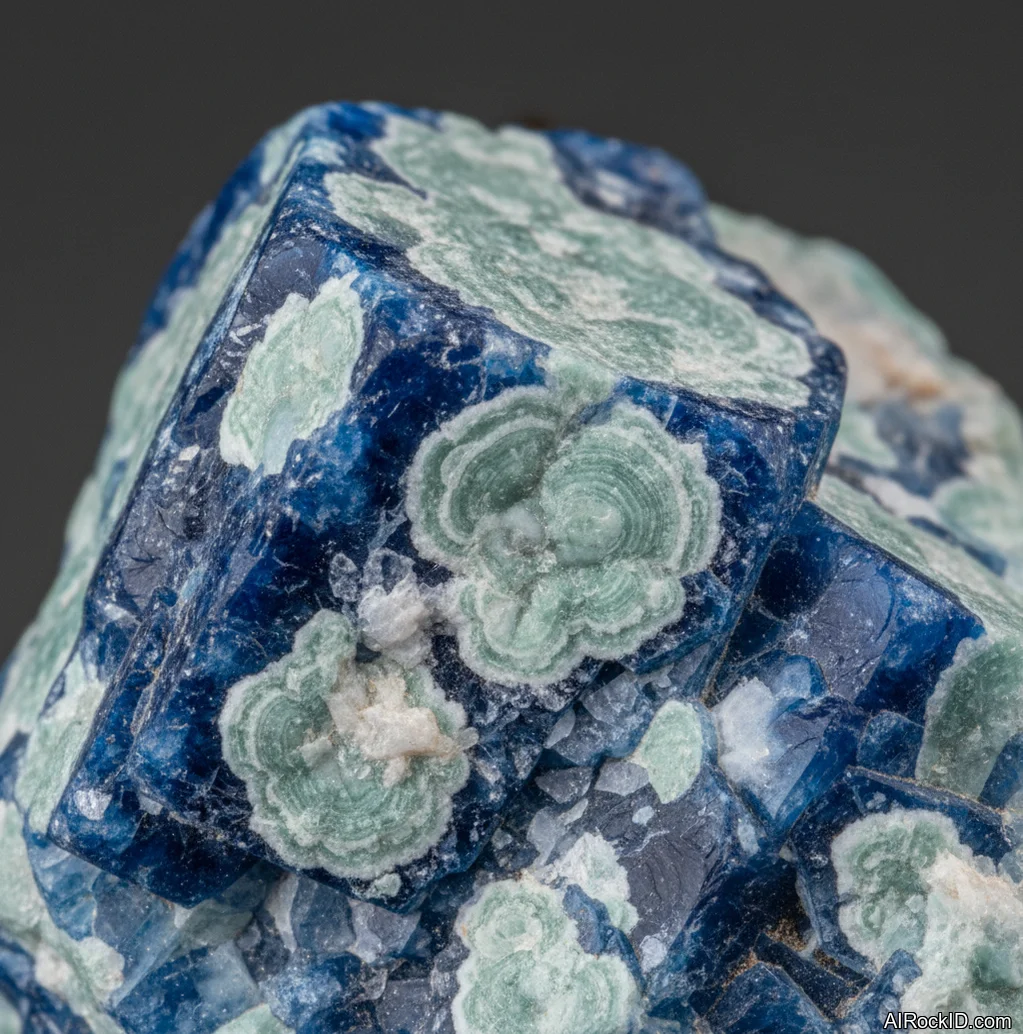
Trolleite is a pretty rare aluminum phosphate mineral with the formula Al4(PO4)3(OH)3, and most of the time it shows up as pale to denim-blue, chunky massive material, not neat, well-formed crystals.
If you grab a polished piece, it usually has that quartz-heavy feel in your hand, kind of cool and dense like a river-worn quartz rock. Thing is, a lot of what gets sold as “trolleite” is actually trolleite scattered through quartz, with little bits of lazulite or scorzalite mixed in. The blue can come off smoky, sometimes even a little chalky, and it shows up in blotches and swirls instead of crisp, sharp banding. Under bright shop lights, some pieces will kick back this soft powder-blue flash, and then you take the same stone over to a window and it looks like a totally different chunk.
Most dealers aren’t sitting on trays of textbook trolleite crystals, either. You’re way more likely to run into spheres, freeforms, palm stones, and those rounded worry-stone shapes. And honestly, that fits the material. It takes a decent polish, but the best pieces still keep that natural, cloudy look instead of turning glassy like agate.
Origin & History
Back in 1868, Adolf Erik Nordenskiöld described trolleite. He was a Finnish-Swedish geologist with a knack for stumbling onto odd minerals out in the field, then going home and naming them with a lot of care. He called it trolleite after Hans Gabriel Trolle-Wachtmeister, a Swedish statesman.
Now for the collector-side reality check. You see the name “trolleite” in the market way more than you did 15 years ago, and that’s not an accident. But a lot of what’s sold as modern “trolleite” is composite material. That doesn’t mean it’s fake. It usually means you’re buying a good-looking phosphate mix, and real trolleite is just one of the players in that rock (not the whole story).
Where Is Trolleite Found?
Trolleite is reported from classic Swedish localities and also from phosphate-bearing pegmatites and metamorphosed phosphate deposits, with a lot of lapidary material sold from Brazil and Madagascar.
Formation
Out in the field, trolleite shows up where there’s a lot of phosphate around. Most of the time it’s tied to granitic pegmatites or high-grade metamorphic zones, the kind where phosphate fluids had enough time to react with aluminum-bearing rocks instead of just flashing through.
So yeah, it tends to have neighbors. You’ll usually run into other phosphate minerals in the same spot, and quartz is a really common host rock for it.
If you’ve got a cut face to stare at, you can usually see what happened. The blue isn’t some surface stain. It runs through the quartz in messy, uneven clouds, and sometimes you’ll catch darker streaks that turn out to be lazulite or scorzalite. And when a piece has those tiny granular patches and small color shifts (the kind you notice when you tilt it under a light), that’s usually your clue the rock formed in pulses, not in one single clean event.
How to Identify Trolleite
Color: Most trolleite sold to collectors is pale blue to denim-blue, sometimes gray-blue, usually in cloudy patches within white or translucent quartz.
Luster: Luster is typically vitreous to dull depending on how much quartz is present and how fine-grained the phosphate is.
Pick up two pieces side by side. If one feels “glassy” and sparkly everywhere, you’re probably holding mostly quartz with minor blue phosphate. The real test is a loupe: trolleite areas often look finely granular or cloudy, while quartz zones look clearer and more sugary at the edges. And don’t be surprised if a seller calls it trolleite when lazulite or scorzalite are doing a lot of the blue work.
Properties of Trolleite
Physical Properties
| Crystal System | Orthorhombic |
| Hardness (Mohs) | 5.0-5.5 (Medium (4-6)) |
| Density | 2.95-3.10 |
| Luster | Vitreous |
| Diaphaneity | Translucent to opaque |
| Fracture | Uneven |
| Streak | White |
| Magnetism | Non-magnetic |
| Colors | pale blue, denim blue, gray-blue, white |
Chemical Properties
| Classification | Phosphates |
| Formula | Al4(PO4)3(OH)3 |
| Elements | Al, P, O, H |
| Common Impurities | Fe, Mg |
Optical Properties
| Refractive Index | 1.61-1.64 |
| Birefringence | 0.015 |
| Pleochroism | Weak |
| Optical Character | Biaxial |
Trolleite Health & Safety
Trolleite’s generally considered non-toxic, so it’s safe enough to hold in your hand and work with. But if you’re cutting or grinding it, don’t breathe in the dust. Stone dust is stone dust (it gets in your nose and throat fast), so wear a mask and keep things ventilated.
Safety Tips
Use water and make sure you’ve got real ventilation going when you’re doing lapidary work (not just a cracked window, either). And after you’ve been around rock dust, wash your hands.
Trolleite Value & Price
Price Range
Rough/Tumbled: $15 - $120 per piece
Prices jump when the blue is strong and even, with hardly any fractures, and you really see that spike on bigger spheres or those clean freeform cuts. With the mixed stuff people sell as “trolleite,” it’s all over the place, because the quartz content and the exact blue phosphate mix can swing the look a ton (some pieces read more milky, some go crisp blue).
Durability
Moderate — Scratch resistance: Fair, Toughness: Fair
It’s generally stable for display, but it can chip on edges and doesn’t love hard knocks, especially if it’s a quartz-phosphate mix with tiny internal seams.
How to Care for Trolleite
Use & Storage
Store it like you’d store feldspar or apatite: wrapped or in a compartment so it doesn’t bang into harder quartz points or metal. If it’s a polished piece, keep it off gritty shelves that can haze the shine.
Cleaning
1) Rinse with lukewarm water. 2) Use a drop of mild soap and your fingers or a soft brush to lift skin oils. 3) Rinse again and pat dry with a soft cloth.
Cleanse & Charge
If you do energy-style care, stick to gentle options like smoke, sound, or a quick rinse and dry. I avoid leaving it soaking just because a lot of pieces have micro-fractures that hold water spots.
Placement
It looks best under neutral light where the blues don’t go gray. I like it on a desk or shelf where you can pick it up, because the color shifts when you tilt it.
Caution
Skip ultrasonic cleaners and harsh chemicals. They can shove grime down into those hairline seams (you know, the ones that catch a fingernail) and leave the polish looking flat. And don’t toss it in a drawer loose with corundum, topaz, or diamond jewelry.
Works Well With
Trolleite Meaning & Healing Properties
Most people reach for trolleite because of the color, honestly. That soft blue looks calm without screaming for attention. I’ve got a chunk that lives right next to my papers and study pile, because just seeing it seems to nudge my brain into a quieter lane. It isn’t sparkly. It just sits there. Steady.
Thing is, a lot of what you see for sale isn’t pure anything, it’s usually a mix, and that changes the whole vibe. When the blue is threaded through quartz, it looks kind of “spaced out,” like blue thoughts drifting across a white page. Grab a polished sphere and roll it around in your palm for a minute. The quartz stays cool longer than you expect, and you can feel this tiny shift in resistance as your thumb passes over those cloudy phosphate areas, like the polish has a slightly different glide. That little texture change? That’s why I end up using it as a fidget stone.
But keep your feet on the ground. Any metaphysical use is personal practice, not medicine, and trolleite isn’t a magic fix for anxiety or insomnia. So if you’re reaching for it, treat it like a cue. Slow down. Breathe. Do the unglamorous helpful stuff: drink water, get some sleep, and ask for support when you actually need it (hard, but worth it).
Identify Any Crystal Instantly
Snap a photo and get properties, value, care instructions, and healing meanings in seconds.