Veszelyite
What Is Veszelyite?
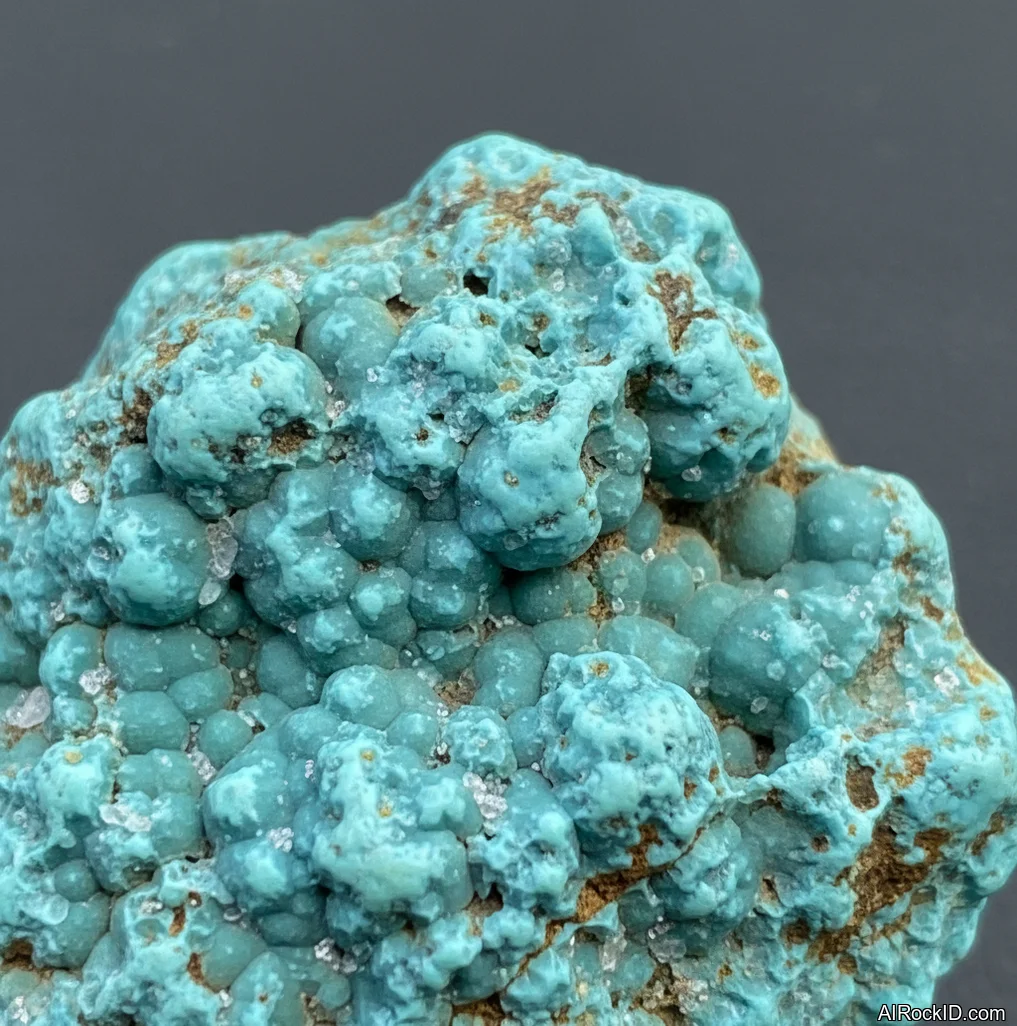
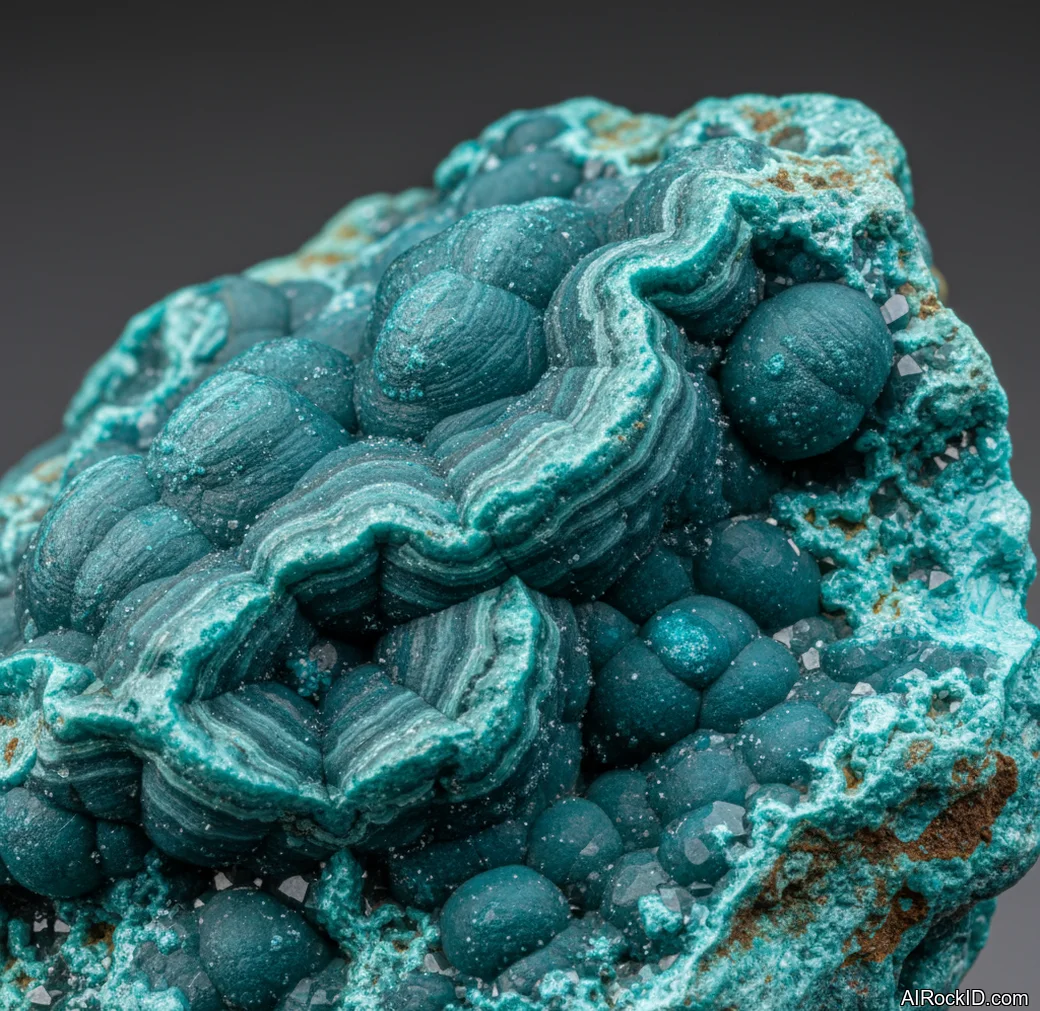
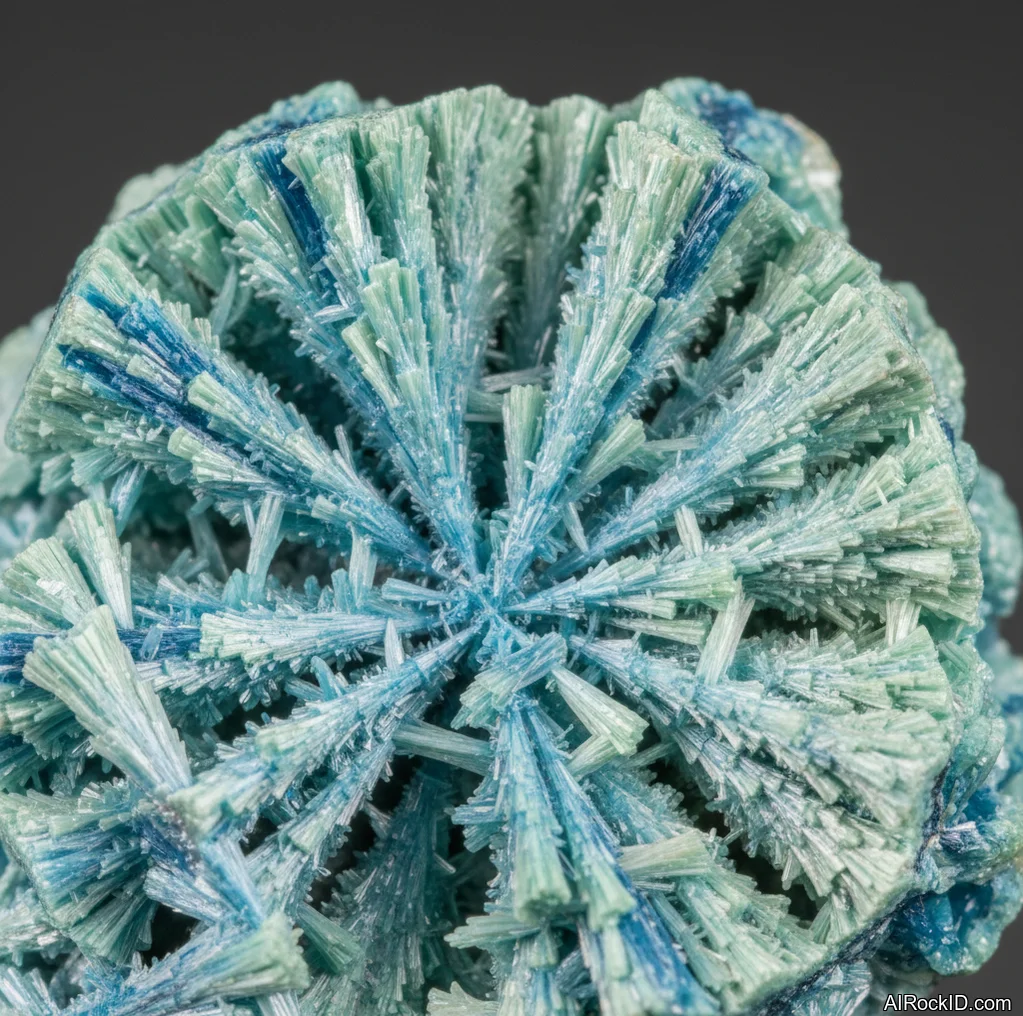
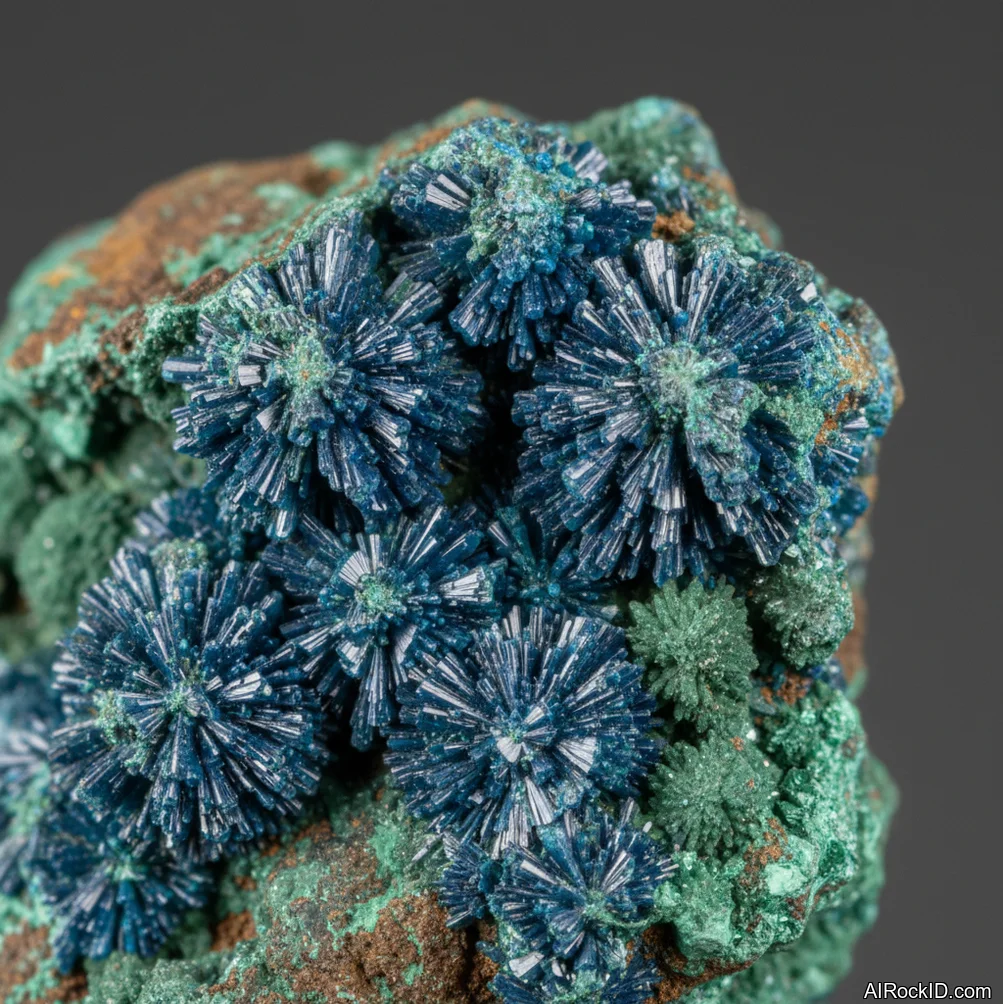
Veszelyite’s a rare hydrated copper-zinc phosphate mineral, and it usually shows up in that blue to blue-green range. Most of the pieces you’ll see for sale aren’t big single crystals. They’re more like a crust of tiny crystals sitting on limonite or some other oxidized gossan material, and if the faces are open you can catch a bit of sparkle when you tilt it.
Pick up a thumbnail-sized piece and the first thing you notice is the weight. It’s lighter than it looks. Not feather-light, just not that “ore-heavy” heft you get from a lot of copper minerals. And photos lie, honestly. Under a warm lamp it can drift greener, but in daylight it usually snaps back to a cleaner teal-blue.
People compare it to turquoise all the time at first glance. But it doesn’t feel the same in your hand. Turquoise tends to be waxier and more solid, like a tight, opaque lump. Veszelyite, when it’s well-crystallized, reads more glassy, and you’ll usually see it as drusy coatings or little rounded aggregates instead of a chunky, opaque mass.
Origin & History
Hungary’s where the name comes from. Veszelyite got its formal description in 1890 from József Szakáll, and the name was picked to honor the Hungarian mineralogist Gábor Veszely.
For collectors, it never really picked up that old-school gemstone storyline that turquoise or malachite ended up with. It’s more for the mineral-nerd crowd than for jewelry boxes. Thing is, it’s one of those species that basically tells you you’ve landed in the right zone of an oxidized Zn-Cu system, so it earns a spot in serious collections even when the crystals are tiny.
Where Is Veszelyite Found?
Veszelyite turns up in the oxidized zones of zinc and copper deposits, often as microcrystalline crusts in vugs and fractures. Good collector material is reported from places like Tsumeb (Namibia) and Bou Skour (Morocco), with classic occurrences tied to Central European ore districts.
Formation
Most dealers say it comes out of oxidized ore zones, and honestly, that tracks. Veszelyite shows up as a secondary mineral when copper and zinc-bearing sulfides start breaking down near the surface, and phosphate-rich fluids slip through fractures and little cavities.
Look, if you stare at a solid specimen long enough, you can almost see what happened in what order. First there’s that brown limonite or goethite, kind of earthy and dull. Then you get this sudden blue-green druse lining a crack (the crystals sit there like a thin crust), sometimes with a few other late-stage phosphates dusted around it. It’s usually a “last act” mineral. So the crystals tend to be small, perched on a crumbly matrix that’ll shed grit if you rub it.
How to Identify Veszelyite
Color: Blue, blue-green, to greenish blue is the usual range, often in thin coatings or tiny crystals. Color can look more green under warm indoor light and more blue in daylight.
Luster: Vitreous to slightly silky on drusy crusts.
Pick up a piece and tilt it under a single overhead light. Good veszelyite has a glassy flash on the microfaces, while turquoise and chrysocolla stay more waxy and dead. The real test is the habit: veszelyite is commonly drusy or in small aggregates, not big smooth nodules. And if you’re shopping from photos, ask for a side angle shot, because sellers can make any blue crust look the same straight-on.
Properties of Veszelyite
Physical Properties
| Crystal System | Orthorhombic |
| Hardness (Mohs) | 3.5-4 (Soft (2-4)) |
| Density | 3.10-3.30 |
| Luster | Vitreous |
| Diaphaneity | Translucent |
| Fracture | Uneven |
| Streak | Pale blue to greenish white |
| Magnetism | Non-magnetic |
| Colors | Blue, Blue-green, Greenish blue, Teal |
Chemical Properties
| Classification | Phosphates |
| Formula | (Cu,Zn)3(PO4)2·3H2O |
| Elements | Cu, Zn, P, O, H |
| Common Impurities | Fe, Mn |
Optical Properties
| Refractive Index | 1.64-1.66 |
| Birefringence | 0.020 |
| Pleochroism | Weak |
| Optical Character | Biaxial |
Veszelyite Health & Safety
Normal handling’s fine. But don’t breathe in the dust if you end up rubbing, scraping, or trimming the matrix (that gritty stuff that can puff up when you nick an edge). And wash your hands after you’ve been handling it, especially if you’re snacking at the table or moving between multiple copper minerals.
Safety Tips
Don’t grind or cut it while it’s dry. If you’re cleaning matrix, at least do the basic dust control stuff: keep it damp, work on a wet paper towel, and don’t let that fine powder puff up into the air. And honestly, after a mineral session, a quick hand wash is enough for most people.
Veszelyite Value & Price
Price Range
Rough/Tumbled: $25 - $300 per specimen
Price jumps usually come down to looks. That bright, in-your-face blue, the clean drusy glitter you see when you tilt it under a lamp, and a matrix that stays put without crumbling matter way more than sheer size. Pieces with sharp, well-formed microcrystals from known localities cost more than those generic blue crusts that all kind of blur together.
Durability
Fragile — Scratch resistance: Fair, Toughness: Poor
It can be stable in a display case, but the drusy crust and oxidized matrix can chip or shed if you handle it a lot.
How to Care for Veszelyite
Use & Storage
Store it in a perky box or on a shelf where it won’t get bumped, because the crusty blue areas chip easier than they look. I keep mine away from heavy cabinet drawers that shake when you close them.
Cleaning
1) Use a soft, dry brush to lift dust from the druse. 2) If you need more, rinse quickly with cool water and pat dry, no soaking. 3) Let it air-dry fully before putting it back in a closed box.
Cleanse & Charge
If you do energy-style care, stick to smoke, sound, or moonlight and keep it gentle. Avoid salt bowls, since salt crystals can scratch soft surfaces and leave crusty residue in vugs.
Placement
A stable shelf with indirect light is best, especially if the matrix is crumbly. Put it where you can view it from an angle, because that’s when the microcrystals actually light up.
Caution
Skip ultrasonic cleaners, harsh acids, or going at it with a stiff brush. Don’t handle it like a solid turquoise cab, because a lot of the time it’s just a thin turquoise skin sitting on softer, oxidized rock underneath.
Works Well With
Veszelyite Meaning & Healing Properties
In the metaphysical world, veszelyite usually gets tossed into the “calm blue stones” bucket. But to me, it’s less about calm and more about sorting signal from noise. You look at that blue-green druse and your brain kind of wants to tidy the mess up. Not in a magical way. Just in that ordinary way certain colors and textures nudge you into a quieter headspace.
Pick up a piece and you’ll notice it right away: the feel flips between the gritty matrix and that slicker crystal crust on top. It’s a weird little contrast, and yeah, that’s why I keep it on my desk. The crystals have that tiny, slightly waxy glide under your thumb, while the rough base catches on your skin like fine sandpaper. And that physical switch is the point. It reminds me to slow down, figure out what’s actually solid, and stop forcing an answer when I’m missing information. Because how many times do we do that?
None of this is medical advice, and it’s not a substitute for treatment. But as a personal tool, I’ve used veszelyite during journaling when I’m trying to name what I’m actually thinking, not what I wish I were thinking (there’s a difference, unfortunately). It’s also a good “small and honest” stone. Most pieces aren’t showy, so it doesn’t turn into a performance item the way big glossy spheres can. Quiet. Handy. Just there when you need it.
Identify Any Crystal Instantly
Snap a photo and get properties, value, care instructions, and healing meanings in seconds.