Volcano Agate
What Is Volcano Agate?
Volcano Agate is just a trade name for agate, the banded kind of chalcedony (microcrystalline quartz), that forms in or around volcanic rocks and often shows smoky grays, rusty reds, and that lava-ish patterning people go for.
Pick up a palm stone and the first thing you clock is the temperature. It stays cool longer than glass or resin, and it has that solid, quartz-y heft in your hand even when the colors are all soft ash. Most pieces I run into go semi-translucent at the thinner edges, and the bands sort of fade in and out (not those crisp, high-contrast stripes you see in some classic Brazilian agates).
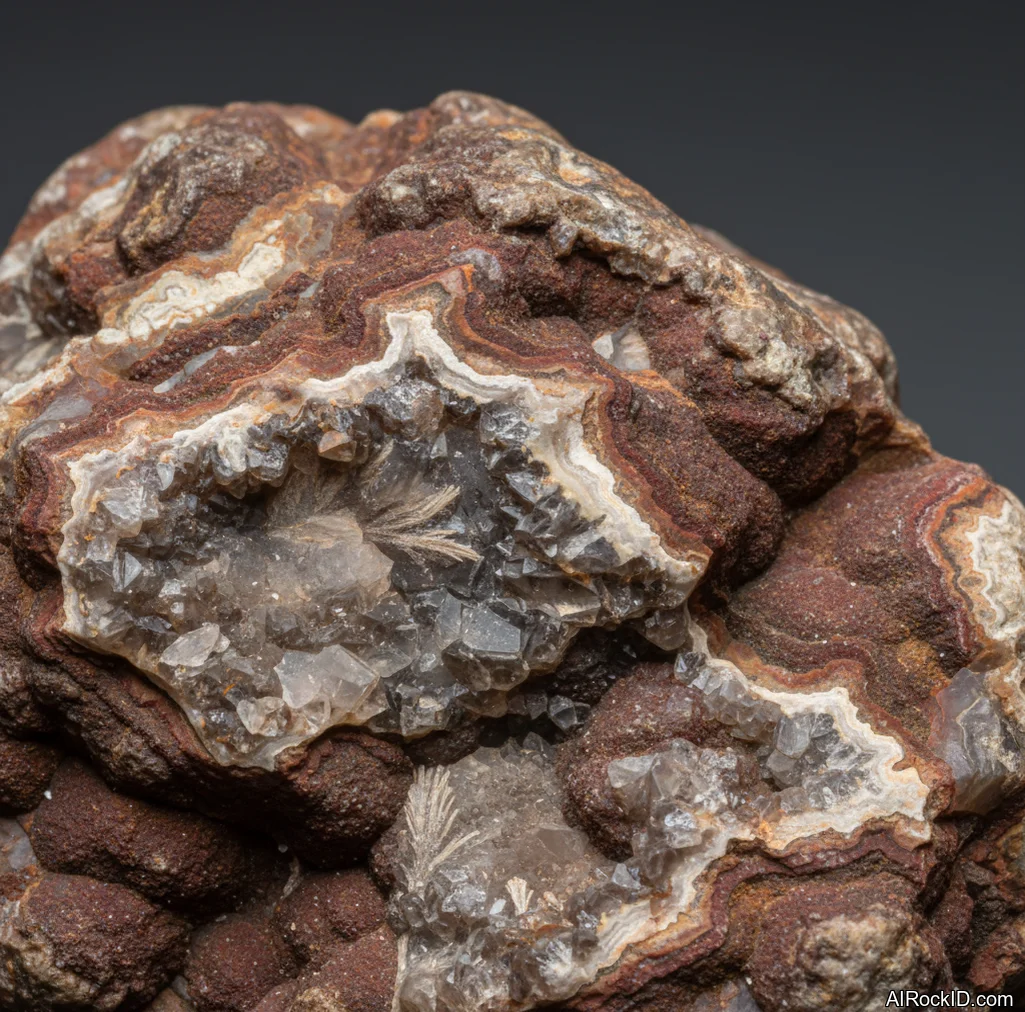
At a glance, a lot of “volcano” stuff reads like plain brown-gray agate. But hit it with a strong light and you’ll spot tiny healed fractures, plume-like wisps, and sometimes little vugs lined with sugar-druse quartz. Thing is, the name isn’t a strict geology term. Different sellers slap it on different volcanic-host agates, so the look can swing from subtle to really dramatic.
Origin & History
Most dealers are using “Volcano Agate” as a modern market label, not a formally described mineral variety, so there isn’t one clean “first described by” moment the way you’d get with a named species.
The name’s pretty literal, honestly. It’s just pointing at the environment: silica-rich fluids seep into bubbles and little cracks in basalt, rhyolite, or other volcanic rocks, then later somebody slices it open and polishes it up, and you get those lava-and-ash style patterns people go for (you can feel that smooth, glassy face after a good polish, and the darker bands tend to show up once it’s wet).
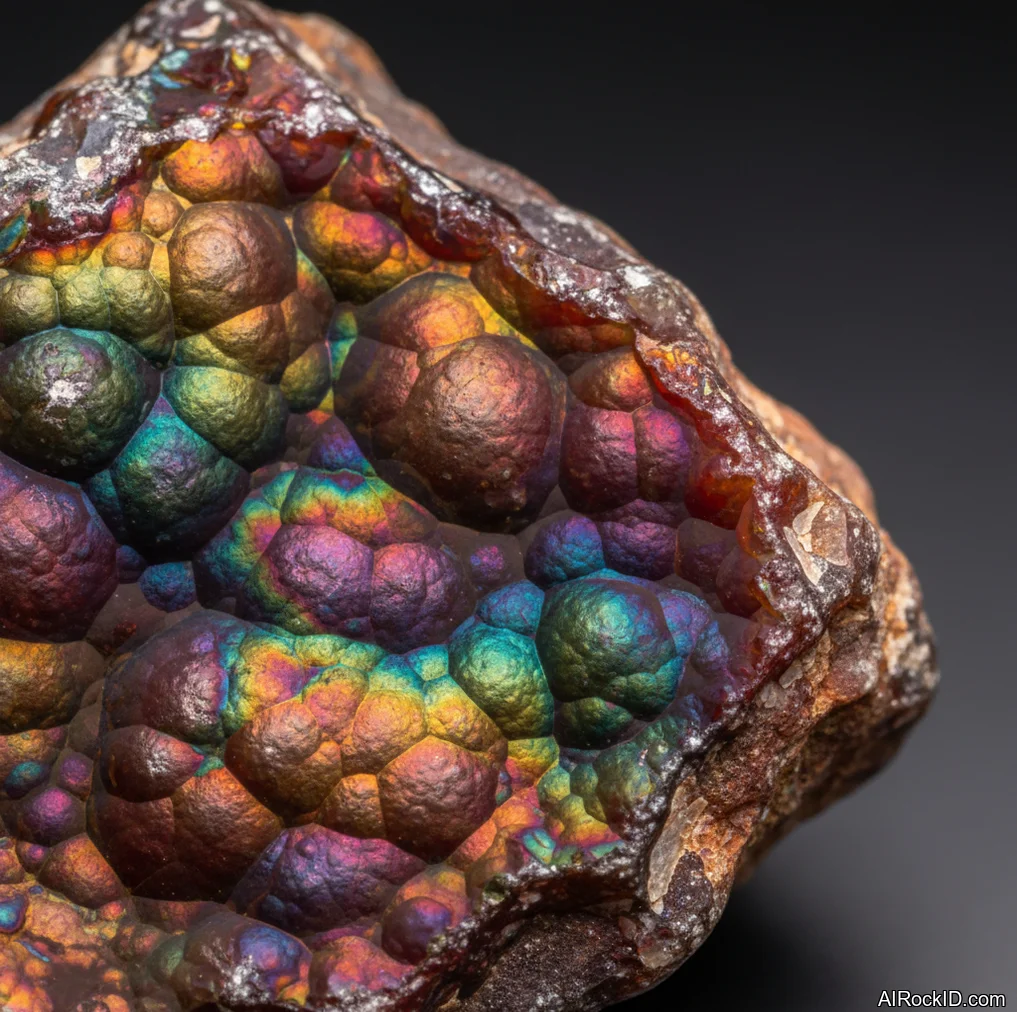
And in shows or online listings, you’ll see the label bleed into other names. “Volcanic agate,” “lava agate,” and sometimes even “fire agate” get used in the same breath, even though fire agate is its own thing with iridescent limonite layers. Why does that happen? Because the patterns look kind of related at a glance, and sellers like short, punchy names.
Where Is Volcano Agate Found?
You’ll run into Volcano Agate as a label for agates from volcanic terrains, especially basalt and rhyolite fields. A lot of the supply in the trade is cut from nodules mined in large agate-producing regions and then sold under this descriptive name.
Formation
Agate forming in volcanic rock really starts with an empty pocket. Gas bubbles get trapped as lava cools, or you can get cracks later on from cooling and tectonic stress, and either way you end up with open space. Then silica-rich fluids thread through and begin coating the walls with chalcedony. It’s not a one-and-done fill. It comes in pulses. And those pulses are what build the banding, the gentle color fades, and sometimes that last little drusy quartz crust sitting in the center.
But if you put volcanic-host agates next to ones from sedimentary settings, you’ll often notice more iron staining in the volcanic stuff, plus more “smoke” in the gray and brown tones. The giveaway, though, is the inside. On a fresh break, chalcedony looks tight and waxy, and it breaks with a clean conchoidal snap. And if there’s a vug, those tiny crystals have that fine-sandpaper feel when you drag a fingertip across them (you can’t not check, right?).
How to Identify Volcano Agate
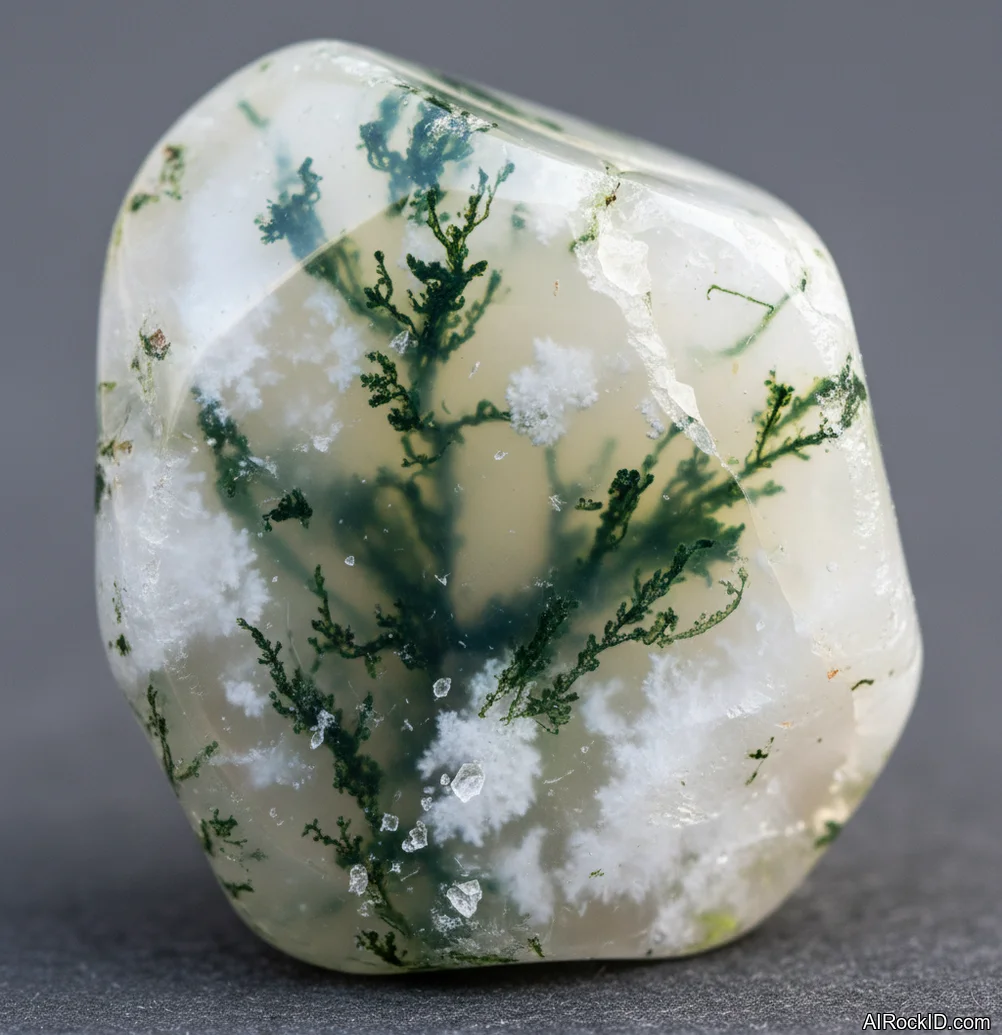
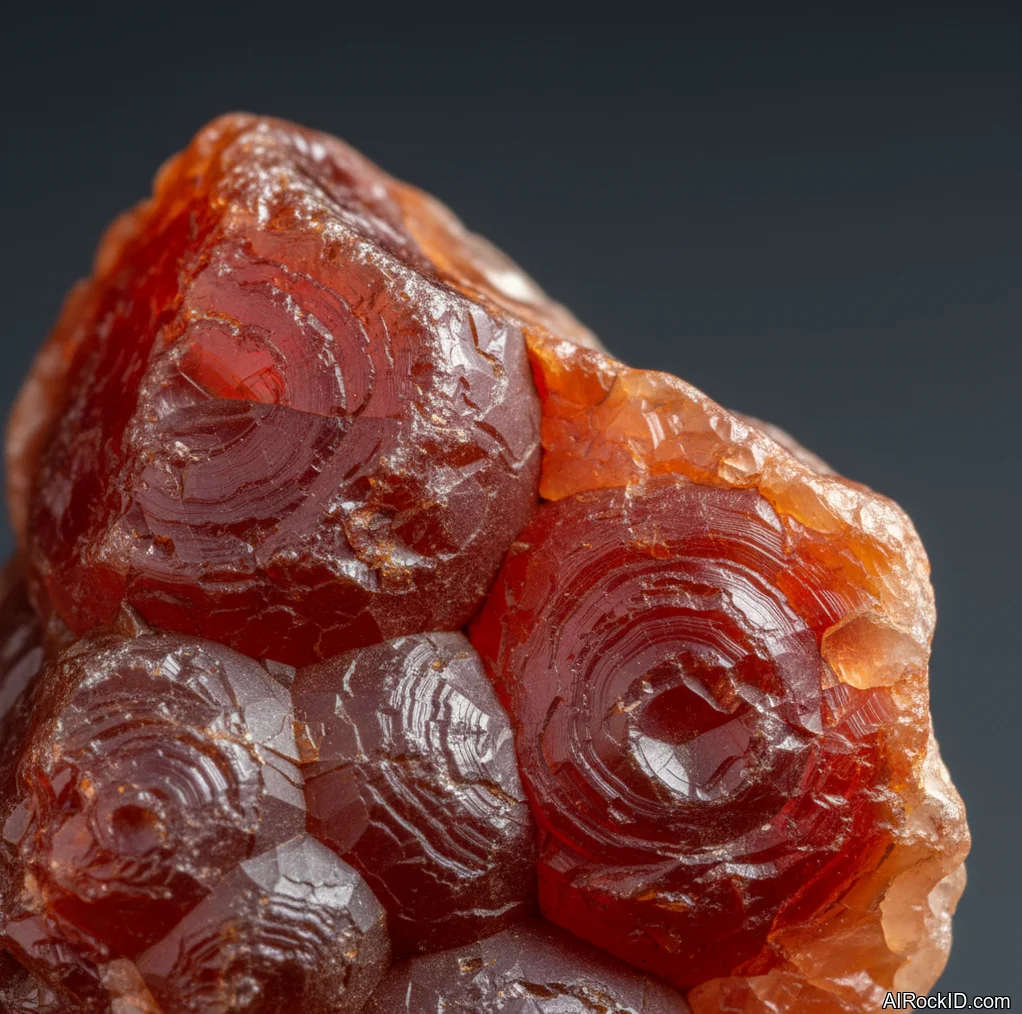
Color: Most Volcano Agate in the trade runs gray, tan, cream, and rusty red-brown, sometimes with black dendritic-looking patches or cloudy plumes. Thin edges can glow a little when backlit, but thick areas usually look opaque.
Luster: Waxy to vitreous, depending on polish and how fine the chalcedony is.
If you scratch it with a steel nail, it shouldn’t take a mark, but it will scratch glass. Look for natural-looking band transitions and little healed fractures that don’t repeat in a perfect pattern. Cheap versions are sometimes dyed agate, and the giveaway is color that pools in cracks or looks too uniform, especially hot red or neon purple that doesn’t fit the usual volcanic palette.
Properties of Volcano Agate
Physical Properties
| Crystal System | Trigonal |
| Hardness (Mohs) | 6.5-7 (Hard (6-7.5)) |
| Density | 2.58-2.64 |
| Luster | Waxy |
| Diaphaneity | Translucent to opaque |
| Fracture | Conchoidal |
| Streak | White |
| Magnetism | Non-magnetic |
| Colors | Gray, Brown, Red-brown, Tan, Cream, Black, White |
Chemical Properties
| Classification | Silicates |
| Formula | SiO2 |
| Elements | Si, O |
| Common Impurities | Fe, Mn, Al, Ca |
Optical Properties
| Refractive Index | 1.530-1.540 |
| Birefringence | 0.004 |
| Pleochroism | None |
| Optical Character | Uniaxial |
Volcano Agate Health & Safety
Volcano Agate is basically quartz, so it’s fine to pick up, handle, and even rinse off under the tap. But if you cut it or grind it, that’s where you’ve got to pay attention. The real issue is silica dust floating in the air.
Safety Tips
If you’re shaping or polishing, keep things wet, crack a window or run a fan for ventilation, and wear a proper respirator that’s actually rated for silica dust. Silica’s no joke, right?
Volcano Agate Value & Price
Price Range
Rough/Tumbled: $5 - $60 per piece
Cut/Polished: $1 - $8 per carat
Price mostly comes down to the pattern, how see-through it is, and whether the banding looks clean or you’re getting those scenic plume shapes. Big slabs with tight, consistent color (the kind that stays steady edge to edge when you tilt it under a lamp) and a few drusy pockets that catch on your fingertip cost more than ordinary tumbled stones.
Durability
Durable — Scratch resistance: Good, Toughness: Good
It holds up well in normal wear, but sharp impacts can chip edges, especially on thin cabochons or points.
How to Care for Volcano Agate
Use & Storage
Keep it in a pouch or a compartmented box if it’s polished, since agate can still scratch softer stones sitting next to it. Raw nodules are fine on a shelf, but drusy pockets chip if they knock around.
Cleaning
1) Rinse with lukewarm water and a drop of mild soap. 2) Use a soft toothbrush to get dust out of bands and tiny vugs. 3) Rinse well and pat dry; avoid soaking pieces with lots of open druse if they’ve got iron staining you don’t want to leach.
Cleanse & Charge
If you do energetic cleansing, a quick rinse and a night on a windowsill with indirect light is plenty. But don’t bake it in harsh sun for days if the color is heavily iron-stained and you care about keeping it consistent.
Placement
On a desk, it’s a good “hands-on” stone since it doesn’t feel fragile and the patterns are fun to stare at between tasks. In a display case, backlighting a thin slab brings out the smoky translucence.
Caution
Skip bleach, strong acids, and any really harsh ultrasonic cleaning, especially if the piece has those drusy little pockets or natural fractures you can feel with a fingernail. And if it’s dyed (some are), go easy, because aggressive cleaners can yank color right out of the cracks. Why risk it?
Works Well With
Volcano Agate Meaning & Healing Properties
Next to the flashy stones, Volcano Agate feels like a slow burn. When I’ve got a chunky piece in my palm, it sits there with this steady, grounded weight, like my attention finally has something to latch onto instead of pinging all over the place. The banding does a lot of the heavy lifting. Your eyes track those lines, and weirdly enough your breathing starts to fall in step.
People love to tag agates as “stability,” and yeah, I see it. But look, if you’re hoping for some dramatic overnight shift from one meditation session, this probably won’t hit like that. It’s more about routine. I’ve left a slab on my workbench for weeks, right by the edge where my wrist keeps brushing it, and I end up touching it without thinking while I’m stuck on a problem (you know the feeling).
And just to be clear, metaphysical talk isn’t medical talk. If you use stones as a focus tool, Volcano Agate works well with grounding practices, stress management habits, body-based calming techniques, and the simple stuff that brings you back into your body. The best way I’ve used it is almost boring: hold it, pick one band you like, and keep your eyes on that for a minute. That’s it. Small. Repeatable. Not mystical.
Identify Any Crystal Instantly
Snap a photo and get properties, value, care instructions, and healing meanings in seconds.