Green Sardonyx
What Is Green Sardonyx?
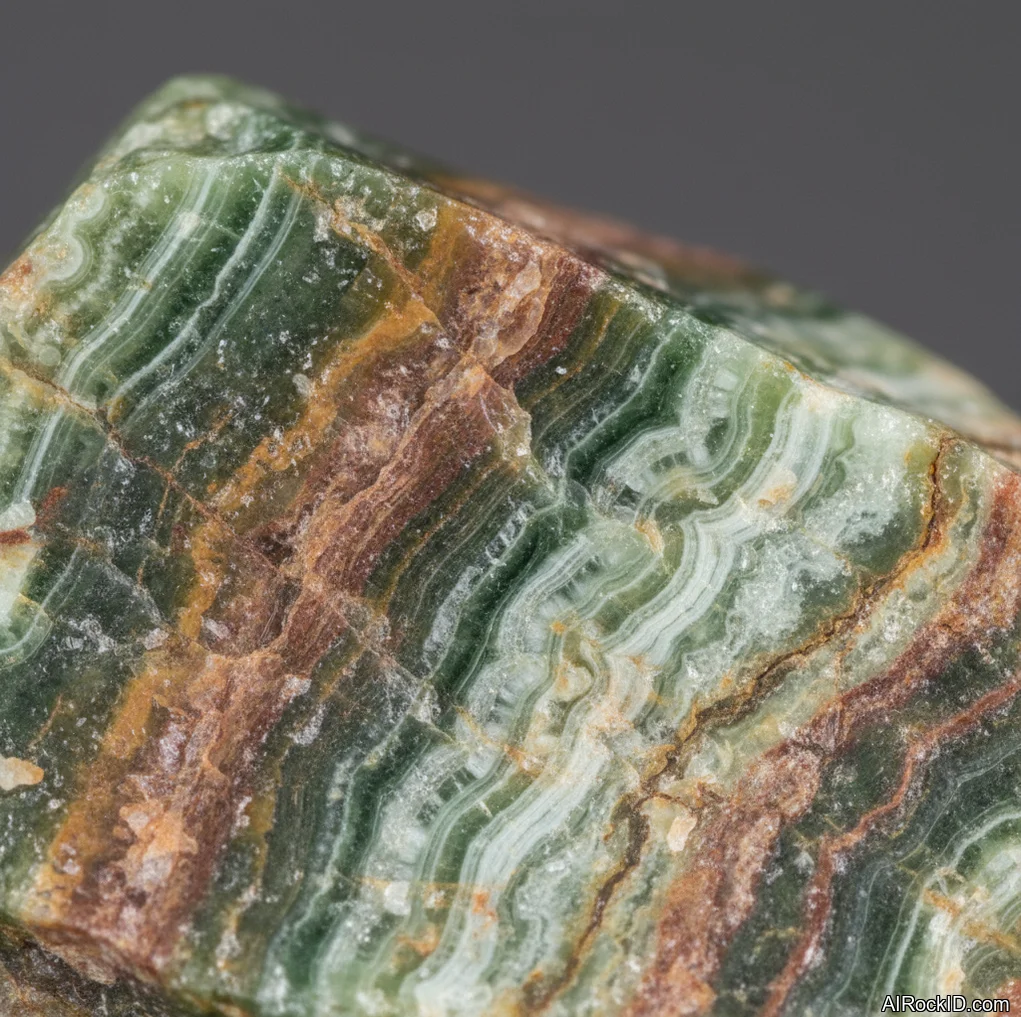
Green Sardonyx is a green-and-white, banded type of chalcedony (microcrystalline quartz) that gets sold under the sardonyx/onyx family.
Pick up a polished piece and you feel it right away. Slick, almost glassy, but not sharp at the edges. And it stays cool in your hand longer than dyed glass does. The banding’s usually the giveaway too: neat, parallel lanes, not those swirly, messy patches you see in a lot of imitations.
At first glance, plenty of people call it “green onyx.” But thing is, in the trade that label gets tossed on a few different green, banded materials, so it’s not as specific as it sounds. The better Green Sardonyx has crisp layers, a slightly waxy shine (not plastic-looking), and a green that has some depth, like it’s inside the stone instead of painted on top.
Origin & History
Sardonyx as a name is old. Like, really old. It comes from “sard” (that reddish-brown chalcedony you’ve probably seen in old carvings) and “onyx” (chalcedony with bands), and the whole sardonyx versus onyx thing has always been about the banding, not some hard switch into a totally different mineral species.
Green Sardonyx, though, is basically a newer market label. It’s green banded chalcedony that looks like the classic sardonyx pattern, just without those warm sard browns, replaced with greens instead. And yeah, you’ll also catch it being sold as green onyx, which can muddy the water because “true onyx” is really about that banded look, not the color by itself.
Where Is Green Sardonyx Found?
Green banded chalcedony shows up in many volcanic and sedimentary settings worldwide, with a lot of lapidary-grade material moving through Brazil and parts of Asia and Eastern Europe.
Formation
Green Sardonyx usually gets made the same basic way as other chalcedonies: silica-rich fluids work their way through little cracks and pockets in rock, then leave behind microcrystalline quartz in thin layers. Over time those layers stack up, kind of like nature slowly painting stripes, one pass at a time.
So where does the green come from? It’s typically trace elements and tiny inclusions, most often iron, and sometimes nickel or other minerals depending on the deposit. If you’ve got a well-cut stone and you hold it under a bright desk lamp, you can sometimes catch the band edges looking a bit feathery at the microscopic level (almost fuzzy, not razor-sharp). That’s a chalcedony tell, and it doesn’t look like glass or plastic when you really stare at it.
How to Identify Green Sardonyx
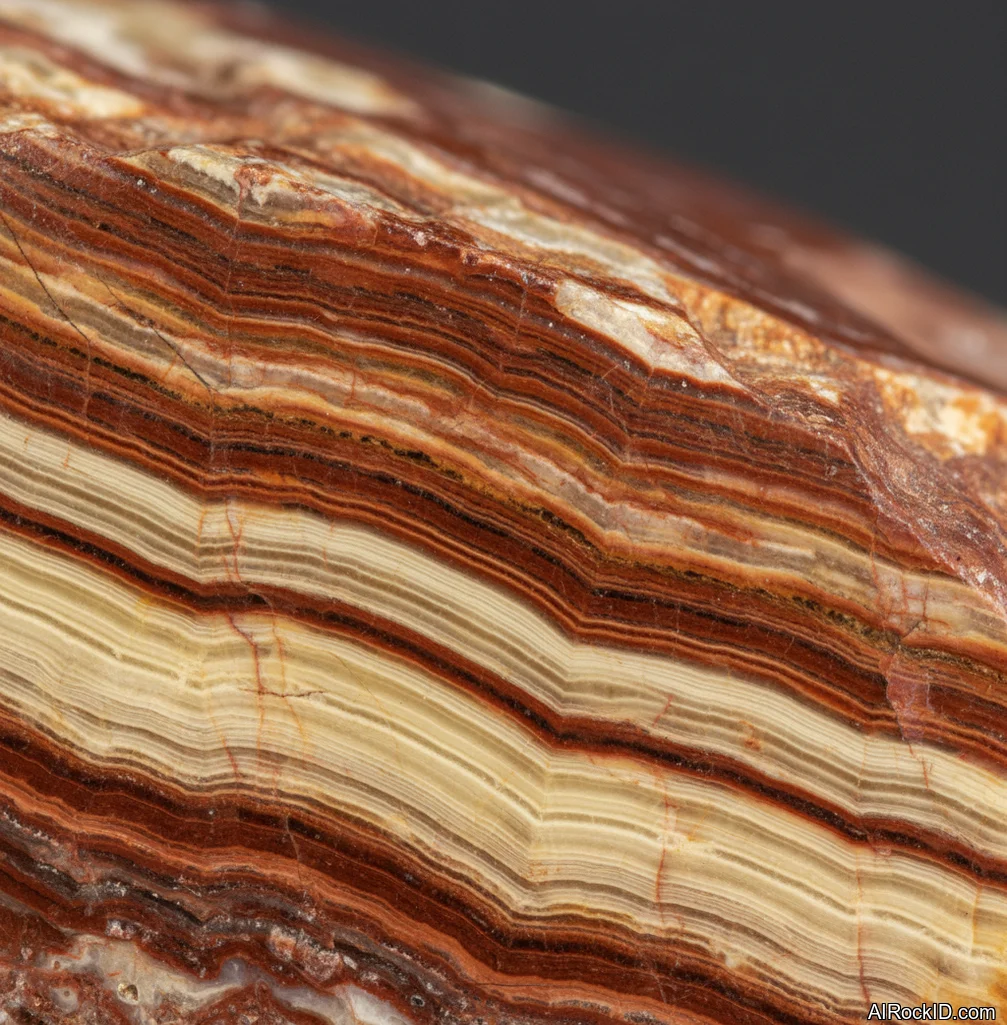
Color: Typically pale to medium green with white, cream, or gray bands; the green can range from minty to mossy. Banding is usually straight to gently curved rather than chaotic.
Luster: Waxy to vitreous when polished.
If you scratch it with a steel nail, it shouldn’t take the scratch easily, but a cheap dyed calcite “green onyx” will. Hold it to your cheek: real chalcedony feels cold and stays cold for a bit, while resin fakes warm up fast. The real test is the banding under strong light; dyed material often has color pooled in tiny pits or along fractures, and the green looks too uniform across different layers.
Properties of Green Sardonyx
Physical Properties
| Crystal System | Trigonal |
| Hardness (Mohs) | 6.5-7 (Hard (6-7.5)) |
| Density | 2.58-2.64 g/cm3 |
| Luster | Waxy |
| Diaphaneity | Translucent to opaque |
| Fracture | Conchoidal |
| Streak | White |
| Magnetism | Non-magnetic |
| Colors | Green, White, Cream, Gray |
Chemical Properties
| Classification | Silicates |
| Formula | SiO2 |
| Elements | Si, O |
| Common Impurities | Fe, Ni, Mn |
Optical Properties
| Refractive Index | 1.530-1.539 |
| Birefringence | 0.004 |
| Pleochroism | None |
| Optical Character | Uniaxial |
Green Sardonyx Health & Safety
Green Sardonyx isn’t toxic, and it’s fine to handle with bare hands. Thing is, just like any quartz, the one real concern only shows up if you’re cutting, grinding, or drilling it: that super-fine silica dust. Get that powder in the air and breathe it in (it hangs around longer than you’d think), and that’s when you want proper protection.
Safety Tips
Do your lapidary work wet, and put on a real respirator (not just a paper dust mask). Seriously, don’t sit there dry-sanding it on a bench with that fine powder floating up into your face.
Green Sardonyx Value & Price
Price Range
Rough/Tumbled: $5 - $40 per tumbled stone or small palmstone
Cut/Polished: $1 - $8 per carat
Price usually comes down to how crisp the banding looks and how natural the color feels in person. The pieces with thick, high-contrast layers and a clean polish (the kind that looks glassy when you tilt it under a light) cost more. But if the pattern’s blotchy or the material’s been heavily dyed and it shows, it stays cheap.
Durability
Very Durable — Scratch resistance: Good, Toughness: Good
It handles daily wear well, but sharp knocks can still chip edges because chalcedony breaks with a conchoidal fracture.
How to Care for Green Sardonyx
Use & Storage
Store it in a soft pouch if it’s polished, because quartz-on-quartz scratches are real and they sneak up on you. Keep it out of direct sun if the color looks dyed, since dyed greens can fade over time.
Cleaning
1) Rinse with lukewarm water and a drop of mild soap. 2) Gently scrub with a soft toothbrush around edges and drill holes. 3) Rinse again and pat dry; avoid harsh cleaners and long ultrasonic cycles if it has fractures.
Cleanse & Charge
If you do metaphysical cleansing, a quick rinse and a dry rest on a shelf works fine. I avoid salt soaks just because they’re messy and don’t add anything for a tough quartz like this.
Placement
On a desk or by a door, it reads as calm green from a distance and the banding shows up when you’re close. If you’ve got a display light, tilt it a bit so the bands don’t wash out.
Caution
Skip bleach and harsh acids. And don’t just trust the label when you see “green onyx”, because it isn’t always quartz. Some of it’s calcite, and that stuff will etch fast (you’ll see the surface go dull and a little chalky where a drop sat). So if you’re shopping for jewelry, look for signs of dye and straight-up ask what the base material is.
Works Well With
Green Sardonyx Meaning & Healing Properties
Look at how people actually use Green Sardonyx in crystal circles and it almost always lands in the “steadying” lane: routines, follow-through, and not getting knocked sideways by every little stressor. That tracks with how it feels in your hand. It’s dense for its size. And the banding gives your eyes something to lock onto when your brain won’t sit still.
But I’ll be blunt about the limits. Any claim that it treats illness is over the line. What I’ve seen is way more practical. People keep a palmstone in a pocket as a tactile reminder to slow down, or they park a banded piece on the desk as a visual cue to stay on task (same idea as keeping a sticky note in your line of sight). Banding helps with that. Kind of like lined paper.
Thing is, the big issue with Green Sardonyx on the market is dye. A lot of the bright “emerald green” pieces are treated, and some people feel odd about that in a spiritual practice. If you care, pick stones where the green shifts naturally across layers instead of looking like it was poured in. And when you rub real polished chalcedony between your thumb and finger, it’s slick but not greasy, and it holds that cool feel longer than plastic ever will. You can tell.
Identify Any Crystal Instantly
Snap a photo and get properties, value, care instructions, and healing meanings in seconds.