Hanksite
What Is Hanksite?
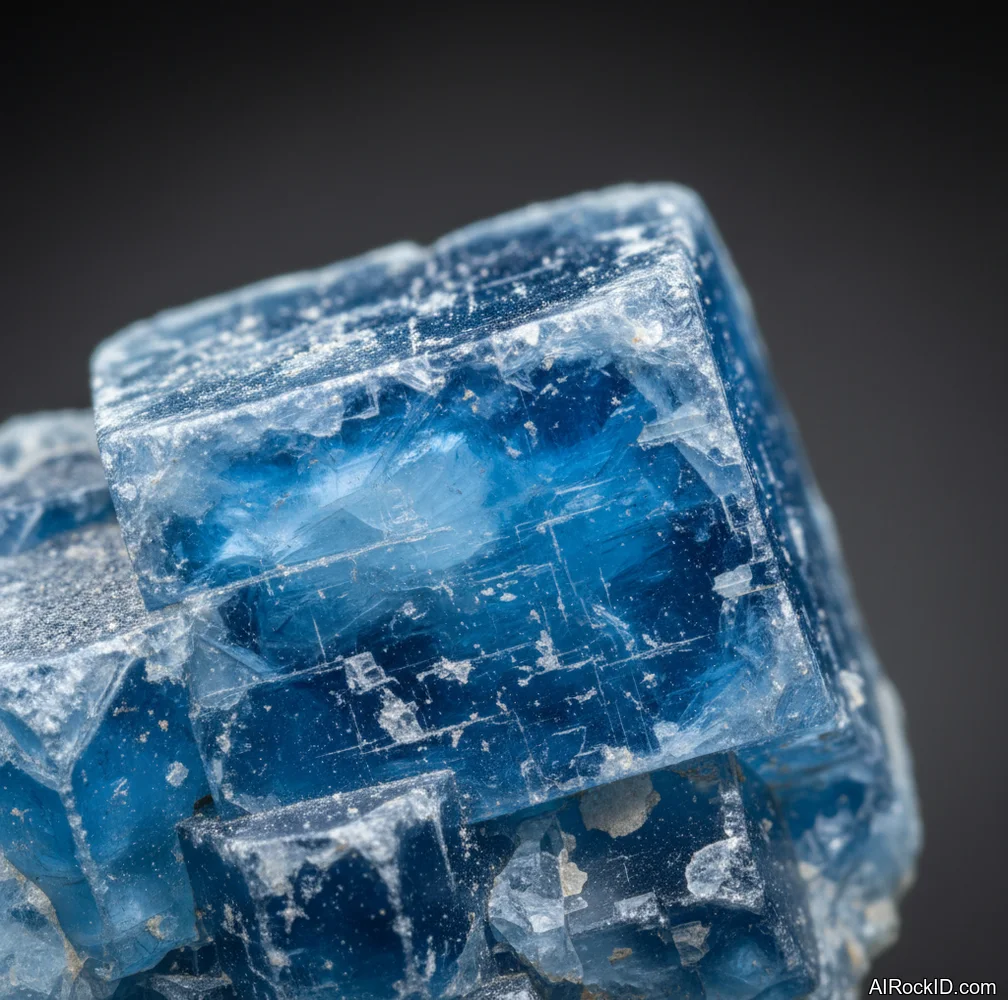
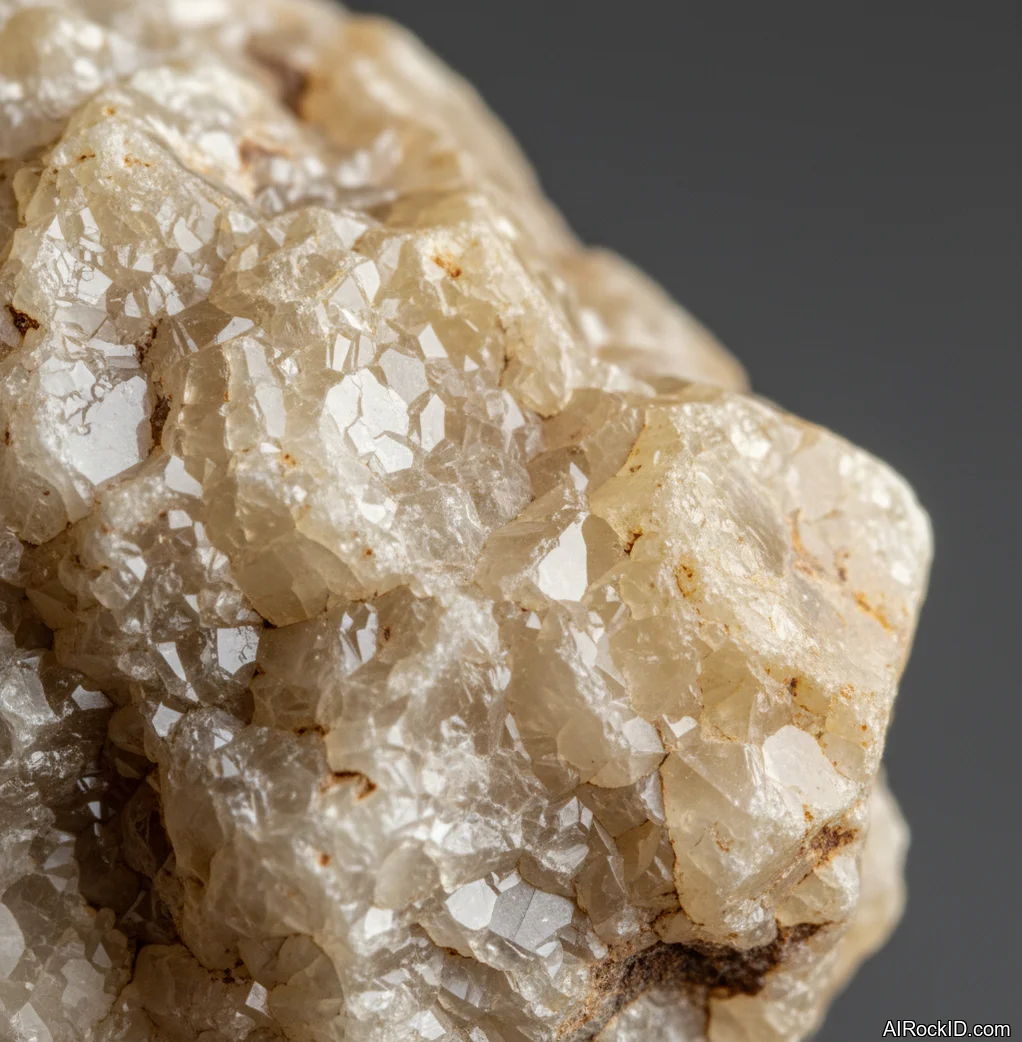
Hanksite is a rare evaporite mineral, basically a hydrated sulfate-carbonate salt, and its formula is Na22K(SO4)9(CO3)2Cl. In your hand, it reads like this clean, geometric hexagon that looks like somebody left it sitting out in the desert a little too long. Most specimens are colorless to cloudy white, sometimes with a smoky gray tint, and at first glance they can look weirdly sugary.
Pick up a hanksite and two things hit you immediately. First, it’s lighter than you’d guess for its size, kind of like holding a chunk of table salt that somehow decided to grow a crystal habit. Second, the surface usually has this dry, dusty bloom on it that just wants to soak up skin oils, so I try to grab them by the edges and then wash my hands after (because otherwise you’ll see fingerprints later). The nicest crystals keep that sharp hexagonal outline, and the faces are often etched, so when you tilt it under a lamp you get these little pinprick flashes of light.
But don’t expect it to act like quartz. Hanksite is a salt mineral, and salt minerals are fussy. Leave one in a humid room and it can start looking kind of tired, like it’s sweating and then drying out again, especially if there’s already a crusty coating sitting on the faces.
Origin & History
California’s where this whole thing kicks off. Hanksite got its first proper description in 1888, when George F. Becker wrote it up from material pulled out of Searles Lake in San Bernardino County. The name’s a nod to Henry Garber Hanks, California’s first State Mineralogist, and a guy who did a ton of the early legwork on the state’s mineral resources.
Those old write-ups keep calling the Searles Lake “salts” an industrial curiosity. And yeah, they were. Collectors showed up later. But if you’ve hung around mineral shows long enough, you’ve heard it said, almost like a reflex: “That’s the Searles Lake hexagon.” Funny thing is, people can picture the shape even when the name slips their mind.
Where Is Hanksite Found?
Hanksite is best known from the evaporite deposits at Searles Lake in California, where it forms in salt-rich brines and layered lakebed sediments.
Formation
Picture a closed-basin desert lake. No outlet, tons of evaporation, and brines that just keep concentrating until they’re basically like syrupy saltwater. Hanksite shows up late, after the chemistry has gotten kind of chaotic, when the brine is already loaded with sodium, potassium, sulfate, carbonate, plus a little chloride sloshing around in the mix. As the water keeps dropping, the solution finally slides into the right saturation window, and hanksite starts crystallizing out.
You usually find the crystals tucked into pockets or laid up in layers alongside other evaporite minerals. And it doesn’t feel like hunting pegmatite crystals, where you track down a vein and follow it. It’s closer to breaking into a salt cake from a natural chemical factory and picking through the crumbly, gritty stuff (sometimes it even has that slightly damp, crusty feel). The associations are often messy, too, which is why so much hanksite for sale has etched faces, or a crust of other salts stuck on it.
How to Identify Hanksite
Color: Most hanksite is colorless to white, often turning cloudy or pale gray from inclusions and surface crust. Clean crystals can look almost like frosted glass.
Luster: Vitreous to slightly dull on weathered faces.
Look closely for that classic hexagonal outline and flat faces with natural etching. The real test is touch and environment: it tends to feel dry and “salty,” and it doesn’t like humidity. If you scratch it with a copper coin, it’ll mark easily, and you can usually scratch it with a fingernail if you press.
Properties of Hanksite
Physical Properties
| Crystal System | Hexagonal |
| Hardness (Mohs) | 3.0-3.5 (Soft (2-4)) |
| Density | 2.56-2.58 g/cm3 |
| Luster | Vitreous |
| Diaphaneity | Transparent to translucent |
| Fracture | Uneven |
| Streak | white |
| Magnetism | Non-magnetic |
| Colors | colorless, white, pale gray |
Chemical Properties
| Classification | Sulfates (evaporite salt mineral) |
| Formula | Na22K(SO4)9(CO3)2Cl |
| Elements | Na, K, S, O, C, Cl |
| Common Impurities | Ca, Mg, B |
Optical Properties
| Refractive Index | 1.481-1.487 |
| Birefringence | 0.006 |
| Pleochroism | None |
| Optical Character | Uniaxial |
Hanksite Health & Safety
It’s usually safe to handle, but treat it the same way you’d treat any salt mineral. Don’t breathe in the fine dusty residue you can get off those crusty, flaky spots (the kind that leaves a little white powder on your fingertips).
Safety Tips
Wash your hands after you’ve handled it (seriously, soap and warm water). And don’t grind or sand it unless you’ve got eye protection on, because that fine dust has a way of popping up right into your face.
Hanksite Value & Price
Price Range
Rough/Tumbled: $20 - $250 per specimen
Price jumps all over the place depending on how crisp those hexagon faces are and how clean the piece is in your hand. The ones with barely any crust, nice transparency you can actually see through when you tilt it under a light, and edges that aren’t chipped tend to pull the highest prices. But if it’s chalky or has that thick, stubborn coating baked onto the faces, it usually stays on the cheap end.
Durability
Nondurable — Scratch resistance: Fair, Toughness: Poor
Hanksite is moisture-sensitive and can degrade or develop surface crusting in humid conditions.
How to Care for Hanksite
Use & Storage
Keep hanksite in a closed display case or a labeled plastic box with silica gel. I don’t leave mine out on an open shelf because humidity will slowly rough it up.
Cleaning
1) Dust with a soft, dry brush. 2) If needed, do a quick rinse in cool distilled water, then pat dry immediately. 3) Let it finish drying in a low-humidity spot with airflow, not in direct sun.
Cleanse & Charge
If you do energy-style care, use smoke, sound, or a short rest on a dry selenite plate. Avoid long water soaks even though it can handle a quick rinse.
Placement
A closed cabinet with stable humidity is best. If it’s on a desk, keep it away from kitchens, bathrooms, and windowsills that get condensation.
Caution
Keep it away from muggy air, salt spray, and anything that keeps it wet for long, because hanksite can get that chalky surface bloom or even start breaking down. And skip saltwater baths or any wet-burial setup, even if it sounds like a clever trick.
Works Well With
Hanksite Meaning & Healing Properties
A lot of people who end up liking hanksite are really just craving structure. It’s got those clean lines, no fuss. During weeks when I’m buried in paperwork, I’ll park it right where I can see it, and just catching that hexagon out of the corner of my eye kind of snaps my brain back into “okay, order first.” Simple. Quiet.
And if you actually stare at it for a minute, it’s basically a little desert chemistry snapshot sitting on your desk. That’s probably why some people connect it with mental clarity or better study habits. I don’t treat it like medicine, and I wouldn’t tell anyone to skip real help for stress or anxiety. But as a physical cue, it works. Like a tiny sign that says: slow down, do one step, then the next.
But there’s a tradeoff. Hanksite can be kind of high maintenance, so it’s not the stone I shove at someone who wants something living in their pocket all day. I’ve seen pocket pieces go chalky fast, and once those faces get that worn, sugar-grain look (you know the one), the crisp geometry doesn’t really come back.
Identify Any Crystal Instantly
Snap a photo and get properties, value, care instructions, and healing meanings in seconds.