Kundalini Citrine
What Is Kundalini Citrine?
“Kundalini Citrine” is just a trade name for natural citrine quartz, usually sold as small, golden-yellow clusters and points under the label “Congo citrine.”
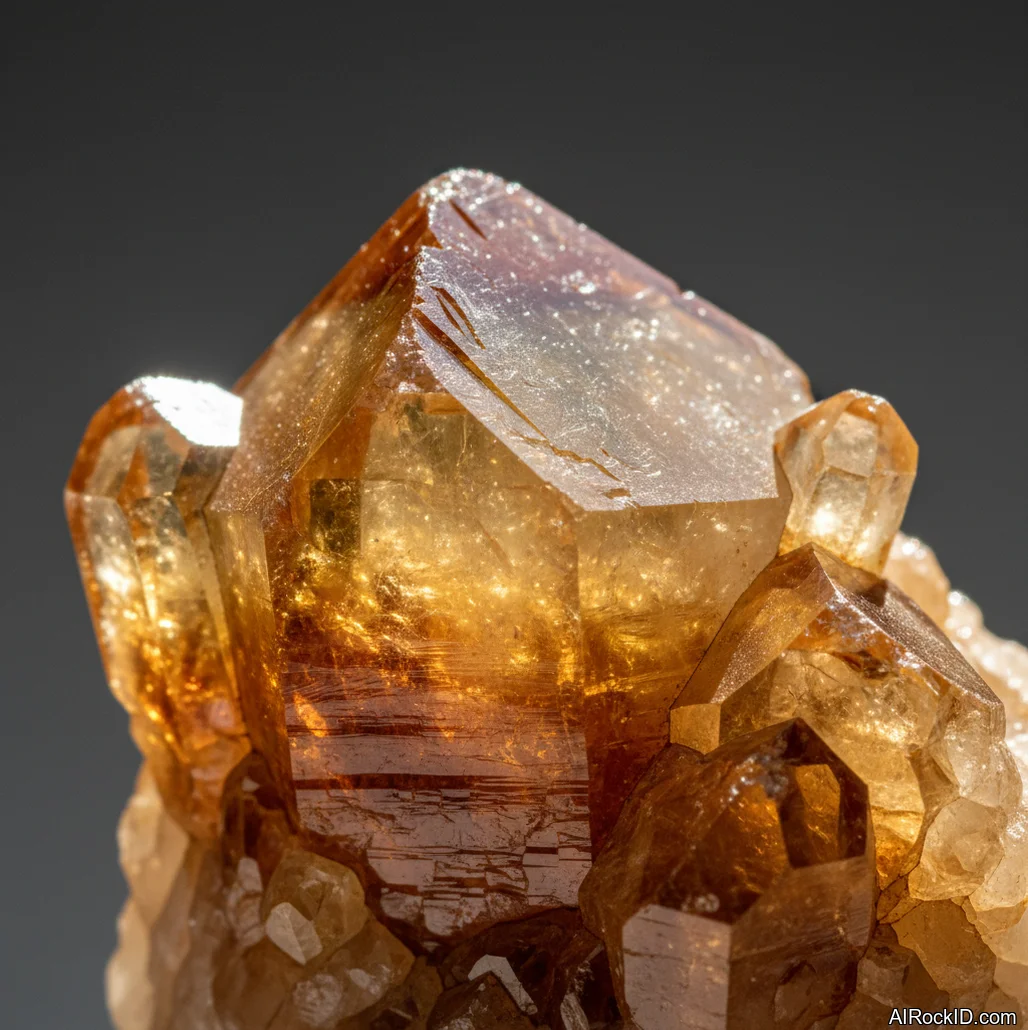
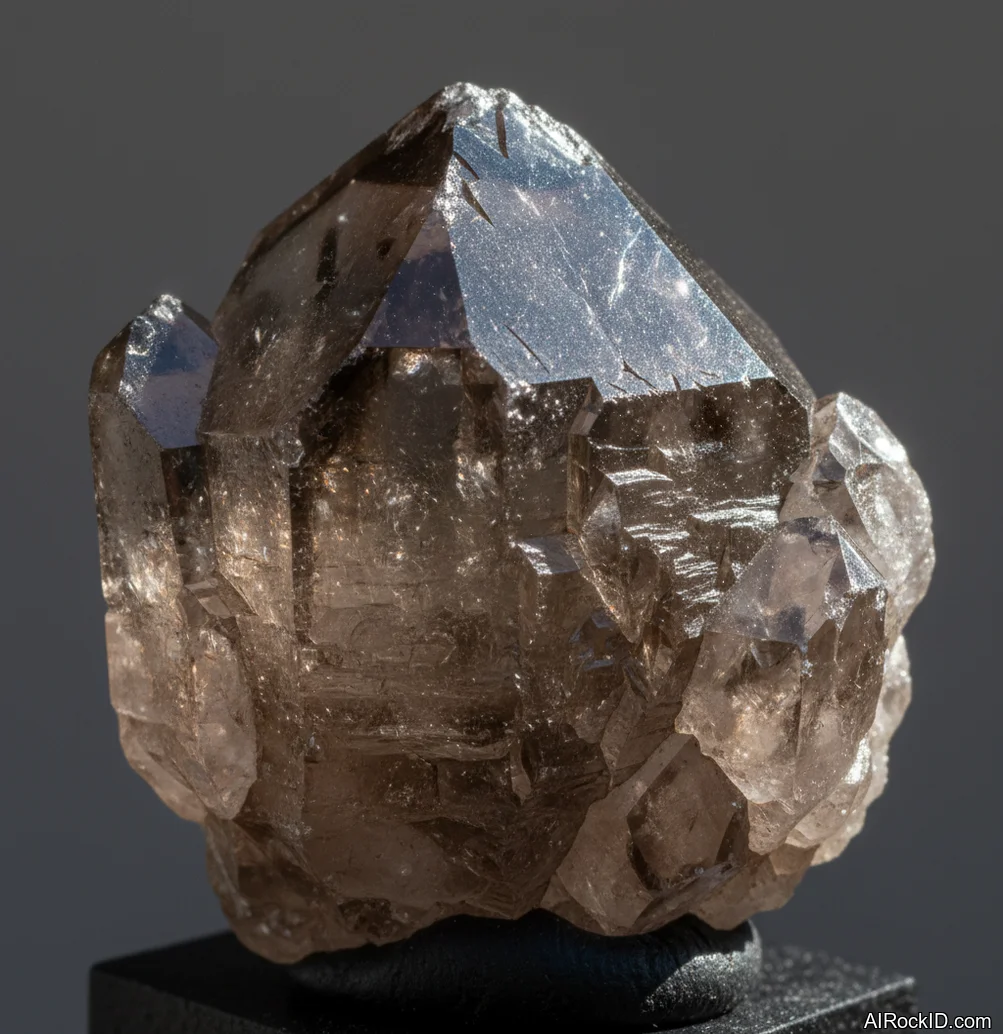
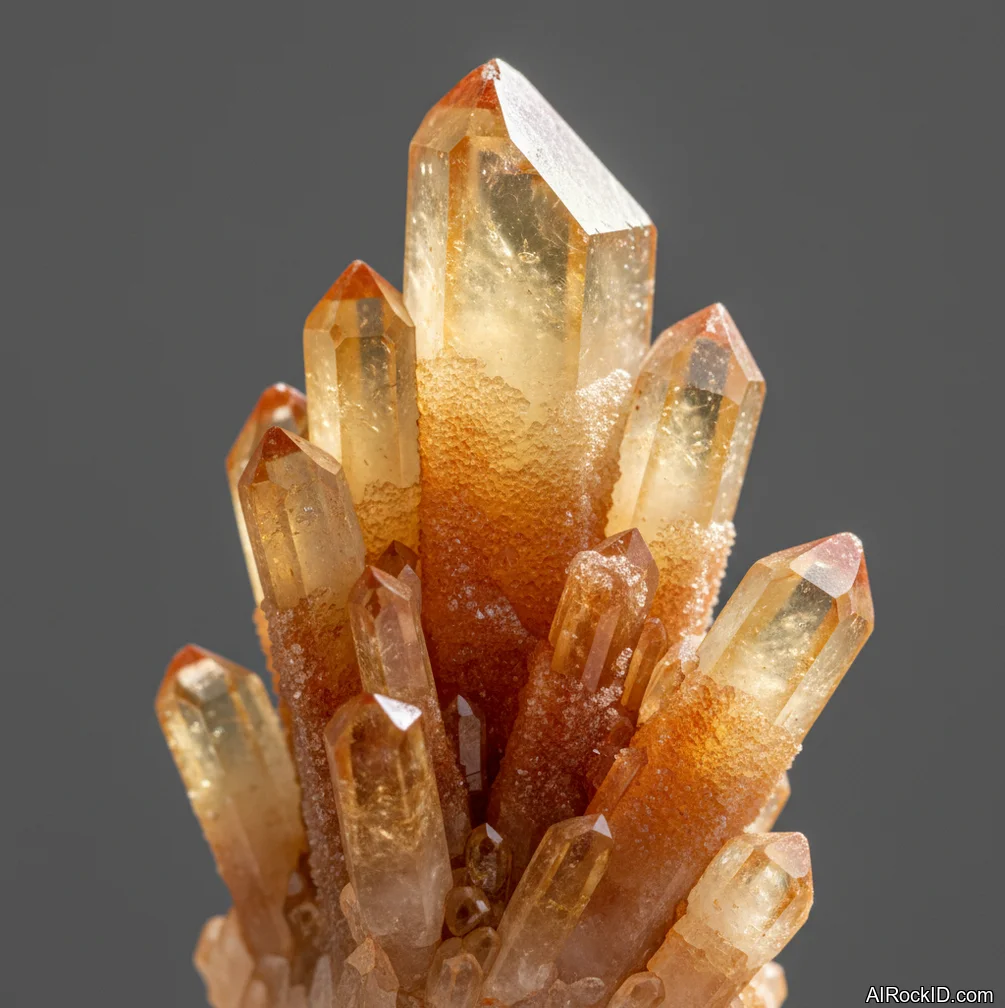
Hold one for a second and yeah, it’s still quartz. Cool against your palm. The faces catch light like glass, and when you drag a fingernail across an edge you get that hard, clean feel you don’t get with softer beginner stones. Most pieces show up as tight little clusters packed with points. Color-wise, it usually sits in that champagne-to-honey zone, not the darker orange you see with heated amethyst. Some have a smoky tint down near the base, or a thin “skin” of iron staining tucked into the crevices (especially between points). Normal stuff.
But here’s the snag in the market. A lot of sellers will slap “kundalini” on basically any yellow quartz, and plenty of what’s out there is heat-treated amethyst or smoky quartz. Real natural citrine tends to have uneven color and a quieter, more subtle look, and when you tip the crystals under a bright light you’ll often catch those slightly frosty growth textures along the sides. You know the look? That soft, almost sugary sheen that comes and goes as you rotate it.
Origin & History
“Citrine” comes from the French *citron*, meaning lemon, and gem folks have used it as a name for yellow quartz for ages. Quartz as a mineral got described, tweaked, and described again back in the early mineralogy days, but once modern naming finally settled down, “citrine” was already treated as a color label, not its own separate species.
“Kundalini Citrine” isn’t an official mineral term. It’s a newer trade name that started catching on in the late 20th century and into the early 2000s, mostly in the metaphysical scene, as a way to separate natural pale-yellow citrine from the far more common heated amethyst that’s sold as citrine. Look, if you’ve ever stood behind a gem show table with fluorescent lights buzzing overhead, you’ve heard that exact pitch. Same mineral either way. But the origin and treatment story? That’s what collectors care about.
Where Is Kundalini Citrine Found?
Natural citrine occurs in many quartz localities worldwide, but a lot of “Kundalini Citrine” in shops is sold as coming from the Democratic Republic of the Congo. Brazil, Russia, the Swiss Alps, and the USA also produce natural citrine in smaller, locality-driven amounts.
Formation
Natural citrine forms the same basic way other quartz does. Silica-rich fluids push through fractures and little cavities in the host rock, then quartz starts growing as the chemistry shifts and the temperature slides around over time. That yellow color usually comes down to trace iron tucked into the quartz structure, plus what that iron went through after millions of years of natural heat and radiation.
Look closer at a cluster and you can sometimes see the whole story written on the crystal. The faces come together at clean, crisp angles. But the sides might look a bit matte or micro-etched, like they got a faint sandblasted finish from later fluids moving past. I’ve handled Congo-type clusters where the terminations are sharp as tacks, yet the sides feel slightly satiny when you rub a fingertip along them (you can feel it catch just a little). That combo is a dead giveaway you’re holding a naturally grown piece, not something that’s been tumbled down into a generic shape.
How to Identify Kundalini Citrine
Color: Color ranges from pale champagne and straw-yellow to warm honey, often with uneven zoning and occasional smoky undertones. The color usually looks softer and less orange than typical heat-treated “citrine.”
Luster: Vitreous, like clean glass on the termination faces.
Pick up the piece and check the temperature. Quartz stays cool in your palm longer than glass fakes, which feel warmer fast. If you scratch it with a steel blade, it shouldn’t mark, but it will scratch window glass easily. The real test is the color pattern. Heat-treated amethyst often shows a burnt-looking orange concentrated near tips, sometimes with a whitish base, while natural citrine more often looks evenly sun-kissed or softly zoned without that toasted edge.
Properties of Kundalini Citrine
Physical Properties
| Crystal System | Trigonal |
| Hardness (Mohs) | 7 (Hard (6-7.5)) |
| Density | 2.65 g/cm3 |
| Luster | Vitreous |
| Diaphaneity | Transparent to translucent |
| Fracture | Conchoidal |
| Streak | White |
| Magnetism | Non-magnetic |
| Colors | Pale yellow, Straw yellow, Golden yellow, Honey, Yellow-brown, Smoky yellow |
Chemical Properties
| Classification | Silicates |
| Formula | SiO2 |
| Elements | Si, O |
| Common Impurities | Fe, Al, Li, Na, K, Ti |
Optical Properties
| Refractive Index | 1.544-1.553 |
| Birefringence | 0.009 |
| Pleochroism | None |
| Optical Character | Uniaxial |
Kundalini Citrine Health & Safety
Kundalini Citrine is quartz (SiO2), so it’s generally safe to handle. Just use basic common sense, especially if it’s got those needle-sharp points or a chipped spot with a rough, scratchy edge.
Safety Tips
If you have to cut or grind it, keep it wet and wear a respirator so you’re not breathing in silica dust. But for normal handling, you’re fine.
Kundalini Citrine Value & Price
Price Range
Rough/Tumbled: $10 - $120 per piece
Cut/Polished: $5 - $30 per carat
Prices bounce around depending on how clear the piece is, how clean the natural termination looks, and if you’re looking at a tidy cluster or a point with a chipped tip. Locality info you can actually verify matters too. And if the seller can back up “clearly natural, not heated” in a way that feels legit, the price tag jumps fast.
Durability
Durable — Scratch resistance: Excellent, Toughness: Good
Quartz is stable for everyday wear, but chips can happen on sharp terminations if you toss it in a pocket with keys.
How to Care for Kundalini Citrine
Use & Storage
Store it where the points won’t get knocked around, like a small box or a shelf with spacing between pieces. If you stack quartz clusters, you’ll hear that awful grit-on-glass sound and you’ll get chips.
Cleaning
1) Rinse with lukewarm water to remove dust. 2) Use a soft toothbrush with a drop of mild soap for crevices. 3) Rinse well and air-dry, or pat dry with a microfiber cloth.
Cleanse & Charge
If you do energetic cleansing, a quick rinse and a night on a windowsill with indirect light is plenty. Don’t bake it in harsh sun for days if you’re worried about any surface staining shifting.
Placement
On a desk, it reads best under angled light so you can see the faces flash. If it’s a cluster, give it a dark background and it’ll look cleaner.
Caution
Skip ultrasonic cleaners and harsh acids. And if a piece has an iron-oxide coating and you want that natural staining to stay put, don’t soak it. Keep the sharp points where kids and pets can’t get to them (those tips are no joke).
Works Well With
Kundalini Citrine Meaning & Healing Properties
A lot of dealers pitch Kundalini Citrine as the “cleaner” citrine because it’s sold as natural, not heat-treated. And honestly, the feel people describe lines up with plain old yellow quartz: bright, steady, and a bit more grounded than the super-orange pieces. I’ve had a small Congo cluster sitting on my workbench for months, kind of off to the side where it catches the lamp, and I reach for it when I’m doing tedious sorting or labeling because it keeps my head feeling tidy, not drowsy.
Thing is, if you watch how you actually use it day to day, it’s usually pretty straightforward. People hook it to routines like budgeting, job hunting, studying, getting out of a slump, that sort of thing. I treat it like a reminder object, not some miracle button. So if you’re someone who gets spun up fast, this is one of the yellow stones that doesn’t feel too “loud” compared to bright lemon calcite or some of that high-saturation treated citrine.
But keep the boundary clear. This isn’t medical care, and it won’t replace therapy, sleep, or real treatment. What it can do (if you’re into this side of the hobby) is give you a consistent physical anchor. The touch part matters more than people admit. When I’m holding a point, my thumb always ends up tracing the little ridges and growth lines, and that repetitive motion is calming all by itself. Right?
Identify Any Crystal Instantly
Snap a photo and get properties, value, care instructions, and healing meanings in seconds.