Mexican Agate
What Is Mexican Agate?
Mexican Agate is banded chalcedony, a microcrystalline variety of quartz, pulled from agate deposits in Mexico.
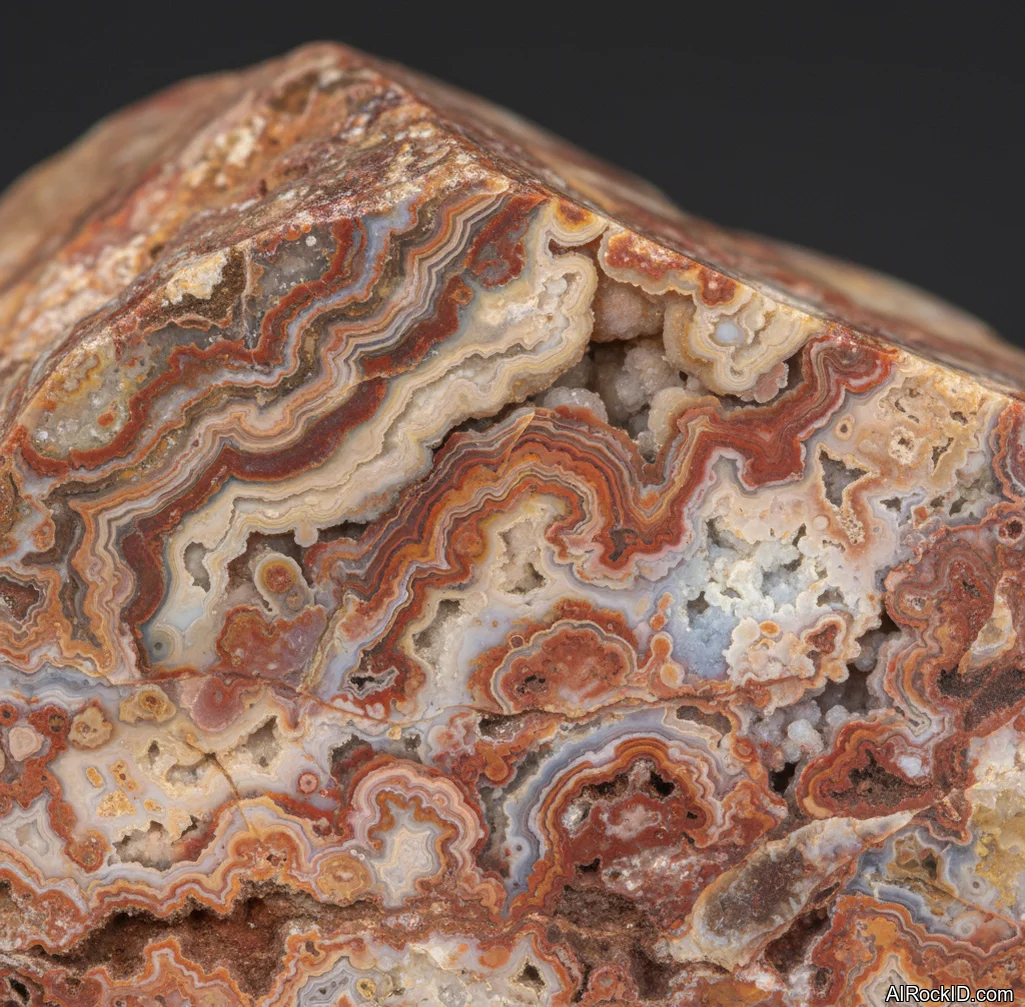
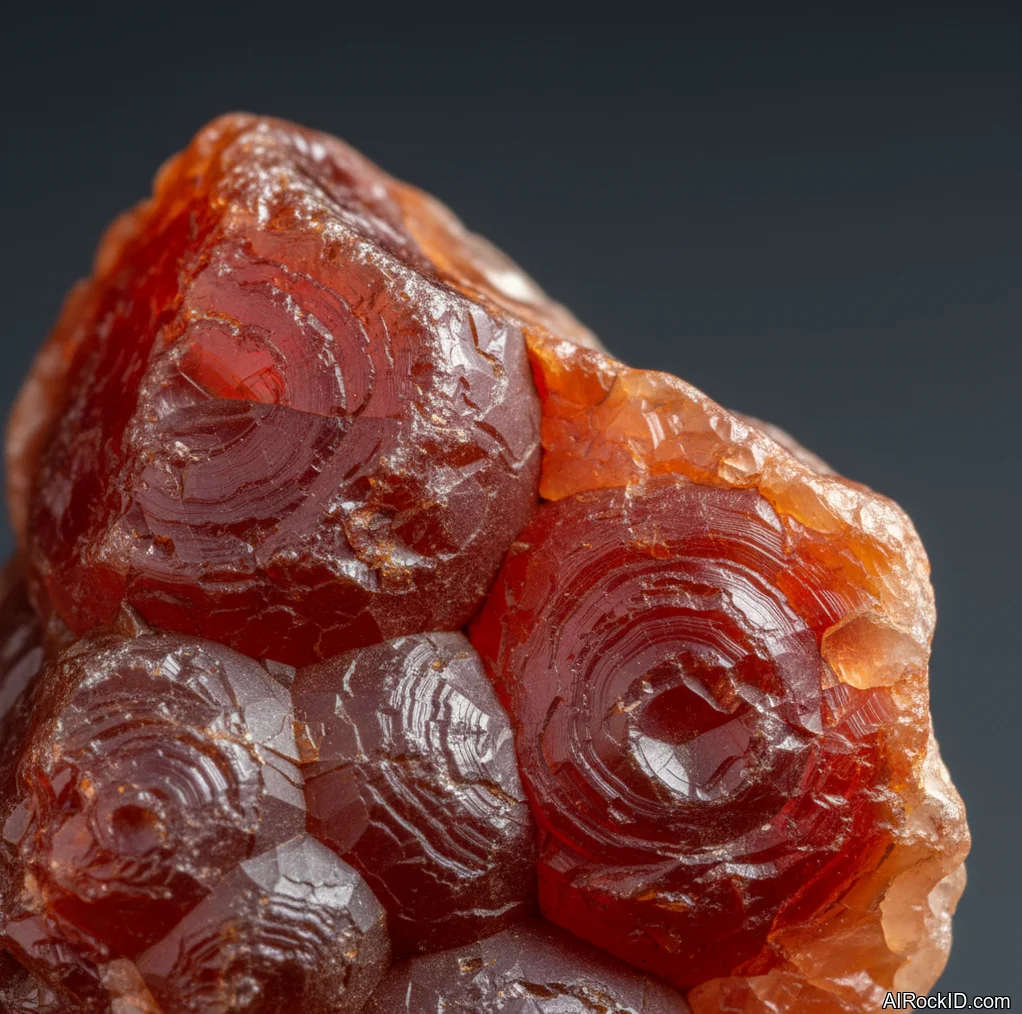
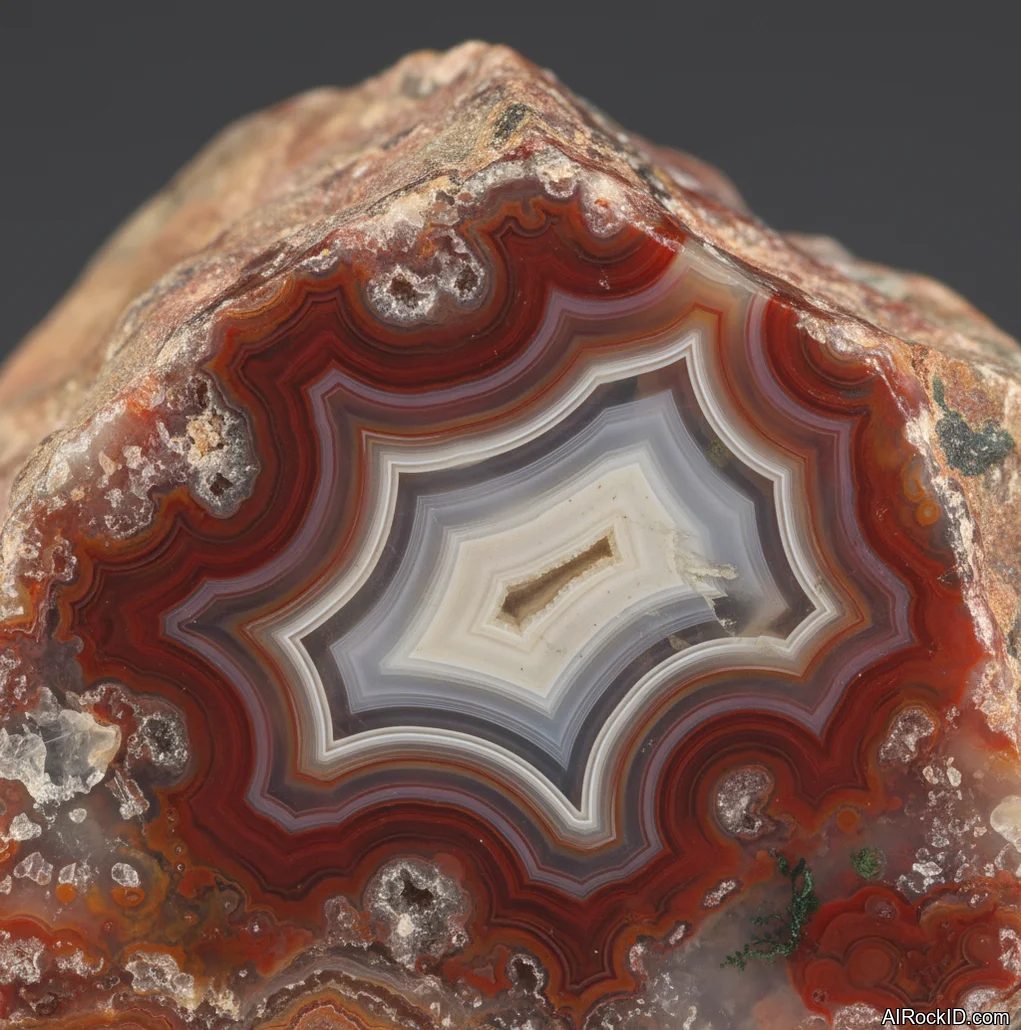
Pick up a solid piece and you feel it right away. It’s weirdly dense for its size, like there’s no empty, crumbly “junk” inside. The Mexican stuff most people go nuts for has tight fortification bands, those little “walls” and scallops that honestly look like a topographic map if you’ve ever stared at one. Colors bounce around too: cream, honey, brick red, rust, coffee brown, and every so often a smoky gray sneaks in. Once it’s polished, it can look almost wet under a lamp, like there’s a thin skin of water on it. But in rough? Pretty plain. You get that dull rind, maybe some pitting, and then if you knock off a tiny chip you’ll catch the waxy translucence underneath.
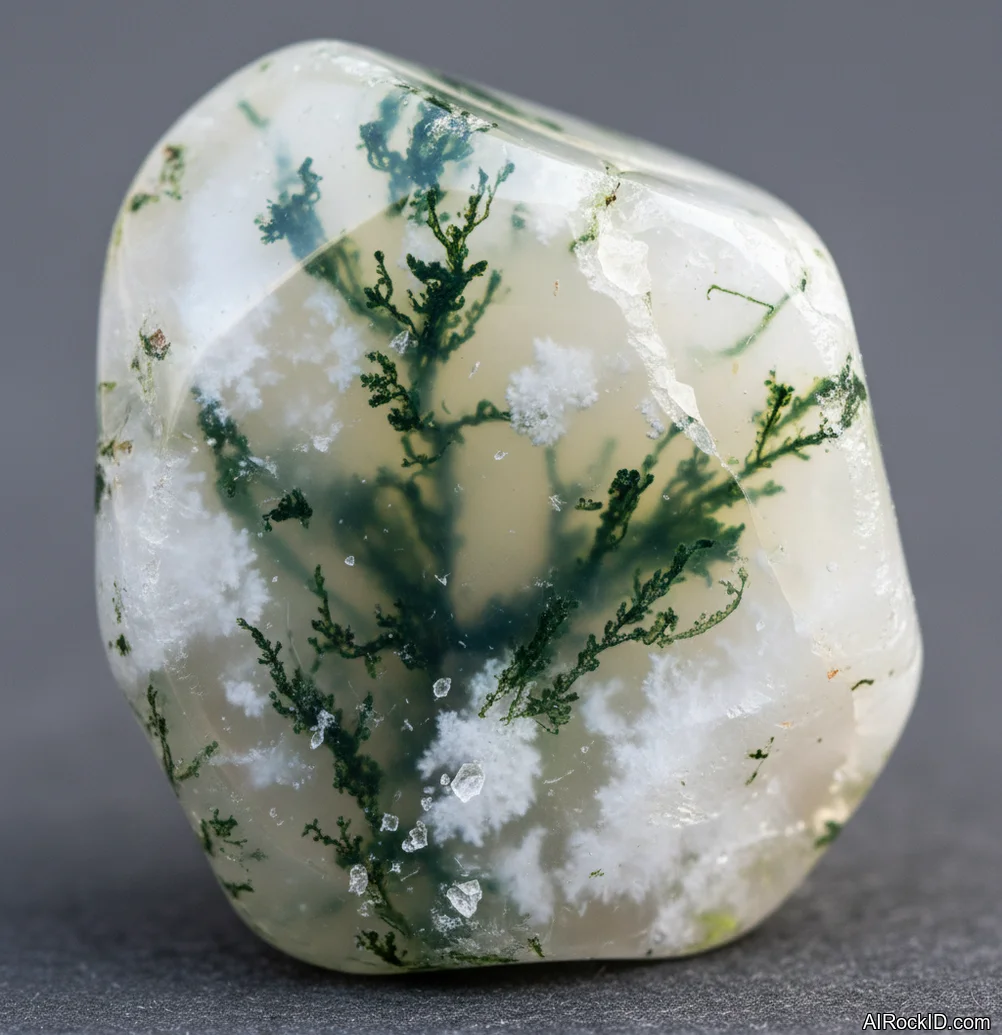
At first glance, people toss all “Mexican agate” into one bucket, but it really shifts depending on where it came from. Laguna can be razor-banded and loud. Coyamito usually shows up as those knobby nodule shapes with fortification and eye patterns (you know the ones that look like little targets). Agua Nueva, on the other hand, often leans into soft pinks and mauves you don’t see as much in other agates. And yeah, most of what you’ll actually handle in shops is cut slabs, tumbled stones, or palm stones, because agate takes a polish like a champ.
Origin & History
The word “agate” traces back to the Achates River in Sicily, a name Theophrastus used way back in antiquity. But “Mexican agate” isn’t some single, formally defined mineral name. It’s more of a trade and collector label people slap on Mexican-sourced banded chalcedony, and it gets more specific when a seller calls out a mine or area like Laguna, Coyamito, or Agua Nueva.
Thing is, most dealers really leaned into those locality names once the lapidary world took off in the mid-1900s and Mexican deposits became a steady pipeline for slab material you could actually cut. If you’ve ever stood at a gem show booth with trays of slabs laid out under those harsh lights, you know how fast “Mexican agate” turns into a vague catch-all. Ask any old-timer there and you’ll hear the same line: the best pieces were the ones that came in with solid provenance. “Mexican agate” on a tag is fine, sure, but “Laguna, Ojo Laguna area” tells you a lot more about what you’re really buying. Why guess when you don’t have to?
Where Is Mexican Agate Found?
Mexican agate is found in volcanic regions of Mexico, especially northern states like Chihuahua, where nodules form in old lava flows and related volcanic rocks.
Formation
A lot of Mexican agate begins as silica-heavy groundwater seeping through volcanic rock. That rock’s full of old gas bubbles and little cavities left behind when the lava cooled, plus cracks and tiny pockets where fluids can pool and just hang out. Over time, silica drops out in thin layers of chalcedony, and if there’s enough open space, you’ll sometimes get tiny quartz crystals growing toward the center.
If you stare at the banding long enough, it kind of feels like you’re looking at the plumbing diagram. Shifts in chemistry, temperature, or how fast the fluid moved can swing the color from cream to red to brown, with iron usually doing the heavy lifting on those warm tones. But it isn’t always tidy. Some nodules show bands that snapped and later got glued back together, brecciated patches, or those “eyes” where fresh silica flowed around earlier fragments (weirdly satisfying to spot, honestly). And when I’m sorting rough at a show, I’ll lightly tap nodules together. The good agate gives off that higher, glassy click, not the duller thud you get from softer lookalikes.
How to Identify Mexican Agate
Color: Mexican agate commonly shows cream, tan, honey, brown, red, and rust colors, often in tight fortification bands or lace-like swirls. Some material runs pink to lavender, and some nodules include gray or black manganese staining.
Luster: Waxy to vitreous, with a glassy shine when well polished.
If you scratch it with a steel blade, it shouldn’t take the scratch, but the blade might leave a faint metal streak you can rub off. Hold a thin edge up to a strong light and you’ll often see a soft glow through the bands, even when the outside looks opaque. The problem with dyed agate is the color pools in fractures and vugs, so check for neon tones that don’t match the banding and for dark dye concentrated along tiny cracks.
Properties of Mexican Agate
Physical Properties
| Crystal System | Amorphous |
| Hardness (Mohs) | 6.5-7 (Hard (6-7.5)) |
| Density | 2.58-2.64 g/cm3 |
| Luster | Waxy |
| Diaphaneity | Translucent to opaque |
| Fracture | Conchoidal |
| Streak | White |
| Magnetism | Non-magnetic |
| Colors | Cream, White, Tan, Honey, Brown, Red, Rust, Gray, Pink, Lavender, Black |
Chemical Properties
| Classification | Silicates |
| Formula | SiO2 |
| Elements | Si, O |
| Common Impurities | Fe, Mn, Al |
Optical Properties
| Refractive Index | 1.530-1.540 |
| Birefringence | None |
| Pleochroism | None |
| Optical Character | Isotropic |
Mexican Agate Health & Safety
Mexican agate itself isn’t toxic, and it’s safe to handle. The real issue comes up when you start cutting or grinding it and that fine silica dust gets in the air, especially if you don’t have proper controls in place.
Safety Tips
If you’re sawing or sanding, keep a steady trickle of water going, crank up the ventilation, and wear a proper respirator that’s actually rated for fine particulates. And don’t dry-grind agate on a hobby wheel, seriously.
Mexican Agate Value & Price
Price Range
Rough/Tumbled: $5 - $60 per piece
Cut/Polished: $1 - $12 per carat
Tight, high-contrast banding and a clean polish can spike the price in a hurry, and pieces from named localities with believable provenance usually move faster. And those big, dramatic slabs? They run higher mostly because solid rough in that kind of size is just tougher to find.
Durability
Very Durable — Scratch resistance: Excellent, Toughness: Good
It’s stable in normal household conditions and doesn’t mind occasional water contact, but it can chip on sharp edges if it gets knocked around.
How to Care for Mexican Agate
Use & Storage
Store it like any hard quartz. I keep polished pieces in a tray or pouch so they don’t clack together and bruise the polish on corners.
Cleaning
1) Rinse with lukewarm water to remove grit. 2) Wash with mild soap and a soft brush, especially around pits or tiny vugs. 3) Rinse well and dry with a soft cloth.
Cleanse & Charge
If you do metaphysical cleansing, running water and smoke are both gentle options for agate. Avoid salt soaks if the piece has lots of pits that can trap residue.
Placement
A windowsill is fine for display, but I’d skip direct blazing sun all day if it’s a dyed piece since dyes can fade. On a desk, a palm stone holds up well to daily handling.
Caution
Don’t use harsh acids or bleach on it. And if you’re shopping for the really bright colors, ask straight up if it’s been dyed, then take a close look around the drill holes and any little fractures since that’s where the color tends to pool and look extra intense.
Works Well With
Mexican Agate Meaning & Healing Properties
A lot of dealers will tell you agate is a “steadying” stone. And honestly, that’s exactly where Mexican agate lands for most people.
In your hand, it’s got that cool, dense feel right away, like it holds onto temperature. The polish is usually slick but not glassy, and you can feel the tiny curve where the stone’s been rounded off (especially along the edges). It’s the kind of piece that disappears into a pocket and still feels reassuring when you thumb it during a long day. Simple. Useful.
Next to flashier stones like labradorite, agate is more of a slow-burn. People reach for it when they’re trying to stick to routine, practice patience, and not spiral over every little thing. I’ve handed a few pieces to friends who fidget constantly, and they almost always talk about the weight and the texture, not some huge mystical event. That matches my experience too. It’s more “this keeps my hands busy” than “this changed my life,” you know?
But look, there are limits. Agate isn’t medical care, and it won’t solve anxiety or sleep problems on its own. What it can do is work like a physical cue. You feel that smooth stone, you remember to take a breath, you stop doom-scrolling for a minute (or at least you notice you’re doing it). If you want to get a little nerdy about it, pick a piece where the banding feels calm to you, because your brain is going to react to the pattern you actually like looking at. Why fight that?
Identify Any Crystal Instantly
Snap a photo and get properties, value, care instructions, and healing meanings in seconds.