Septarian
What Is Septarian?
Septarian is a sedimentary concretion made of mudstone or limestone that cracked, then later got filled in with minerals like calcite and aragonite.
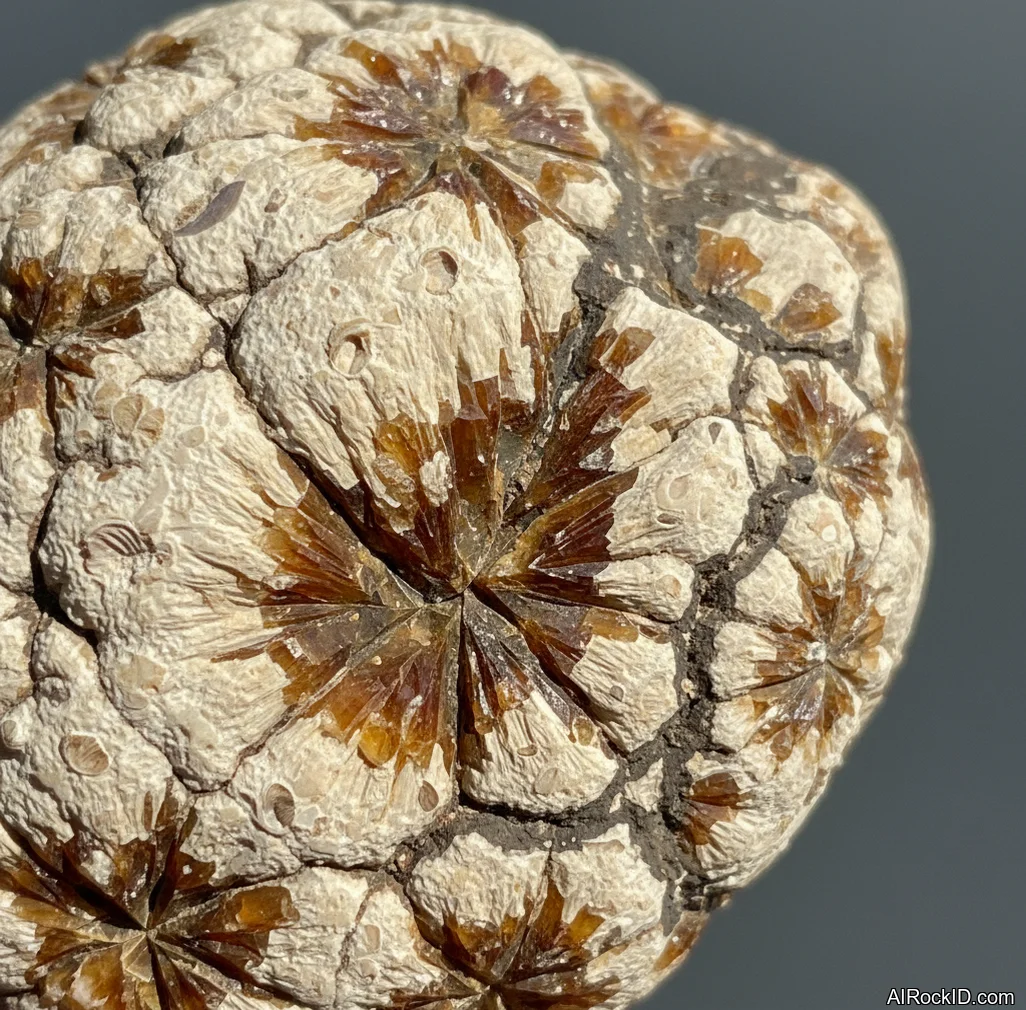
Grab a decent nodule and the first thing you clock is the heft. It’s got that dense, no-nonsense weight that sinks into your palm like a river rock, not a pointy crystal you’d set on a shelf. And the pattern? That’s the whole point. Those sharp, angular “turtle shell” cracks with honey-yellow calcite running through them. People see it once and go, “dragon stone.” Hard to argue.
Most of what’s for sale is cut and polished because the outside, raw, can look kind of blah until somebody cracks it open (honestly, who’d guess?). But slice it and you get the brown matrix, cream to gray edges, and those yellow veins that jump out under shop lights. Some pieces even have a little glitter tucked into small pockets where the calcite didn’t quite fill all the way. Pretty satisfying.
Origin & History
“Septarian” comes from the Latin *septum*, meaning partition or fence, which fits because the nodule has those internal cracks that split it up into sections. It isn’t a single mineral species, so in older books you’ll find it filed under concretion descriptions instead of a neat little “first described by” mineral entry.
Collectors were calling these crack-filled nodules “septarian” as a handy label way before the metaphysical market cared. And you’ll see “septaria” used for the crack pattern itself. Dealers also sometimes push “dragon stone” for the wow factor (sounds cooler on a tag, right?), even though that name gets slapped on other materials too.
Where Is Septarian Found?
Septarian nodules turn up in marine sedimentary layers worldwide, especially in Cretaceous and Jurassic-aged shales and limestones. The Madagascar nodules and Utah material are the ones I see most often on dealer tables.
Formation
Most septarian starts off as a plain lump of mud or limey sediment that gets cemented into a concretion while it’s still buried. Then it splits. People still argue about what kicks that off, but shrinkage, dewatering, and pressure changes during burial are the usual suspects.
And those cracks don’t stay empty for long. Later on, fluids work their way through and leave minerals behind in the gaps, usually calcite and/or aragonite, and sometimes there’s a bit of barite in there too. So you can pick up one nodule and see a couple textures right away: a dense brown matrix, that buttery yellow vein fill, plus the occasional tiny cavity that feels gritty if you drag a fingertip across it (you can almost feel the rough little crystals catch).
How to Identify Septarian
Color: Typical septarian shows a brown to gray matrix with cream edges and yellow to amber calcite vein fill. Some pieces lean more gray and tan, especially if the calcite is pale.
Luster: Polished faces range from waxy to vitreous depending on how much calcite vein you’re looking at.
Look closely for polygonal crack networks that cut through a concretion body, not random webbing on the surface. The real test is the cross section: the veins should be mineral fill, not paint sitting in grooves. And if you tap it with a fingernail, the calcite-heavy areas often sound a little “tighter” than the softer matrix, almost like two different stones bonded together.
Properties of Septarian
Physical Properties
| Crystal System | Trigonal |
| Hardness (Mohs) | 3 (Soft (2-4)) |
| Density | 2.6-2.9 g/cm3 |
| Luster | Vitreous |
| Diaphaneity | Opaque |
| Fracture | Uneven |
| Streak | white |
| Magnetism | Non-magnetic |
| Colors | brown, tan, gray, cream, yellow, amber |
Chemical Properties
| Classification | Carbonates (dominantly calcium carbonate) |
| Formula | CaCO3 (dominant; calcite and aragonite) |
| Elements | Ca, C, O |
| Common Impurities | Fe, Mn, Ba, S |
Optical Properties
| Refractive Index | 1.49-1.66 |
| Birefringence | 0.172 |
| Pleochroism | None |
| Optical Character | Uniaxial |
Septarian Health & Safety
Septarian’s usually fine to pick up, hold, and keep on a shelf. But if you’re cutting or grinding it, don’t let it turn into dust and don’t breathe that stuff in. Same rule as with any stone, really.
Safety Tips
If you’re sanding or polishing, keep things wet, crack a window or run a fan for airflow, and wear a real particulate-rated respirator, not just a flimsy dust mask.
Septarian Value & Price
Price Range
Rough/Tumbled: $10 - $250 per piece
Price usually comes down to three things: how crisp the pattern looks, how clean the polish is, and how big the piece is. The ones with clean yellow calcite veins and those tight, even “plates” (the kind you can feel with your fingertip when you tilt it under a light) move quick. But if it’s muddy and the contrast is weak? Those pieces just sit around.
Durability
Moderate — Scratch resistance: Poor, Toughness: Fair
It’s stable in normal room conditions, but the calcite content means it scratches and etches easier than people expect.
How to Care for Septarian
Use & Storage
Store it like you’d store calcite: away from harder stones that can scuff it up. If it’s a polished egg or sphere, a small ring stand keeps it from rolling into trouble.
Cleaning
1) Rinse briefly with lukewarm water and a drop of mild soap. 2) Use a soft toothbrush for grime in the cracks. 3) Rinse again and pat dry; don’t soak it for hours if you’ve got open pockets.
Cleanse & Charge
For non-water methods, I stick to smoke, sound, or a night on a shelf away from direct sun. If you use selenite, set septarian next to it rather than rubbing it.
Placement
On a desk it’s great because you can actually study the pattern up close. I like putting a cut half where side light hits it, since the calcite veins catch the glow.
Caution
Skip acids and acid-based cleaners, vinegar included, because calcite will etch. And don’t just toss it into a bowl with quartz points. Unless you’re cool with random little scratches showing up later (the kind you only notice when the light hits it just right).
Works Well With
Septarian Meaning & Healing Properties
A lot of people who pick up septarian for “energy” stuff are really reacting to the way it looks and feels in your hand. It’s earthy. Solid. And the whole cracked-then-healed thing is right there in the pattern, which hits home for folks who are trying to steady themselves again.
In my own stash, septarian’s one of the stones I grab when I want something steady sitting on the table while I’m sorting other material or slogging through paperwork. When you pick up a polished nodule, it stays cool longer than you’d think, especially if the room’s a little chilly, and it’s got this satisfying heft that settles you down in a plain, physical way. But look, I’m not going to act like it replaces sleep, therapy, or a doctor.
So if you’re using it during meditation, here’s the practical move: use a piece with strong contrast so your eyes have something to lock onto. The issue with a lot of cheaper septarian is the pattern goes kind of muddy, and then it’s just a brown rock with faint lines. Better material has crisp “cells” and veins that look like somebody drew them in with a pen, and that sense of visual order is what people are responding to (even if they don’t say it that way).
Identify Any Crystal Instantly
Snap a photo and get properties, value, care instructions, and healing meanings in seconds.