Moroccan Agate
What Is Moroccan Agate?
Moroccan Agate is a banded type of chalcedony (microcrystalline quartz). It comes out of agate nodules and seams tucked into Moroccan volcanic and sedimentary host rocks.
Pick up a decent palm stone and you feel it immediately. Cool in your hand. Heavier than most people guess. And the polish has that slightly waxy, almost soapy slip that a glassy quartz point just doesn’t.
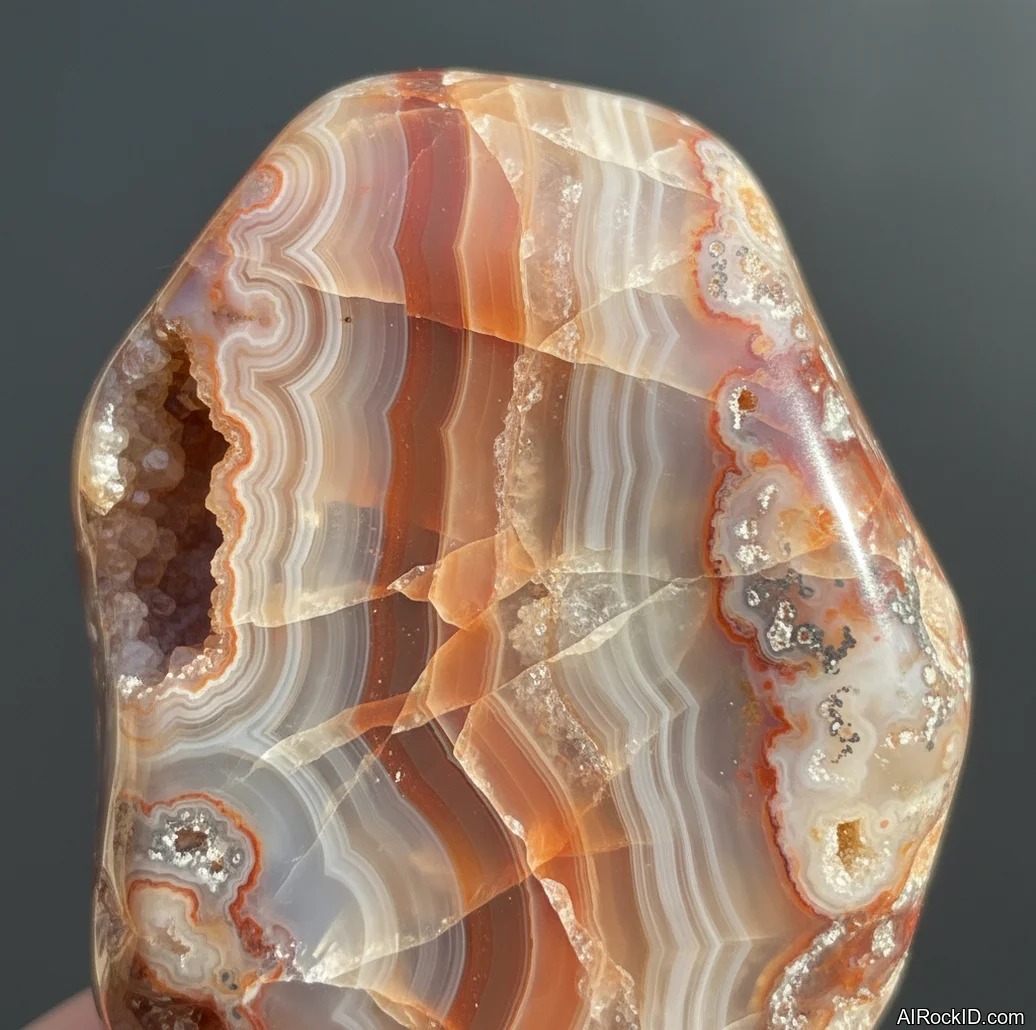
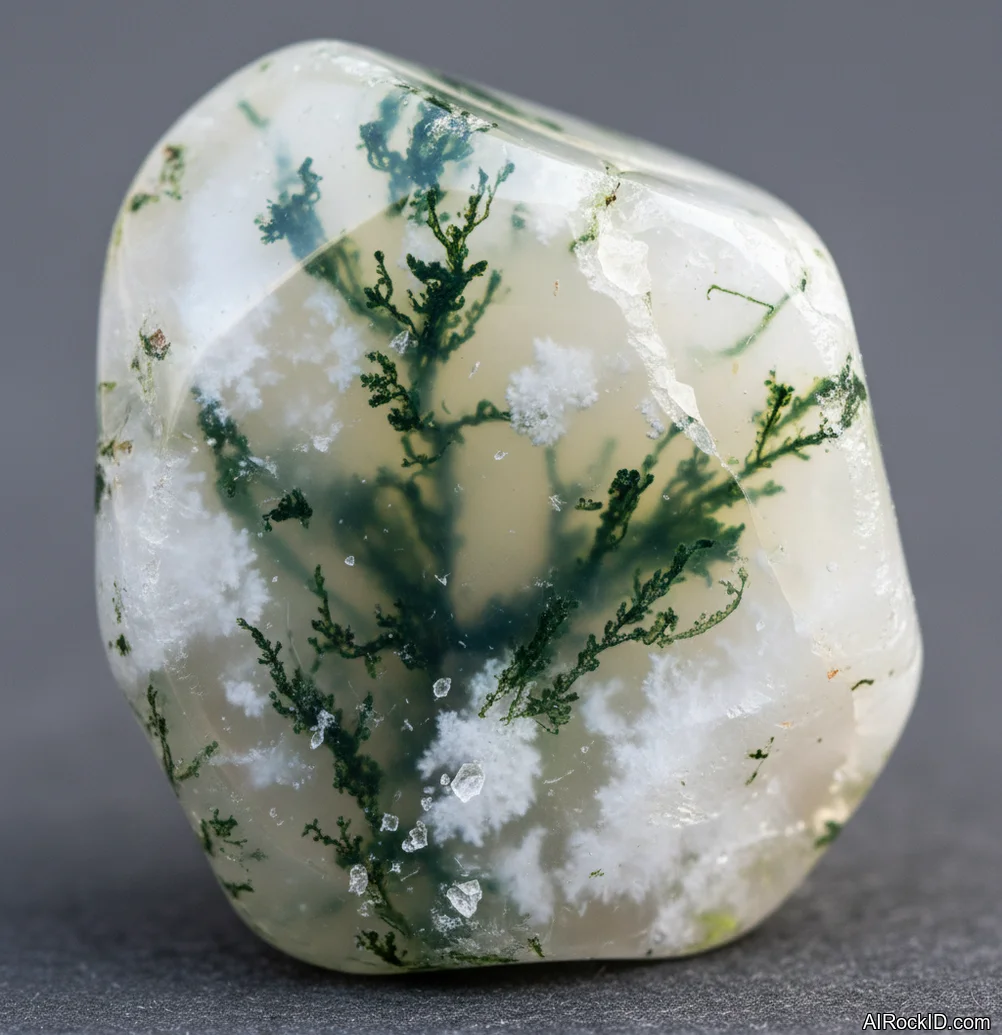
The colors tend to sit in that desert range: tan, caramel, cream, smoky gray. Rusty red shows up a lot too, and every once in a while you’ll catch a little mossy green. The banding’s the fun part. Sometimes it’s tight and crisp, like someone drew the lines on. Other times it’s blurry and cloud-like, and you have to turn it a bit to see what’s going on.
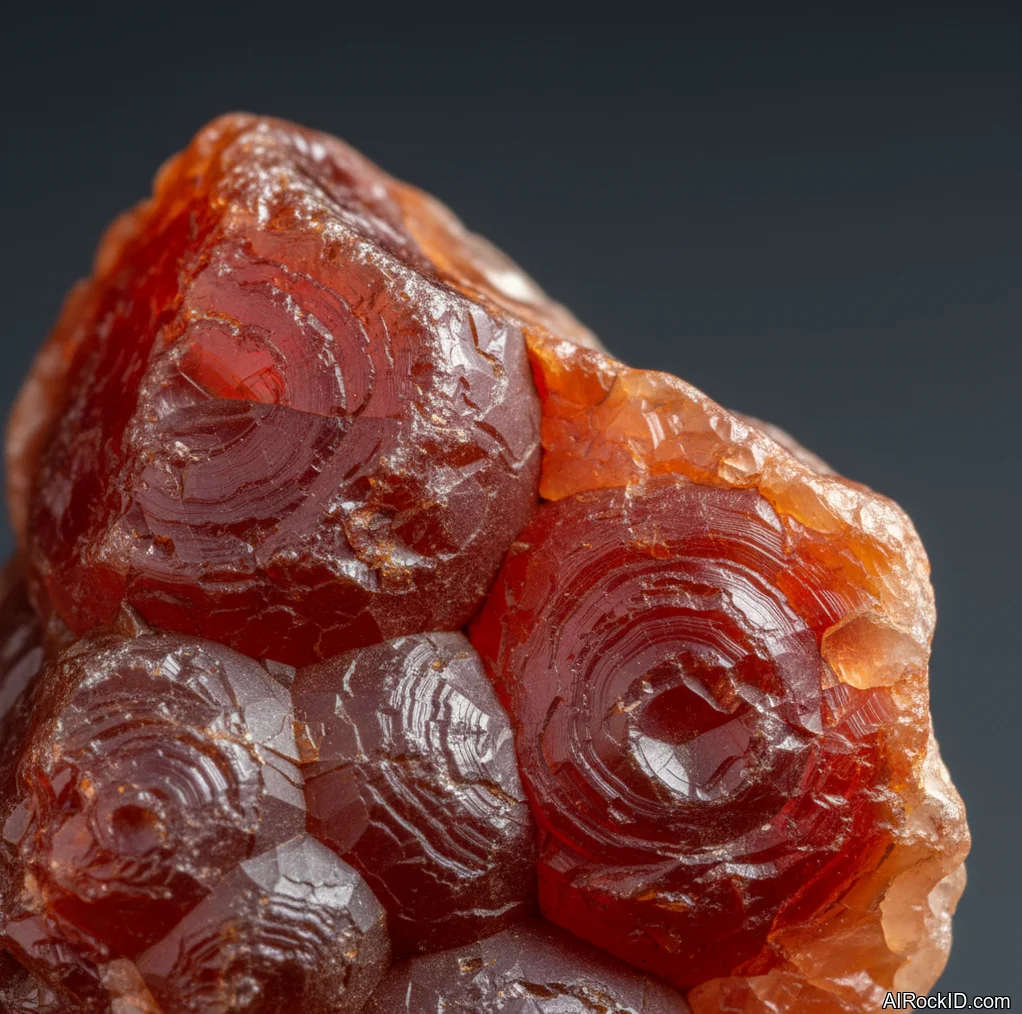
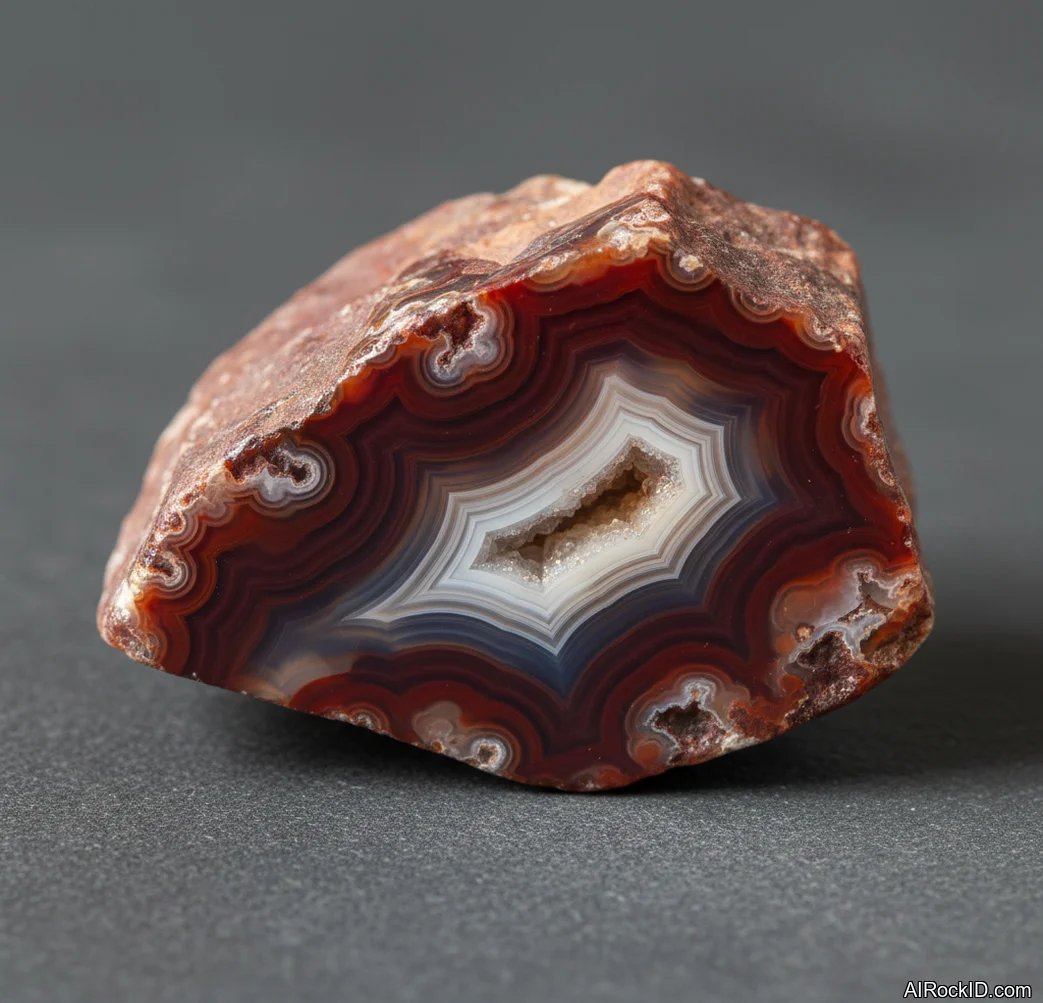
Most of the material you see for sale is cut from nodules, so you’ll run into “eyes” (those circular fortification bands), lacey ribbons, plus the occasional tiny quartz pocket you can feel with a fingernail if you go looking for it. But look, here’s the honest bit: a lot of Moroccan agate on the market is pretty average. The really clean, high-contrast banded pieces get cherry-picked fast at shows, and what’s left can read like plain brown chalcedony unless you tilt it under decent light.
Origin & History
“Agate” as a word traces back to the Achates River in Sicily, and in antiquity it gets credited to Theophrastus. But “Moroccan agate” isn’t one formally defined mineral name. It’s basically a trade or locality tag collectors use for agate material that comes out of Morocco.
I started running into it constantly in the 2000s at gem shows, usually sitting in those shallow flats with palm stones and chunky freeforms you can feel clacking together when you pick one up. Dealers will sometimes label it by a region or a nearby town if they actually know where it came from. But a lot of parcels just get the country name slapped on, since the rough can pass through a bunch of hands before it ever touches a saw.
Where Is Moroccan Agate Found?
Moroccan agate is collected from multiple sites across Morocco, especially in desert and foothill areas where nodules weather out and can be gathered from the surface.
Formation
Look at agate banding for a minute and you’re basically watching chemistry at a crawl. Silica-rich fluids seep through cracks, cavities, gas bubbles in volcanic rock, or into those porous zones in sedimentary layers. And as the temperature, pressure, or chemistry shifts, silica gels and tiny crystals settle out in layers, stacking up those bands one skin-thin sheet at a time.
Moroccan pieces often tell the classic nodule tale. You’ll see an outer rind, then those fortification bands, and then a center that’s either solid chalcedony or it opens into tiny drusy quartz (the kind that feels like fine sandpaper if you run a fingertip over it after a fresh cut). But once you slice one open, the real giveaway is the band behavior: kinks, pinches, or a sudden color jump. Looks like damage? It isn’t. It’s the stone keeping a record of the fluid changing over time.
How to Identify Moroccan Agate
Color: Most Moroccan agate runs tan, beige, cream, gray, and reddish brown, often with fortification banding or lace-like ribbons. Some pieces show small white quartz pockets or translucent edges when held to a strong light.
Luster: Polished surfaces have a waxy to vitreous luster.
If you scratch it with a steel nail, nothing should happen, but a quartz point will scratch it only with real pressure. The real test is temperature and feel: agate stays cool in your hand longer than resin or plastic, and it doesn’t feel “warm” right away. And check the banding under a phone flashlight. Dyed material can look too uniform, with color sitting in tiny fractures or along the outside rind more than the interior.
Properties of Moroccan Agate
Physical Properties
| Crystal System | Trigonal |
| Hardness (Mohs) | 6.5-7 (Hard (6-7.5)) |
| Density | 2.58-2.64 |
| Luster | Waxy |
| Diaphaneity | Translucent to opaque |
| Fracture | Conchoidal |
| Streak | White |
| Magnetism | Non-magnetic |
| Colors | tan, beige, cream, gray, brown, reddish brown, white |
Chemical Properties
| Classification | Silicates |
| Formula | SiO2 |
| Elements | Si, O |
| Common Impurities | Fe, Mn, Al |
Optical Properties
| Refractive Index | 1.530-1.543 |
| Birefringence | 0.004 |
| Pleochroism | None |
| Optical Character | Uniaxial |
Moroccan Agate Health & Safety
Moroccan agate isn’t toxic, so you can handle it without worrying. And if it gets a quick rinse or a splash of water, that’s totally fine. The real issue only shows up when you cut or grind it, because that can kick up silica dust.
Safety Tips
If you have to shape it, do it wet. Keep a steady trickle of water on the cut or grind so the dust turns into that gray slurry instead of floating around. And don’t cheap out on the mask, either. Wear a proper respirator that’s actually rated for fine particulate (not just a floppy paper one).
Moroccan Agate Value & Price
Price Range
Rough/Tumbled: $5 - $60 per piece
Cut/Polished: $1 - $10 per carat
Price jumps around depending on how sharp the band contrast is, how tight those fortification patterns look, and whether the polish comes out glassy or has that faint “orange peel” feel you can catch when you tilt it under a lamp. Big slabs with clean, well-defined banding, plus matched pairs you can actually set as jewelry, will run higher than the usual mixed-color tumbled stones.
Durability
Very Durable — Scratch resistance: Excellent, Toughness: Good
It’s stable in normal household conditions, but polished surfaces can dull if they rub against harder quartz or grit in a pocket.
How to Care for Moroccan Agate
Use & Storage
Store it where it won’t grind against other stones. I keep agates in small cloth bags or in compartment boxes so the polish stays crisp.
Cleaning
1) Rinse with lukewarm water and a drop of mild soap. 2) Use a soft toothbrush to get into tiny pits or drusy pockets. 3) Rinse well and dry with a microfiber cloth to avoid water spots on a high polish.
Cleanse & Charge
If you do energetic cleansing, running water, smoke, or leaving it on a windowsill for indirect light all work. But don’t bake it in harsh sun for days just to “charge” it, because heat can stress some agates and fade any dyed pieces.
Placement
On a desk, it’s a great worry stone because it’s tough and takes handling. For display, angle it so the bands catch side light, since overhead light can flatten the pattern.
Caution
Skip harsh chemicals and ultrasonic cleaners if the piece has open vugs or any fracture fill, because that stuff can seep in and cause trouble later. And if you’re cutting, sanding, or polishing agate, don’t breathe the dust (seriously, it gets everywhere).
Works Well With
Moroccan Agate Meaning & Healing Properties
Next to the flashier stones, Moroccan agate feels more like the quiet friend who shows up every time, not the one who kicks the door in. People grab agate when they want calm they can count on, not some huge emotional spike. And in my own stash, it’s what I reach for when I’m sorting flats or doing inventory, because it keeps my fingers busy without hogging my focus.
Pick up a banded piece and your thumb just… follows the stripes. Automatically. That’s the whole thing. It’s tactile. It grounds you in a very practical way, like counting breaths or walking the same trail after a long week in the same beat-up shoes. But look, I’ll say it plainly: it’s not medicine, and it’s not going to fix anxiety on its own. What it can do is give you a physical anchor, something cool and solid in your hand while you do the real work.
Thing is, the “healing stone” market gets so wrapped up in hype-speak that it’s hard to take seriously, so here’s a cleaner way to think about it. Moroccan agate is often linked with steadiness, patience, and keeping your feet on the ground when life’s in a messy transition. And if you’re using it for meditation, it usually works better as a palm stone or a worry stone than a tiny chip, because the feel in your hand is half the point. (Honestly, what’s the point if you can’t actually feel it?)
Identify Any Crystal Instantly
Snap a photo and get properties, value, care instructions, and healing meanings in seconds.