Truffle Chalcedony
What Is Truffle Chalcedony?
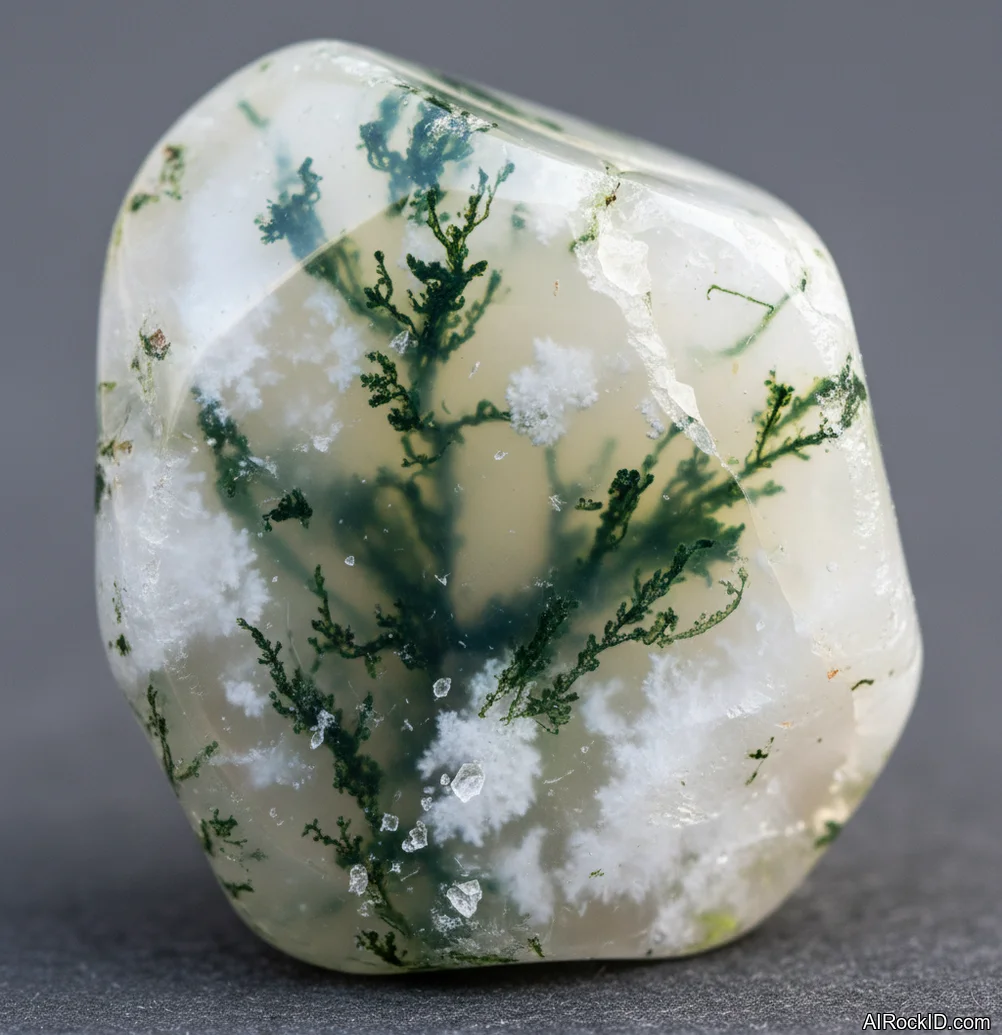
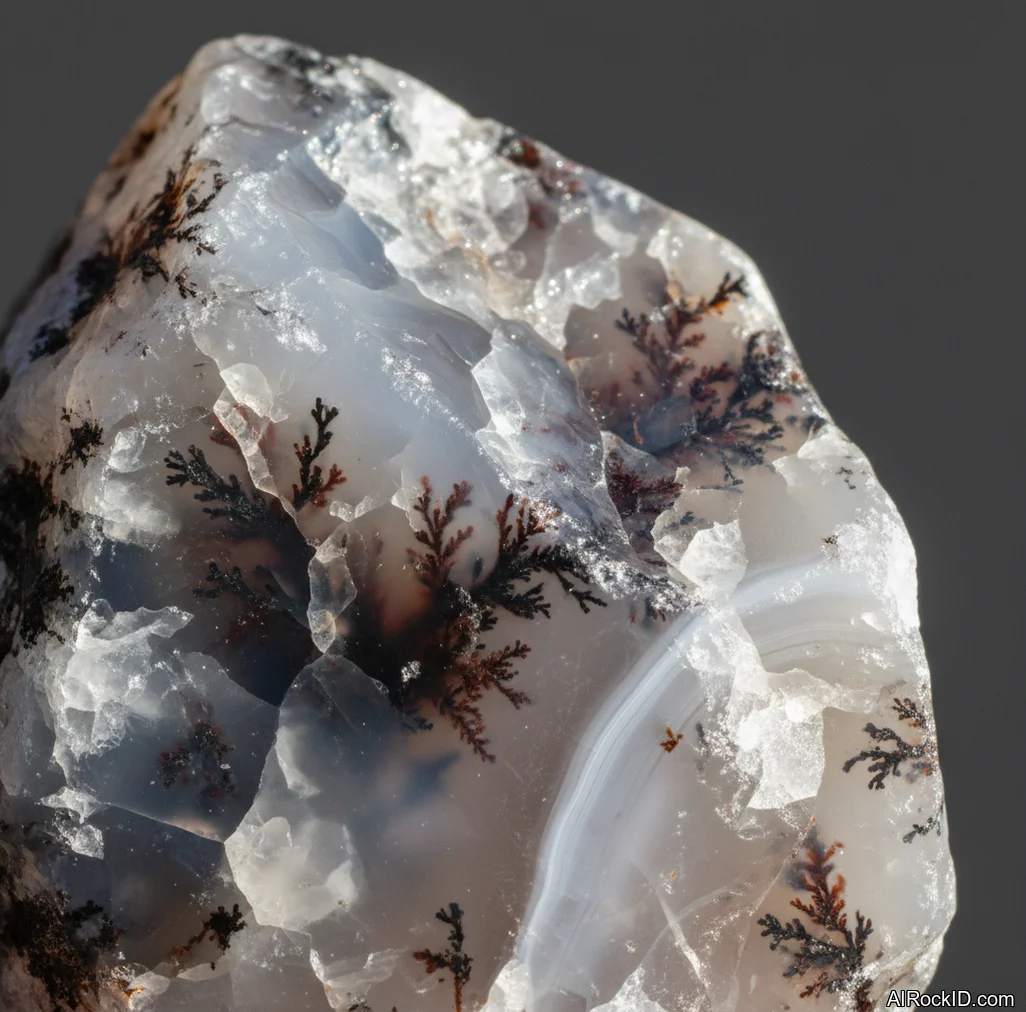
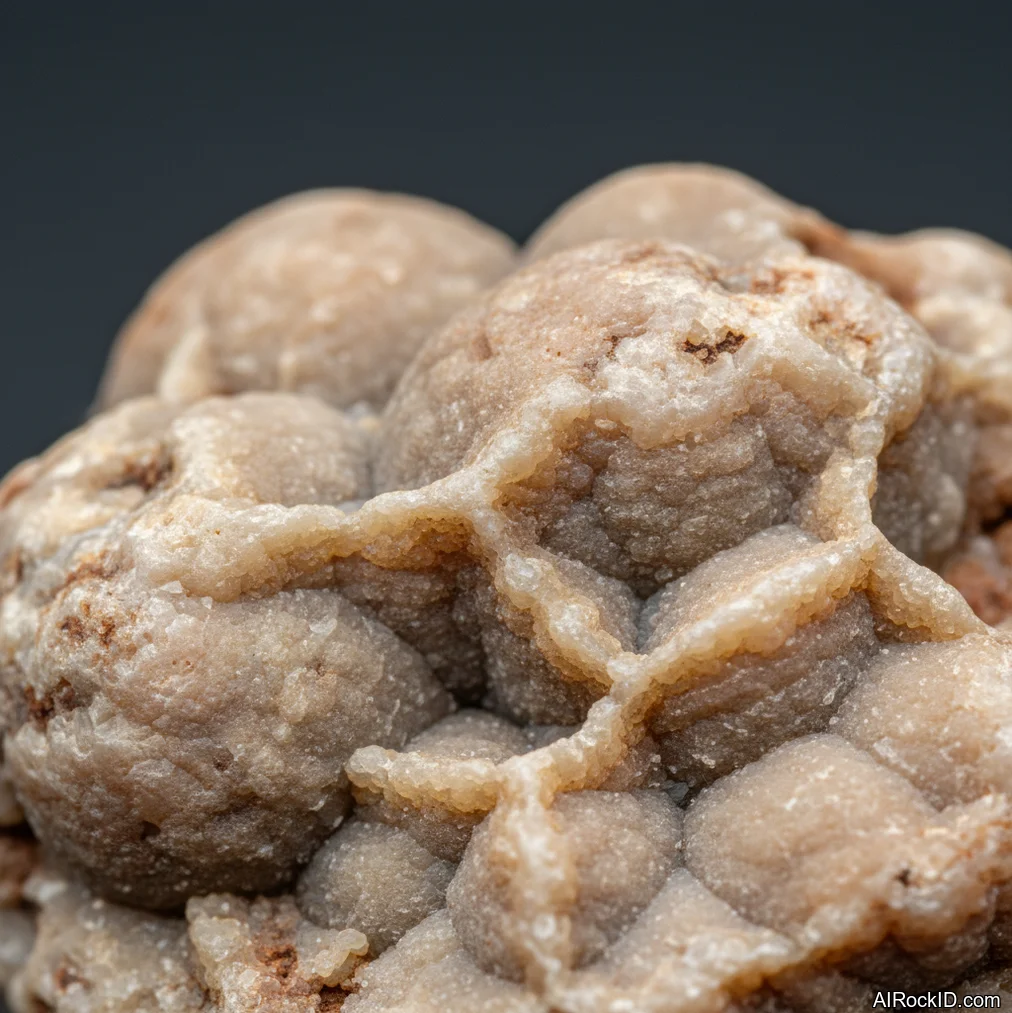
Truffle Chalcedony is a trade name for chalcedony (microcrystalline quartz) with rounded brown, tan, or black orb-like patterning that looks like truffle slices set in a pale base.
Pick up a piece and you’ll notice the feel first. It’s got that classic chalcedony waxy glide under your thumb, not slick like glass, and not gritty like jasper. Most of what I run into comes as palm stones or slabs, and when you tip it under a shop light the orbs don’t throw sparkles. They kind of glow from inside, especially when the base is even a little translucent (the sort of milky, backlit look you only see once you actually move it around).
People glance at it and call it “agate.” And sometimes, sure, it’s banded enough to earn that name. But a lot of it reads more like patterned chalcedony with blobby inclusions, and that’s honestly the whole point. The pattern stays rounded and organic, like little islands, sometimes with darker rims and lighter centers. And if you’ve handled much chalcedony, you know that cool-to-the-touch feel, the kind that lingers in your palm for a bit.
Origin & History
“Truffle Chalcedony” isn’t some dusty museum label. It’s a newer trade nickname that showed up in the lapidary and crystal market once cutters started leaning into those truffle-looking little orbs (the kind that jump out when the stone’s freshly cut and still has that slick, wet shine) and selling it as a pattern stone.
Chalcedony itself has been described and used for ages, but this exact name is basically just a visual tag. Dealers use it the same way they toss around names like “moss agate” or “plume agate.” But here’s the snag: different sellers slap “truffle chalcedony” on different orbicular or dendritic chalcedonies, so from one piece to the next you’re going to see some variation. That’s just how it goes.
Where Is Truffle Chalcedony Found?
It turns up anywhere silica-rich fluids fill cracks and cavities, but most of what I’ve seen for sale is marketed as coming out of Brazil or the western United States.
Formation
Look at the patterns for a minute and you can usually see it didn’t all happen at once. Chalcedony forms from silica-rich fluids, most often in volcanic rocks or in fractures where groundwater can actually move through, leaving microscopic quartz fibers behind layer by layer (you can almost picture it lining the walls like a thin skin that keeps building).
That “truffle” look usually comes from inclusions or from little localized growth zones that bunch up into rounded blobs. Sometimes it’s iron and manganese oxides getting carried along with the silica. Sometimes it’s just how the chalcedony gel set up, then later got overwritten by another pulse of silica. And here’s the tell: a lot of pieces have soft, hazy boundaries instead of crisp crystal outlines. Kind of smudgy, not sharp. That’s a pretty solid clue you’re looking at microcrystalline quartz, not some separate mineral growing perfect little spheres.
How to Identify Truffle Chalcedony
Color: Most pieces are creamy white, beige, or light gray chalcedony with brown, tan, dark gray, or nearly black rounded orbs and blotches. The pattern can be sparse like freckles or packed tight like a peppered loaf.
Luster: Waxy to vitreous luster, especially on a fresh polish.
If you scratch it with a steel nail, it won’t take the scratch, but the nail might leave a faint metal streak you can rub off. The real test is feel and fracture: a broken edge should show a smooth, shell-like conchoidal curve, not crumbly grains. And if a seller is calling it “truffle jasper,” check the translucency at the edge with a phone flashlight. Chalcedony often glows at thin edges, while many true jaspers stay dead opaque.
Properties of Truffle Chalcedony
Physical Properties
| Crystal System | Trigonal |
| Hardness (Mohs) | 6.5-7 (Hard (6-7.5)) |
| Density | 2.58-2.64 |
| Luster | Waxy |
| Diaphaneity | Translucent to opaque |
| Fracture | Conchoidal |
| Streak | White |
| Magnetism | Non-magnetic |
| Colors | Cream, Beige, White, Light gray, Brown, Tan, Dark gray, Black |
Chemical Properties
| Classification | Silicates |
| Formula | SiO2 |
| Elements | Si, O |
| Common Impurities | Fe, Mn, Al, Ca |
Optical Properties
| Refractive Index | 1.530-1.540 |
| Birefringence | 0.004 |
| Pleochroism | None |
| Optical Character | Uniaxial |
Truffle Chalcedony Health & Safety
Truffle Chalcedony isn’t toxic, and it’s fine to handle with bare hands. The real practical issue only shows up if you’re cutting or grinding it: that process can kick up super-fine silica dust, and you really don’t want to be breathing that stuff in.
Safety Tips
Use water while you sand, and if you’re doing lapidary work, put on a proper respirator. Don’t dry-sweep the dust. Wipe the surfaces down instead (a damp rag grabs that gritty powder way better).
Truffle Chalcedony Value & Price
Price Range
Rough/Tumbled: $8 - $60 per palm stone or small slab
Cut/Polished: $2 - $15 per carat
Prices bounce around based on how clean the polish is and how “truffle-like” the orbs look from arm’s length. Big, high-contrast patterns run higher. But that muddy brown-on-brown stuff? It’ll sit on tables all weekend, untouched.
Durability
Durable — Scratch resistance: Good, Toughness: Good
It’s stable in normal household conditions, but sharp impacts can chip edges because it breaks conchoidally.
How to Care for Truffle Chalcedony
Use & Storage
Keep it in a pouch or a divided box if it’s polished, because chalcedony can still pick up scuffs from harder stones like topaz or corundum. Raw chunks are easy, but thin slabs chip on corners if they rattle around.
Cleaning
1) Rinse with lukewarm water and a drop of mild soap. 2) Use a soft toothbrush to get into pits and natural vugs. 3) Rinse well and pat dry; don’t bake it on a heater to “dry faster.”
Cleanse & Charge
If you do energetic cleansing, running water or a quick smoke cleanse works fine, and moonlight won’t hurt it. I skip long sun baths since some chalcedonies can look a little washed out over time on a bright windowsill.
Placement
It looks best where side light hits it, like a shelf near a lamp, because the orbs pop with angled lighting. If you’ve got a translucent edge, stand it upright and backlight it for a softer glow.
Caution
Skip harsh acids and gritty cleaners. And don’t toss it in an ultrasonic cleaner if it’s already cracked or full of little pits, because those tiny holes love to hang onto gunk and won’t let go. Thing is, thin cabochons need the same kind of respect you’d give a glass slide. One slip, one drop on tile, and that’s it. End of day.
Works Well With
Truffle Chalcedony Meaning & Healing Properties
Compared to the flashy stuff, Truffle Chalcedony is quiet. It doesn’t try to steal the show. In my own stash, it’s the one I reach for when I want something in my pocket that feels good in the hand and won’t make me act precious about it.
Thing is, the pattern does a lot of the work. Your eyes kind of hop from orb to orb instead of pinning on one bright sparkly point, and that can feel steadier when you’re already wound tight. I’ve carried pieces that stay cool longer than you’d expect, even after they’ve been sitting in a warm palm for a bit, and the surface has that smooth, almost waxy slip that makes you keep rubbing your thumb over it without thinking (you know what I mean?).
In crystal culture, chalcedony usually gets linked to calming, communication, and general emotional smoothing. With the truffle-pattern material, people also lean hard into “grounding” themes because it’s all browns and earthy-looking. But I keep it practical. If a stone helps you slow down because it feels cool and smooth and gives your hands something to do, that’s a real effect. It’s not medical care. Full stop.
And something I’ve noticed from selling and trading it: people either love the “snack food” look or they just don’t get it at all. Some pieces really do read like cookies and cream. Others? More like muddy camouflage, kind of blotchy, kind of meh.
So if you’re buying online, ask for a video under a single light source. Not a bunch of ring lights and filters. The best ones have clear contrast and those rounded little forms that still make sense when you pull your phone back and stop staring at it from two inches away.
Identify Any Crystal Instantly
Snap a photo and get properties, value, care instructions, and healing meanings in seconds.