Iris Agate
What Is Iris Agate?
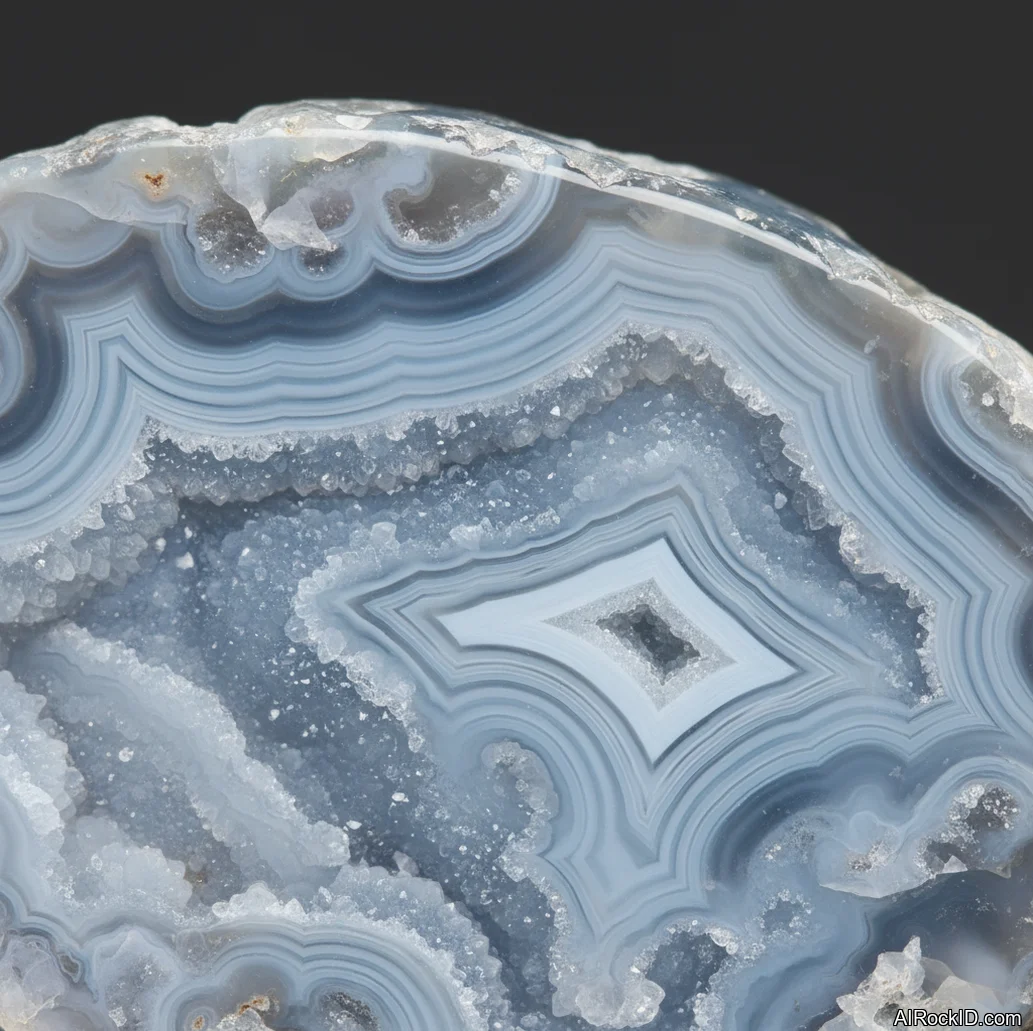
Iris agate is a banded chalcedony (agate) that can throw off a rainbow-like diffraction effect, but only when it’s sliced really thin and you light it from behind.
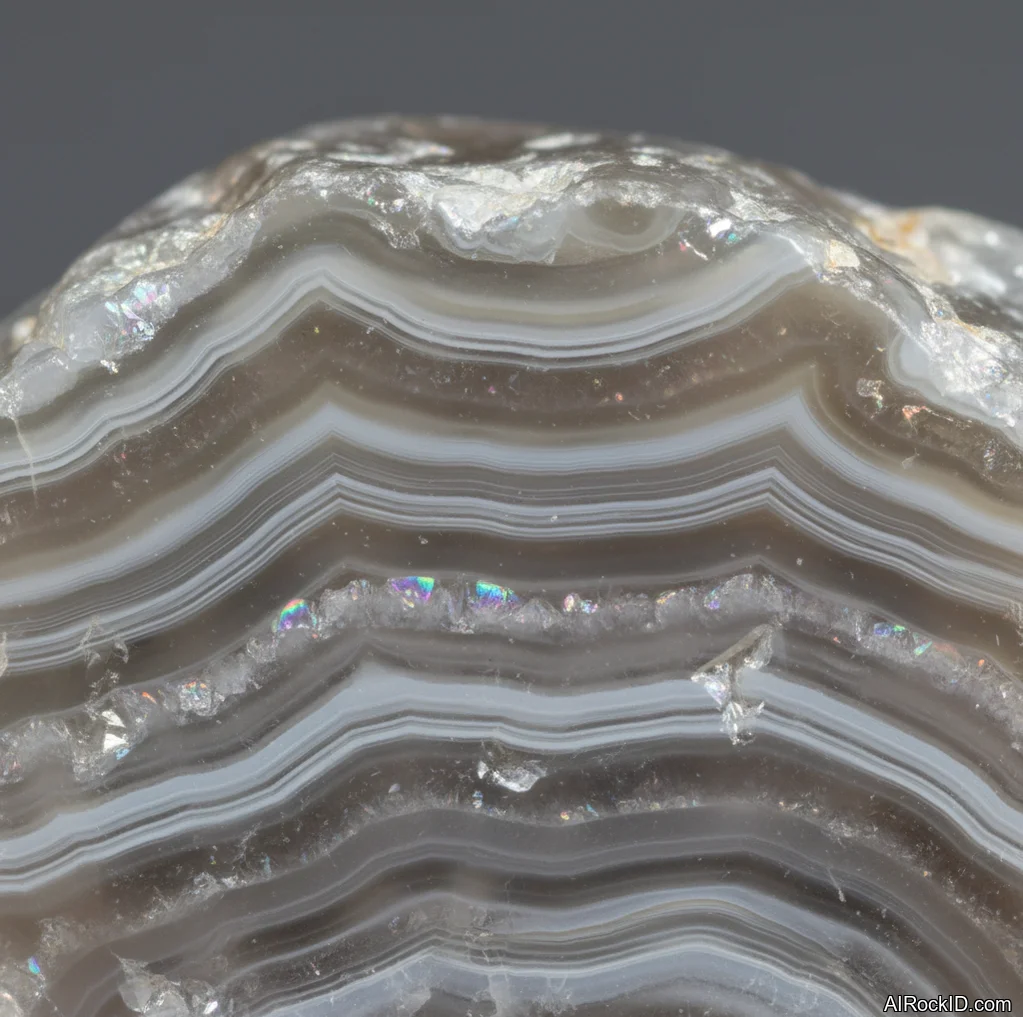
Hold a piece in your hand and, honestly, it just feels like quartz. Cool to the touch. Smooth if it’s been polished. And it’s a bit heavier than you’d guess, especially when you’re looking at a slice that seems almost flimsy because it’s cut so thin. The iris effect mostly comes from super-fine, parallel banding packed in tight. You won’t always catch it under regular room light, either. But tip a thin slice toward a lamp or a bright window and, at the right angle, the bands kick out color like an oil slick. Wild.
A lot of iris agate gets written off as “just agate” at first glance, and I get why. The trick is the prep. Thick slabs usually read like normal gray, white, tan, or pale blue chalcedony with those tight little lines. Once it’s down around a millimeter or two, everything changes. And yeah, I’ve literally watched people at shows stroll right past it until the dealer pops it in front of a flashlight, then suddenly everyone’s leaning in and wants to touch it.
Origin & History
“Iris agate” gets its name from Iris, the rainbow figure in Greek mythology. It’s basically a trade name lapidaries use for agate that throws diffraction color because the bands are insanely fine. And on older tags you’ll sometimes see “iris chalcedony,” especially from old-school lapidary folks who cared more about the optical trick than the marketing.
It wasn’t some single, dramatic discovery like you get with certain minerals. Thing is, as lapidaries got brave enough to slice agate thinner and thinner, then hold those wafers up to a strong backlight, they noticed a few pieces had banding tight enough to behave like a diffraction grating. That rainbow effect turns up in the classic agate regions, and it’s been a quiet favorite in the lapidary world for a long time.
Most collectors I know ran into it the same way I did. Someone at a booth presses a thin slice into your hand (the kind that feels almost like a glassy potato chip) and goes, “Hold it to the light.” And when you do? There it is.
Where Is Iris Agate Found?
Iris agate turns up wherever tight-banded agate occurs, with good material commonly coming out of Brazil and the western USA, plus some European alpine finds.
Formation
Agate starts out when silica-rich fluids seep into little cavities, cracks, or old gas bubbles in volcanic rock. Over time, that silica drops out as microcrystalline quartz in layers, kind of like stacking insanely thin coats of paint. Each new pulse can leave a fresh band, and even tiny shifts in chemistry, temperature, or how fast the fluid moves can nudge the color and translucency.
With iris agate, it really comes down to band spacing. The bands have to be extremely fine and very regular, the sort of thing you don’t even notice until you’ve got it under good light and it’s cut just right. If you slice a slab thin enough, light can pass through and diffract along those layers, splitting into colors. But here’s the annoying part: you can’t stare at a rough nodule and promise it’ll do the iris trick. I’ve cracked pieces that looked plain and dusty on the outside (chalky skin, nothing special), then found this skinny little zone inside that suddenly lit up like a rainbow, but only from one direction and only after it was sliced right. How are you supposed to call that from the outside? You can’t.
How to Identify Iris Agate
Color: Base colors are usually gray, white, cream, pale blue, or tan with very tight parallel banding; the rainbow shows as spectral flashes under transmitted light.
Luster: Polished surfaces are waxy to vitreous, like other agates.
Look closely at the banding density. The best iris material has bands so fine they look like hairlines or a barcode when you use a loupe. The real test is backlighting a thin slice and rocking it slowly until the diffraction colors pop. Cheap glassy fakes tend to feel warmer and lighter, and the color looks like a surface film instead of coming from inside the banding.
Properties of Iris Agate
Physical Properties
| Crystal System | Trigonal |
| Hardness (Mohs) | 6.5-7 (Hard (6-7.5)) |
| Density | 2.58-2.64 |
| Luster | Waxy |
| Diaphaneity | Translucent to opaque |
| Fracture | Conchoidal |
| Streak | White |
| Magnetism | Non-magnetic |
| Colors | Gray, White, Cream, Tan, Pale blue, Brown, Black |
Chemical Properties
| Classification | Silicates |
| Formula | SiO2 |
| Elements | Si, O |
| Common Impurities | Fe, Mn, Al, Ca |
Optical Properties
| Refractive Index | 1.530-1.539 |
| Birefringence | None |
| Pleochroism | None |
| Optical Character | Uniaxial |
Iris Agate Health & Safety
Iris agate is non-toxic, so you can handle it without worrying. And in normal use, it won’t react in water.
Safety Tips
If you’re going to cut it or grind it, handle it the same way you would quartz. Silica dust is nasty stuff, so don’t breathe it in. Use water to keep the dust down, and wear proper respiratory protection.
Iris Agate Value & Price
Price Range
Rough/Tumbled: $10 - $150 per piece
Cut/Polished: $2 - $25 per carat
Prices can swing a lot. It mostly comes down to how strong that iris effect actually looks in your hand, how thin and clean the slice is (no cloudy bits or ragged edges), and whether the banding stays straight enough that it lights up across a bigger section instead of just flashing in one tiny spot.
Durability
Durable — Scratch resistance: Good, Toughness: Good
It’s stable like other agates, but thin iris slices can chip at the edges if they rattle around in a pocket or box.
How to Care for Iris Agate
Use & Storage
Store thin slices flat or in a padded slot so the edges don’t get nicked. I keep my best ones in a little photo sleeve so they don’t scratch each other.
Cleaning
1) Rinse with lukewarm water and a drop of mild soap. 2) Gently wipe with a soft cloth or a very soft brush around the edges. 3) Rinse and air-dry, then buff lightly with microfiber.
Cleanse & Charge
If you do energetic cleansing, a quick rinse and a night on a windowsill away from harsh midday sun is plenty. Smoke cleansing works too if you don’t want to wet a mounted slice.
Placement
Put it where you can backlight it, like near a lamp or a window you don’t leave blazing hot all day. A little stand with a small LED behind it makes the iris effect show up on demand.
Caution
Skip ultrasonic cleaners if the piece has fractures or it’s set in a mount. And don’t just chuck thin slices into a jar with harder stones, because those sharp edges will get knocked around fast and end up looking chewed up.
Works Well With
Iris Agate Meaning & Healing Properties
A lot of people who say they’re buying iris agate for metaphysical reasons are, honestly, responding to how it looks. That rainbow flash hits like a reset button. In my own stash, it’s the one I grab when my brain’s being loud and I just need something to stare at that isn’t a screen. And it doesn’t feel “spiky” like some high-flash stones do. It’s steadier. Calmer.
Next to the louder stones, iris agate comes off grounding first, then clarifying. But here’s the thing: if the slice is too thick, you won’t get the iris effect and the whole vibe changes. It just feels like plain agate. I’ve had two slices from the same nodule, one thin and electric under a flashlight, the other thicker and kind of sleepy. Same material. Different cut. Totally different feel in the hand (even the way the edge sits on your skin is different).
So keep some perspective. Any calming or focus effect is personal, and it’s not medical care. If you’re using it as a meditation cue, do the practical stuff too. Dim the room. Slow your breathing. Actually look through the bands. Pick up the slice and you can feel that little temperature shift against your fingertips, especially if you’ve been holding a warm phone and the stone feels cool by comparison. That tiny sensory contrast? That’s half the point.
Identify Any Crystal Instantly
Snap a photo and get properties, value, care instructions, and healing meanings in seconds.